Design, synthesis and studies on thermodynamic and biological activities of lanthanide III complexes of hydrazinecarbothioamide ligands
Keywords:
Tetradentate ligands, Lanthanide complexes, biological activity, Molecular docking, Thermodynamic stabilityAbstract
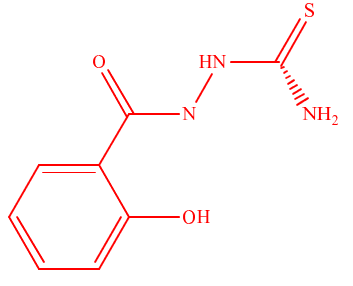
New tetradentate ligands, 2-(2-hydroxybenzoyl)hydrazinecarbothioamide, HL1, and 2-(2-mercaptobenzoyl)hydrazinecarbothioamide, HL2, were designed and synthesized from the condensation reactions of salicylic and, thiosalicylic acids with thiosemicarbazide in one pot without any coupling agent. The ligands were characterized using physical and spectroscopic methods. They formed complexes with Nd (III) and Dy (III) ions. The FTIR results suggest that the ligands exhibit azo-hydrazo tautomerism. The complexes were thermally stable with NdHL1 having a decomposition activation energy, Ea of 54.7 kJmo${}^{-1}$, $\Delta$H value of 47.8 kJmol${}^{-1}$, $\Delta$S value of -23.1 kJmol${}^{-1}$, $\Delta$G value of 237.8 kJmo${}^{-1}$ being the most stable at 530 C. The dysprosium complexes were crystalline, while the~neodymium complexes were~amorphous and produced no peaks in X-ray diffraction spectra. The complexes have the general formula [Ln (HL)${}_{2}$(H${}_{2}$O)${}_{\ m}$(NO${}_{3}$)${}_{\ n}$] (H${}_{2}$O)${}_{\ m}$(NO${}_{3}$)${}_{\ n}$, where m ranged between 0 and 2, while n ranged from 0 to 1. The complexes showed thermal stability beyond 400~ $\circ$C. All the compounds showed significant antimicrobial activities against aspergillus flavus at concentrations of 12.5, 25, and, 50 mg/ml, with the highest activity recorded at 50 mg/ml for DyHL2. DyHL2 complex also showed the highest binding affinity of 5.3 kcal/mol, compared to the binding affinities -1.3, kcal/mol, -1.2, -5.2, 5.1, and -5.0 kcal/mol obtained for HL1, HL2, NdHL1, NdHL1, DyHL1 and NdHL2 respectively from molecular docking studies, indicating inhibitory efficacy against A. \textit{f}lavus. The complexes are potential novel compounds for the development of drugs, photocatalysts, photosensitized materials, and photocells used in organic synthesis, and solar energy conversion devices.
Published
How to Cite
Issue
Section
Copyright (c) 2025 U. B. Amadi, M. Ogwuegbu, C. K. Enenebeaku, G. onyedika

This work is licensed under a Creative Commons Attribution 4.0 International License.
How to Cite
Similar Articles
- M. Kida, S. Adamu, O. O Aduroja, P. T Pantuvo, Numerical Solution of Stiff and Oscillatory Problems using Third Derivative Trigonometrically Fitted Block Method , Journal of the Nigerian Society of Physical Sciences: Volume 4, Issue 1, February 2022
- Olumide O. Olaiya, Mark I. Modebei, Saheed A. Bello, A One-Step Block Hybrid Integrator for Solving Fifth Order Korteweg-de Vries Equations , Journal of the Nigerian Society of Physical Sciences: Volume 4, Issue 3, August 2022
- K. Issa, A. S. Olorunnisola, O. T. Aliu, A. D. Adeshola , Approximate solution of space fractional order diffusion equations by Gegenbauer collocation and compact finite difference scheme: Solution of space fractional diffusion equation , Journal of the Nigerian Society of Physical Sciences: Volume 5, Issue 2, May 2023
- Emmanuel Chidiebere Duru, Godwin Christopher Ezike Mbah, Michael Chimezie Anyanwu, Nnamani Nicholas Topman, Modelling the co-infection of malaria and zika virus disease , Journal of the Nigerian Society of Physical Sciences: Volume 6, Issue 2, May 2024
- O. S. Oguntoye, A. M. Okooboh, O. M. Bello, A. H. Usman, S. S. Abdussalam, G. V. Awolola, Antimicrobial Assessment of Different Solvent Extracts of the Root-bark, Stem-bark and Leaves of Acacia ataxacantha Linn. , Journal of the Nigerian Society of Physical Sciences: Volume 1, Issue 1, February 2019
- C. A. Onate, M. C. Onyeaju, Entropic system in the relativistic Klein-Gordon Particle , Journal of the Nigerian Society of Physical Sciences: Volume 3, Issue 3, August 2021
- Peter Urane Achimugwu, Mathew Ngugi Kinyanjui, David Mumo Malonza, Analysis of a fractional order climate model due to excessive emission and accumulation of carbon dioxide in the atmosphere , Journal of the Nigerian Society of Physical Sciences: Volume 5, Issue 4, November 2023
- Ahmed Fadhil Noaman, Zaid Adil Abdalkareem, Bareq Baqi Salman, Application of the SEE transform with the Adomian decomposition method to a nonlinear tumor growth model , Journal of the Nigerian Society of Physical Sciences: Volume 8, Issue 3, August 2026
- Kazeem adebowale Dawodu, Extension of ADMMAlgorithmin Solving Optimal Control Model Governed by Partial Differential Equation , Journal of the Nigerian Society of Physical Sciences: Volume 3, Issue 2, May 2021
- A. A. Willoughby, A. A. Soge, O. F. Dairo, O. D. Olukanni, E. U. Durugbo, W. S. Michael, T. A. Adebayo, Fabrication and Characterization of a Dye-Sensitized Solar Cell using Natural Dye Extract of Rosella (Hibiscus sabdariffa L.) as Photosensitizer , Journal of the Nigerian Society of Physical Sciences: Volume 3, Issue 4, November 2021
You may also start an advanced similarity search for this article.