Integrated data-driven credit default prediction in Uganda using machine learning models
Keywords:
SVM, XGBoost, Credit defaulter, Prediction model, Financial dataAbstract
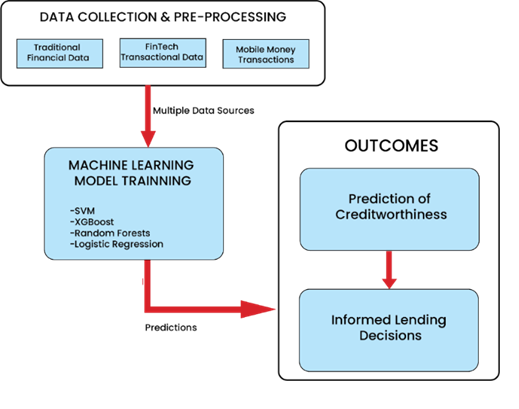
The prediction of credit facility defaulters is quite a challenge in Uganda, particularly for those without a formal banking history. Existing prediction models cater for prediction using conventional banking records which is not sufficient. The use of integrated data to cater for the unbanked population is required to further enhance financial inclusivity and stability in Uganda’s financial landscape. This study therefore aims at filling this gap by using machine learning techniques on a rich blend of financial data, including mobile money and Fintech (Financial Technology) services, as well as traditional banking records. Several machine learning algorithms used for loan default prediction were compared, such as Random Forest, Logistic Regression, Support Vector Machines (SVM), and Extreme Gradient Boosting (XGBoost). Random Forest Model showed 96.66% accuracy, 79.65% recall, 96.52% precision and 0.85 AUC. XGBoost model was found to have an accuracy of 95.23%; recall, 73.32%; precision, 94.11%; and Area Under the Curve (AUC) of 0.81. However, Random Forest performed best by all metrics with XGBoost following slightly. Logistic Regression showed 89.53% accuracy but had a very low recall at 43.24% and precision at 66.59%. SVM performed averagely with 93.21% accuracy and 62.80% recall all falling below that of XGBoost and Random Forest. Thus, the study revealed the significance of machine learning models like Random Forest and XGBoost for credit scoring prediction. Overall, it will improve the ability of institutions and policymakers to identify potential default borrowers so as to mitigate loan default rates and ensure economic growth in underserved communities through more accurate and inclusive credit evaluation tools.
Published
How to Cite
Issue
Section
Copyright (c) 2025 George Muddu, Shefiu Olusegun Ganiyu, Adekunle Olugbenga Ejidokun, Yusuf Abass Aleshinloye (Author)

This work is licensed under a Creative Commons Attribution 4.0 International License.
How to Cite
Similar Articles
- O. J. Ibidoja, F. P. Shan, Mukhtar, J. Sulaiman, M. K. M. Ali, Robust M-estimators and Machine Learning Algorithms for Improving the Predictive Accuracy of Seaweed Contaminated Big Data , Journal of the Nigerian Society of Physical Sciences: Volume 5, Issue 1, February 2023
- Nahid Salma, Majid Khan Majahar Ali, Raja Aqib Shamim, Machine learning-based feature selection for ultra-high-dimensional survival data: a computational approach , Journal of the Nigerian Society of Physical Sciences: Volume 7, Issue 3, August 2025
- Gabriel James, Ime Umoren, Anietie Ekong, Saviour Inyang, Oscar Aloysius, Analysis of support vector machine and random forest models for classification of the impact of technostress in covid and post-covid era , Journal of the Nigerian Society of Physical Sciences: Volume 6, Issue 3, August 2024
- Kanak Saini, Monika Saini, Ashish Kumar, Dinesh Kumar Saini, Availability predictions of solar power plants using multiple regression and neural networks: an analytical study , Journal of the Nigerian Society of Physical Sciences: Volume 7, Issue 2, May 2025
- Xiaojie Zhou, Majid Khan Majahar Ali, Farah Aini Abdullah, Lili Wu, Ying Tian, Tao Li, Kaihui Li, Air quality prediction enhanced by a CNN-LSTM-Attention model optimized with an advanced dung beetle algorithm , Journal of the Nigerian Society of Physical Sciences: Volume 7, Issue 3, August 2025
- Shaymaa Mohammed Ahmed, Majid Khan Majahar Ali, Arshad Hameed Hasan, Evaluating feature selection methods in a hybrid Weibull Freund-Cox proportional hazards model for renal cell carcinoma , Journal of the Nigerian Society of Physical Sciences: Volume 7, Issue 3, August 2025
- Gabriel James, Ifeoma Ohaeri, David Egete, John Odey, Samuel Oyong, Enefiok Etuk, Imeh Umoren, Ubong Etuk, Aloysius Akpanobong, Anietie Ekong, Saviour Inyang, Chikodili Orazulume, A fuzzy-optimized multi-level random forest (FOMRF) model for the classification of the impact of technostress , Journal of the Nigerian Society of Physical Sciences: Volume 7, Issue 3, August 2025
- Shaymaa Mohammed Ahmed, Majid Khan Majahar Ali, Raja Aqib Shamim, Integrating robust feature selection with deep learning for ultra-high-dimensional survival analysis in renal cell carcinoma , Journal of the Nigerian Society of Physical Sciences: Volume 7, Issue 4, November 2025
- Osowomuabe Njama-Abang, Denis U. Ashishie, Paul T. Bukie, Addressing class imbalance in lassa fever epidemic data, using machine learning: a case study with SMOTE and random forest , Journal of the Nigerian Society of Physical Sciences: Volume 7, Issue 3, August 2025
- Ibrahim Adamu Mohammed, Majid Khan Majahar Ali, Sani Rabiu, Raja Aqib Shamim, Shahida Shahnawaz, Development and validation of hybrid drying kinetics models with finite element method integration for black paper in a v-groove solar dryer , Journal of the Nigerian Society of Physical Sciences: Volume 7, Issue 4, November 2025
You may also start an advanced similarity search for this article.