Effective tweets classification for disaster crisis based on ensemble of classifiers
Keywords:
Disaster Crisis Management, Social Media Analytics, Twitter, Machine Learning Classifiers, Ensemble Methods, Feature ExtractionAbstract
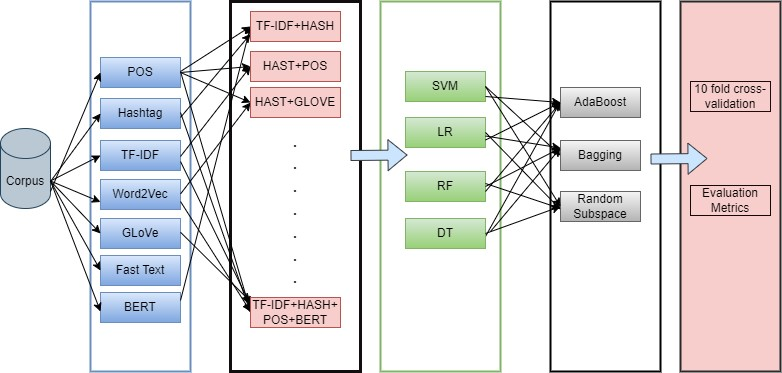
In the field of disaster management, social media analytics has gained significant recognition. Social media platforms, particularly Twitter, have become an invaluable source for disseminating information during disasters, offering real-time updates on events, crisis reports, and casualty information. However, the deluge of information on social media can also be overwhelming, with a substantial amount of irrelevant content. To address this challenge, researchers leverage machine learning (ML) classifiers to automatically categorize disaster-related tweets. However, ML classifiers, while being effective, also face issues such as overfitting and class imbalance. This study proposes an ensemble-based approach that integrates a variety of linguistic and word embedding features, including Parts-Of-Speech (POS), hashtags, Term Frequency-Inverse Document Frequency (TF-IDF), GloVe, Word2Vec, and BERT. A range of supervised learning algorithms like Decision Trees, Logistic Regression, Support Vector Machines, and Random Forests, were evaluated individually and as part of ensemble methods like AdaBoost, Bagging, and Random Subspace. The results show that combining TF-IDF with word embeddings and using the AdaBoost ensemble model yields superior performance, achieving a classification accuracy of 98.92%. This represents a notable improvement over the conventional standalone classifiers and highlights the advantage of ensemble methods in enhancing model robustness and minimizing overfitting. The proposed approach demonstrates not only high predictive capacity but also scalability for real-time tweet filtering during emergencies. In addition to demonstrating the efficacy of ensemble methods in disaster tweet classification, this study also provides valuable insights for improving social media-based crisis response. It also establishes a foundation for future research, particularly in multi-lingual and multi-disaster scenarios.
Published
How to Cite
Issue
Section
Copyright (c) 2025 Christopher Ifeanyi Eke, Kholoud Maswadi, Musa Phiri, Mulenga Mwege, Mohammad Imran, Dekera Kenneth Kwaghtyo, Akeremale Olusola Collins

This work is licensed under a Creative Commons Attribution 4.0 International License.
How to Cite
Similar Articles
- Gabriel James, Ime Umoren, Anietie Ekong, Saviour Inyang, Oscar Aloysius, Analysis of support vector machine and random forest models for classification of the impact of technostress in covid and post-covid era , Journal of the Nigerian Society of Physical Sciences: Volume 6, Issue 3, August 2024
- Unyime Ufok Ibekwe, Uche M. Mbanaso, Nwojo Agwu Nnanna, Umar Adam Ibrahim, A machine learning sentiment classification of factors that shape trust in smart contracts , Journal of the Nigerian Society of Physical Sciences: Volume 7, Issue 1, February 2025
- Nour Hamad Abu Afouna, Majid Khan Majahar Ali, Optimizing precision farming: enhancing machine learning efficiency with robust regression techniques in high-dimensional data , Journal of the Nigerian Society of Physical Sciences: Volume 7, Issue 1, February 2025
- Muhammad Dahiru Liman, Salamatu Ibrahim Osanga, Esther Samuel Alu, Sa'adu Zakariya, Regularization Effects in Deep Learning Architecture , Journal of the Nigerian Society of Physical Sciences: Volume 6, Issue 2, May 2024
- O. J. Ibidoja, F. P. Shan, Mukhtar, J. Sulaiman, M. K. M. Ali, Robust M-estimators and Machine Learning Algorithms for Improving the Predictive Accuracy of Seaweed Contaminated Big Data , Journal of the Nigerian Society of Physical Sciences: Volume 5, Issue 1, February 2023
- Ebere Uzoka Chidi, Edward Anoliefo, Collins Udanor, Asogwa Tochukwu Chijindu, Lois Onyejere Nwobodo, A blind navigation guide model for obstacle avoidance using distance vision estimation based YOLO-V8n , Journal of the Nigerian Society of Physical Sciences: Volume 7, Issue 1, February 2025
- Christian N. Nwaeme, Adewale F. Lukman, Robust hybrid algorithms for regularization and variable selection in QSAR studies , Journal of the Nigerian Society of Physical Sciences: Volume 5, Issue 4, November 2023
- Dekera Kenneth Kwaghtyo, Christopher Ifeanyi Eke, Timothy Moses, CropGAN: A conditional GAN framework for synthetic tabular data augmentation in crop recommendation systems , Journal of the Nigerian Society of Physical Sciences: Volume 8, Issue 3, August 2026
- Shaymaa Mohammed Ahmed, Majid Khan Majahar Ali, Arshad Hameed Hasan, Evaluating feature selection methods in a hybrid Weibull Freund-Cox proportional hazards model for renal cell carcinoma , Journal of the Nigerian Society of Physical Sciences: Volume 7, Issue 3, August 2025
- Leonce Wehnelt TOKAM, Sanoussi S. OURO-DJOBO, Non-Intrusive Load Monitoring (NILM), Interests and Applications , Journal of the Nigerian Society of Physical Sciences: Volume 5, Issue 2, May 2023
You may also start an advanced similarity search for this article.
Most read articles by the same author(s)
- Dekera Kenneth Kwaghtyo, Christopher Ifeanyi Eke, Timothy Moses, CropGAN: A conditional GAN framework for synthetic tabular data augmentation in crop recommendation systems , Journal of the Nigerian Society of Physical Sciences: Volume 8, Issue 3, August 2026