Optimizing initial chlorine dosage at an injection point along a water distribution pipe
Keywords:
Optimizing, Chlorine dosage, Chlorine residual, Water distribution pipeAbstract
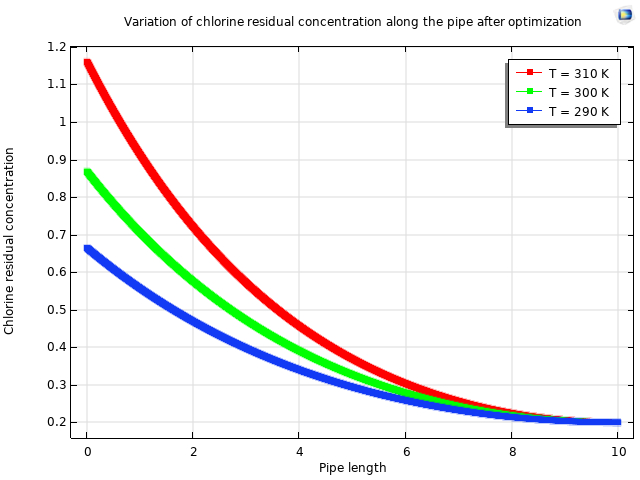
This study proposed a gradient-based optimization framework for determining the optimal initial chlorine dosage at an injection point along a water distribution pipe, with the aim of ensuring microbial safety and regulatory compliance while minimizing chlorine overuse and associated costs. Leveraging the SNOPT (Sparse Nonlinear Optimizer) algorithm integrated within the COMSOL Multiphysics environment, the approach systematically refined dosing strategies based on temperature-dependent chlorine decay dynamics. Prior to optimization, a uniform dosage of 1 mg/L yielded suboptimal outlet residuals; 0.30 mg/L, 0.23 mg/L, and 0.17 mg/L at 290K, 300K, and 310K, respectively. Post-optimization, precise dosing of 0.66 mg/L, 0.87 mg/L, and 1.16 mg/L achieved the target residual concentration of 0.2 mg/L across the same temperature conditions, enhancing disinfection control by 13-17%. The results demonstrate that this method delivers accurate, adaptive chlorine dosing, reducing the risk of harmful disinfection byproducts (DBPs), improving cost efficiency, and supporting sustainable water quality management. The proposed model is suitable for real-time integration into supervisory control systems, offering a practical pathway for advancing water safety, operational effectiveness, and environmental stewardship.
References
[1] C. O. Okafor, U. I. Ude, F. N. Okoh & B. O. Eromonsele, Safe drinking water: the need and challenges in developing countries, in Water quality new perspectives, I. Sarbu and S. Popa-Albu (Eds.), IntechOpen, London, UK, 2024, pp. 144–155. https://doi.org/10.5772/intechopen.108497.
[2] M. E. Machweu, Addressing high dimensionality in water quality modelling in water distribution networks, M.Sc. dissertation, University of the Witwatersrand, Johannesburg, South Africa, 2024. https://wiredspace.wits.ac.za/server/api/core/bitstreams/16e66b06-4dd8-4dab-9c09-1625279d0193/content.
[3] S. Yan, P. Drogui, R. D. Tyagi & J. W. C. Wong, Development of decentralized drinking water treatment plant, in Decentralized sanitation and water treatment: concept and technologies, London, UK, 2024, pp. 139–153. https://doi.org/10.1201/9781003381419-11.
[4] A. Gani, M. Singh, S. Patha & A. Hussain, Recent advancements in chlorine applications for water quality control, in Drinking water disinfection by-products: sources, fate and remediation, Springer nature, London, UK, pp. 35–58. https://doi.org/10.1007/978-3-031-49047-7_3.
[5] I. Hespanhol & A. Prost, “WHO guidelines and national standards for reuse and water quality”, Water Research 28 (1994) 119. https://www.sciencedirect.com/science/article/pii/0043135494901252
[6] B. Gael Fouda-Mbanga, T. Seyisi, Y. Boitumelo Nthwane, B. Nyoni & Z. Tywabi-Ngeva, “A review on pollutants found in drinking water in SubSahara African rural communities: detection and potential low-cost remediation methods”, Industrial and Domestic Waste Management 3 (2023) 67. https://doi.org/10.53623/idwm.v3i2.264
[7] I. Sarbu & S. Popa-Albu, “Optimization of urban water distribution networks using heuristic methods: an overview”, Water International 48 (2023) 120. https://doi.org/10.1080/02508060.2022.2127611.
[8] M. Moeini & A. Abokifa, “Chlorine dosage management in drinking water systems: comparing Bayesian optimization to evolutionary algorithms”, Journal of Hydroinformatics 26 (2024) 2720. https://doi.org/10.2166/HYDRO.2024.090.
[9] M. Gregov, J. G. Kljusuric, D. Valinger, M. Benkovi´ c, T. Jurina, A.´ J. Tusek, V. Crnek, M Mato´ si´ c, “Optimization of Ozonation in drink-´ ing water production at Lake Butoniga”, Water 17 (2025) 97. https://doi.org/10.3390/W17010097/S1.
[10] F. D. Frederick, M. S. Marlim & D. Kang, “Optimization of chlorine injection schedule in water distribution networks using water age and breadth-first search algorithm, Water 16 (2024) 486. https://doi.org/10.3390/W16030486.
[11] N. T. Linh, “A novel combination of genetic algorithm, particle swarm optimization, and teaching-learning-based optimization for distribution network reconfiguration in case of faults”, Engineering, Technology & Applied Science Research 14 (2024) 12959. https://doi.org/10.48084/ETASR.6718.
[12] X. Song, Y. Zhang, W. Zhang, C. He, Y. Hu, J. Wang & D. Gong, “Evolutionary computation for feature selection in classification: a comprehensive survey of solutions, applications and challenges”, Swarm and Evolutionary Computation 90 (2024) 101661. https://doi.org/10.1016/J.SWEVO.2024.101661.
[13] R. Naveiro and B. Tang, “Simulation based Bayesian optimization”, 2024. [Online]. https://arxiv.org/abs/2401.10811.
[14] H. F. Maathuis, R. De Breuker & S. G. P. Castro, “High-dimensional Bayesian optimisation with large-scale constraints via latent space Gaussian processes”, 2024. [Online]. https://arxiv.org/abs/2412.15679.
[15] J. Zeijden “A hybrid method for numerical optimization”, 2025.[Online]. https://fse.studenttheses.ub.rug.nl/id/eprint/34694.
[16] A. J. Joshy and J. T. Hwang, “Modopt: a modular development environment and library for optimization algorithms”, 2024. [Online]. https://arxiv.org/abs/2410.12942.
[17] E. Zerrouk, “How WASH supports social justice in a changing climate: the importance of Water”, Revista Tecnologica - ESPOL´ 37 (2025) 121. https://doi.org/10.37815/RTE.V37N1.1274.
[18] World Health Organization, “Nickel in drinking water: background document for development of WHO Guidelines for drinking-water quality”, 2021. [Online]. https://iris.who.int/handle/10665/350934.
[19] T. Slawig, U. Prufert & ZIK Virtuhcon, “Mathematics-based optimiza-¨ tion in the COMSOL Multiphysics framework”, COMSOL Conference, Stuttgart, Germany, 2011, pp. 110–116. https://www.comsol.jp/paper/download/83389/slawig_paper.pdf.
[20] E. Philip, W. Murray & M. A. Saunders, “User’s guide for SNOPT version 7: software for large-scale nonlinear programming”, UCSD, San Diego, CA, USA, 2019, pp. 15–21. https://ccom.ucsd.edu/reports/UCSD-CCoM-19-01.pdf.
[21] J. Tulirinya, M. Kinyanjui, S. Mutua & A. Muhumuza, “A twodimensional mathematical model of chlorine residual transport in a water distribution pipe”, Engineering Reports 7 (2025) e70325. https://doi.org/10.1002/eng2.7032510.1002/eng2.70325.
Published
How to Cite
Issue
Section
Copyright (c) 2025 John Tulirinya, Mathew Kinyanju, Samuel Mutua, Asaph Muhumuza (Author)

This work is licensed under a Creative Commons Attribution 4.0 International License.