Dynamics of the Earth’s magnetopause’s subsolar location during solar cycle 24 in relation to the phases of geomagnetic storms of CME origin
Keywords:
Magnetopause, Subsolar position, ICME storm, Empirical model, Solar windAbstract
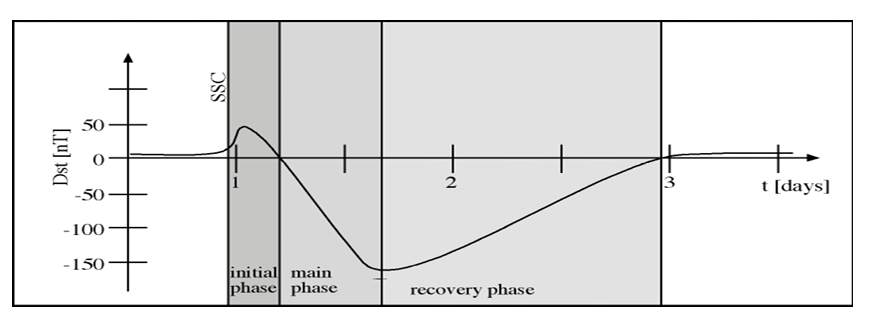
This article analyses the response of the subsolar position (Ro) of the Earth’s magnetopause to geo-effective ICME storms in solar cycle 24, ranging from minor to extreme intensity, based on the model developed by Shue et al. (1998) and 1-minute OMNI data. The study combines a phase analysis of representative storms with an analysis of the influence of Ro variability on solar wind parameters, without phase distinction (correlations, time lags, Granger causality, and adjustments). The results show that the dynamics of Ro are driven almost exclusively by Pd in the minor and moderate storms studied, while a synergistic shift appears in strong and extreme storms, where magnetic reconnection or even magnetopause erosion becomes decisive. The crossing of the magnetopause at the subsolar point of the geosynchronous orbit (<6.6 Re) is a signature of the main phase of the storm on 22 June 2015 (strong) and the initial and main phase of the storm on 17 March 2015 (extreme). The autocorrelation correction confirms the robustness of the high correlations observed. The relationships between Ro and Pd remain linear except for the extreme event, while Bz requires polynomial adjustments in most of the events studied. Variations in Pd and N precede those in Ro by 1 min to 3 min and significantly influence those in Ro, with a maximum effect at lag = 0 min in almost all events. The predominant response of Ro to the magnetic constraint imposed by B is delayed, with lag varying from 30 min to 7 min depending on the event, except in the extreme case where lag = 0 min, controlled by the structure of the magnetosphere, and Bz plays a secondary role except in the extreme case where it contributes to magnetic reconnection and magnetopause erosion.
References
[1] J. E. Borovsky & M. H. Denton, “Differences between CME-driven storms and CIR-driven storms”, Journal of Geophysical Research 111 (2006) 2005JA011447. https://doi.org/10.1029/2005JA011447.
[2] N. Gopalswamy, S. Yashiro & S. Akiyama, “Coronal mass ejections and space weather due to extreme events”, Proceedings of the ILWS Workshop, Goa, India, 2006, pp. 79. https://cdaw.gsfc.nasa.gov/publications/ilws_goa2006/079_Gopalswamy.pdf.
[3] Y. D. Liu et al., “Plasma and magnetic field characteristics of solar coronal mass ejections in relation to geomagnetic storm intensity and variability”, The Astrophysical Journal 809 (2015) L34. https://doi.org/10.1088/2041-8205/809/2/L34.
[4] J.-H. Shue et al., “A new functional form to study the solar wind control of the magnetopause size and shape”, Journal of Geophysical Research: Space Physics 102 (1997) 9497. https://doi.org/10.1029/97JA00196.
[5] J.-H. Shue et al., “Magnetopause location under extreme solar wind conditions”, Journal of Geophysical Research: Space Physics 103 (1998) 17691. https://doi.org/10.1029/98JA01103.
[6] J.-H. Shue et al., “Intense growth phase events of substorms”, Journal of Geophysical Research: Space Physics 105 (2000) 5357. https://doi.org/10.1029/1999JA900454.
[7] R. E. F. Bonde et al., “The effect of IMF fluctuations on the subsolar magnetopause position: A study using a global MHD model”, Journal of Geophysical Research: Space Physics 123 (2018) 2598. https://doi.org/10.1002/2018JA025203.
[8] A. A. Samsonov et al., “Long-term variations in solar wind parameters, magnetopause location, and geomagnetic activity over the last five solar cycles”, Journal of Geophysical Research: Space Physics 124 (2019) 4049. https://doi.org/10.1029/2018JA026355.
[9] N. Grimmich et al., “Investigation of the occurrence of significant deviations in the magnetopause location: Solar-wind and foreshock effects”, Annales Geophysicae 43 (2025) 151. https://doi.org/10.5194/angeo-43-151-2025.
[10] D. G. Sibeck, “Demarcating the magnetopause boundary”, Reviews of Geophysics 33 (1995) 651. https://doi.org/10.1029/95RG00285.
[11] T. Iyemori, “Storm-time magnetospheric currents inferred from mid-latitude geomagnetic field variations”, Journal of Geomagnetism and Geoelectricity 42 (1990) 1249. https://doi.org/10.5636/jgg.42.1249.
[12] W. D. Gonzalez et al., “What is a geomagnetic storm?”, Journal of Geophysical Research: Space Physics 99 (1994) 5771. https://doi.org/10.1029/93JA02867.
[13] C. S. Bretherton et al., “The effective number of spatial degrees of freedom of a time-varying field”, Journal of Climate 12 (1999).
[14] D. A. Dickey & W. A. Fuller, “Distribution of the estimators for autoregressive time series with a unit root”, Journal of the American Statistical Association 74 (1979) 427. https://doi.org/10.1080/01621459.1979.10482531.
[15] C. W. J. Granger, “Investigating causal relations by econometric models and cross-spectral methods”, Econometrica 37 (1969) 424. https://doi.org/10.2307/1912791.
[16] S. Iyer & A. Mahajan, “Granger causality analysis of deviation in total electron content during geomagnetic storms in the equatorial region”, Journal of Engineering and Applied Science 68 (2021) 4. https://doi.org/10.1186/s44147-021-00007-x.
[17] D. N. Politis & J. P. Romano, “The stationary bootstrap”, Journal of the American Statistical Association 89 (1994) 1303. https://doi.org/10.1080/01621459.1994.10476870.
[18] A. Hatemi-J, “Asymmetric causality tests with an application”, Empirical Economics 43 (2012) 447. https://doi.org/10.1007/s00181-011-0484-x.
[19] J. R. Spreiter & S. S. Stahara, “Magnetohydrodynamic and gasdynamic theories for planetary bow waves”, Collisionless Shocks in the Heliosphere, AGU, 1985, pp. 85–107. https://doi.org/10.1029/GM035p0085.
[20] J. De Keyser et al., “Empirical reconstruction and long-duration tracking of the magnetospheric boundary in single- and multi-spacecraft contexts”, Annales Geophysicae 23 (2005) 1355. https://doi.org/10.5194/angeo-23-1355-2005.
[21] S. Chapman & V. C. A. Ferraro, “A new theory of magnetic storms”, Terrestrial Magnetism and Atmospheric Electricity 36 (1931) 171. https://doi.org/10.1029/TE036i003p00171.
[22] J. R. Spreiter, A. Summers & A. Alksne, “Hydromagnetic flow around the magnetosphere”, Planetary and Space Science 14 (1966) 223. https://doi.org/10.1016/0032-0633(66)90124-3.
[23] M. H. Farris, S. M. Petrinec & C. T. Russell, “The thickness of the magnetosheath: Constraints on the polytropic index”, Geophysical Research Letters 18 (1991) 1821. https://doi.org/10.1029/91GL02090.
[24] M. P. Aubry, C. T. Russell & M. G. Kivelson, “Inward motion of the magnetopause before a substorm”, Journal of Geophysical Research 75 (1970) 7018. https://doi.org/10.1029/JA075i034p07018.
[25] Y. P. Maltsev et al., “Magnetic flux redistribution in the storm time magnetosphere”, Journal of Geophysical Research: Space Physics 101 (1996) 7697. https://doi.org/10.1029/95JA03709.
[26] Y. P. Maltsev & W. B. Lyatsky, “Field-aligned currents and erosion dayside magnetosphere”, Planetary and Space Science 23 (1975) 1257. https://doi.org/10.1016/0032-0633(75)90149-X.
[27] D. G. Sibeck et al., “Solar wind control of the magnetopause shape, location, and motion”, Journal of Geophysical Research: Space Physics 96 (1991) 5489. https://doi.org/10.1029/90JA02464.
[28] P. M. Dredger et al., “Investigating potential causes for the prediction of spurious magnetopause crossings at geosynchronous orbit in MHD simulations”, Space Weather 21 (2023) e2022SW003266. https://doi.org/10.1029/2022SW003266.
[29] J. W. Dungey, “Interplanetary magnetic field and the auroral zones”, Physical Review Letters 6 (1961) 47. https://doi.org/10.1103/PhysRevLett.6.47.
[30] R. E. Holzer & J. A. Slavin, “Magnetic flux transfer associated with expansions and contractions of the dayside magnetosphere”, Journal of Geophysical Research: Space Physics 83 (1978) 3831. https://doi.org/10.1029/JA083iA08p03831.
[31] J. Raeder et al., “Global simulation of magnetospheric space weather effects of the Bastille Day storm”, Physique Solaire 204 (2001) 323. https://doi.org/10.1023/A:1014228230714.
[32] D. Herrera et al., “Characterizing magnetopause shadowing effects in the outer electron radiation belt during geomagnetic storms”, Journal of Geophysical Research: Space Physics 121 (2016) 9517. https://doi.org/10.1002/2016JA022825.
[33] G. Le et al., “Magnetopause erosion during the 17 March 2015 magnetic storm”, Geophysical Research Letters 43 (2016) 2396. https://doi.org/10.1002/2016GL068257.
[34] H. Kim et al., “Relation between magnetopause position and reconnection rate under quasi-steady solar wind dynamic pressure”, Earth, Planets and Space 76 (2024) 165. https://doi.org/10.1186/s40623-024-02101-9.
[35] R. L. Lin et al., “A three-dimensional asymmetric magnetopause model”, Journal of Geophysical Research: Space Physics 115 (2010). https://doi.org/10.1029/2009JA014235.
[36] J. Wang et al., “Responses of the Earth’s magnetopause and bow shock to IMF Bz and solar wind dynamic pressure”, Journal of Space Weather and Space Climate 8 (2018) A41. https://doi.org/10.1051/swsc/2018030.
[37] A. A. Samsonov et al., “What happens before a southward IMF turning reaches the magnetopause?”, Geophysical Research Letters 44 (2017) 9159. https://doi.org/10.1002/2017GL075020.
[38] M. Wiltberger et al., “Magnetopause erosion: A global view from MHD simulation”, Journal of Geophysical Research: Space Physics 108 (2003) 2002JA009564. https://doi.org/10.1029/2002JA009564.
[39] M. P. Freeman & D. J. Southwood, “Correlation of variations in the IMF with magnetosheath field variations”, Advances in Space Research 8 (1988) 217. https://doi.org/10.1016/0273-1177(88)90134-2.
[40] R. E. Lopez et al., “Role of magnetosheath force balance in regulating the dayside reconnection potential”, Journal of Geophysical Research: Space Physics 115 (2010). https://doi.org/10.1029/2009JA014597.
[41] Z.-Q. Liu et al., “A three-dimensional high Mach number asymmetric magnetopause model from global MHD simulation”, Journal of Geophysical Research: Space Physics 120 (2015) 5645. https://doi.org/10.1002/2014JA020961.
Published
How to Cite
Issue
Section
Copyright (c) 2025 Boukary DAMIBA, Christian ZOUNDI, Abdoul Kader SEGDA (Author)

This work is licensed under a Creative Commons Attribution 4.0 International License.