Exploring the application of machine learning for facies classification in oil and gas exploration
Keywords:
Facies classification, Hybrid explainable transformer framework, SHAP, Uncertainty quantification, Well-log analysisAbstract
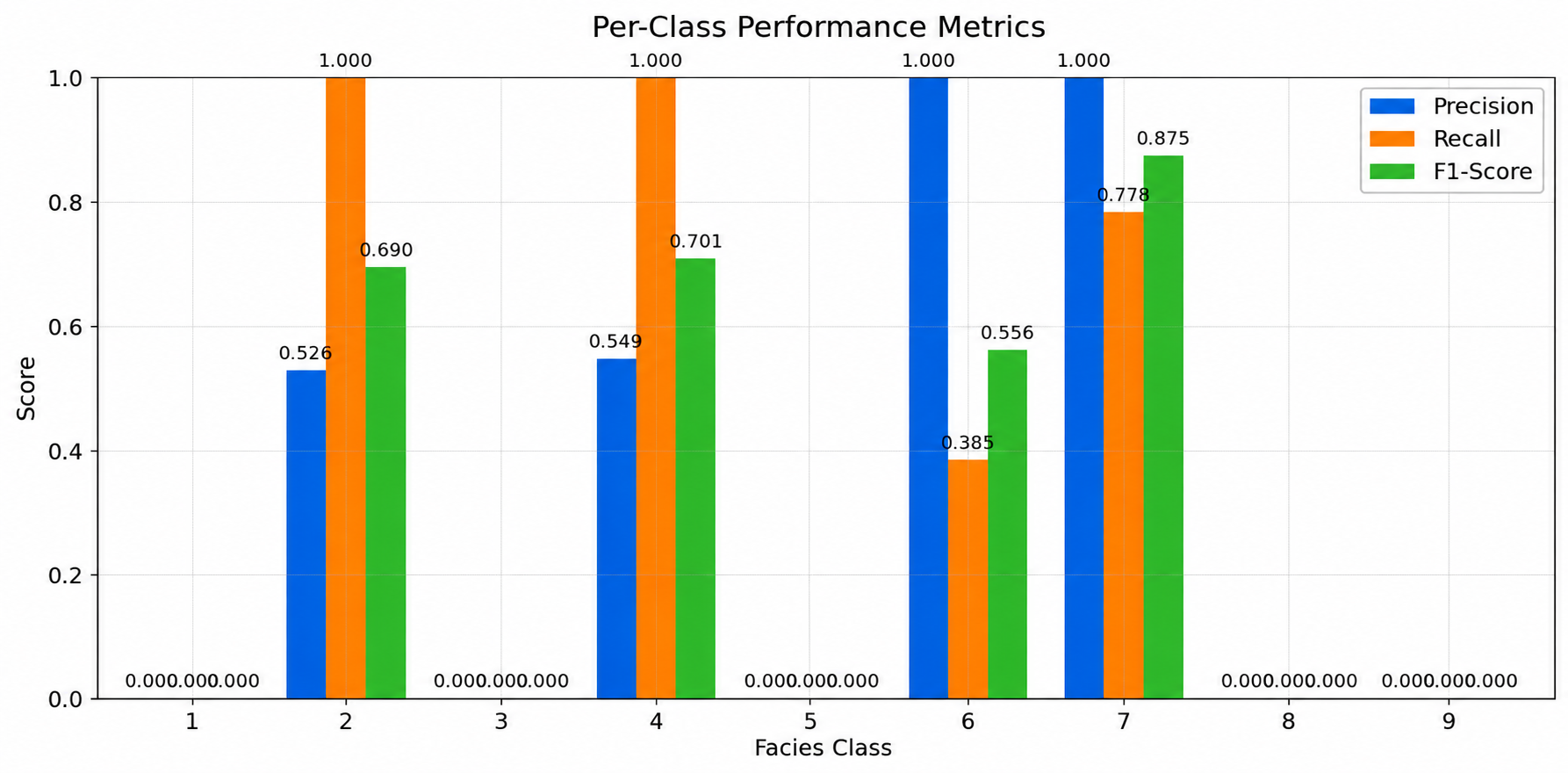
Trustworthy machine learning for facies classification depends critically on leakage-free evaluation. This study proposes the Hybrid Explainable Transformer Framework (HETF), combining convolutional neural network (CNN), bidirectional long short-term memory (BiLSTM), and Transformer branches, with SHapley Additive exPlanations (SHAP) and Monte Carlo Dropout uncertainty estimates. Using 830 samples from two wells in the SEG 2016 dataset, we correct leakage caused by random splitting of overlapping windows and apply depth-contiguous, blocked five-fold cross-validation. Across four repeated cross-validation runs, HETF achieved 58% mean accuracy (run range 52.5--60.8%) and 31% mean macro F1-score (run range 25.5--33.6%). Training accuracy of 85--98% substantially exceeded validation accuracy, indicating overfitting attributable to class scarcity. Under an identical leakage-free protocol, the Transformer-only model (76.4% accuracy; 49.2% macro F1), Random Forest (72.5%; 40.8%), and XGBoost (75.2%; 46.8%) outperformed full HETF (61.4%; 38.0%) in this single ablation comparison. Thus, branch fusion does not justify its complexity at this dataset scale. Preliminary KernelSHAP analysis ranked deep resistivity (ILD_log10), neutron porosity (PHIND), and gamma ray (GR) as the most influential features. The reproducible workflow, with released code, emphasizes methodological validity over inflated accuracy estimates.
References
[1] S. Tao, ``Exploration and development of unconventional oil and gas resources: latest advances and prospects'', Energies 18 (2025) 3933. https://doi.org/10.3390/en18153933
[2] C. Orfanos, K. Leontarakis, G. Apostolopoulos, I. E. Zevgolis & B. Brodic, ``I.S.G.E.: an integrated spatial geotechnical and geophysical evaluation methodology for subsurface investigations'', Geosciences 15 (2025) 264. https://doi.org/10.3390/geosciences15070264
[3] Y. Zhang, C. Li, J. Li, X. Luo, M. Cheng, X. Zhang & B. Lu, ``A new method of geological modeling for the hydrocarbon secondary migration research'', Applied Sciences 15 (2025) 3377. https://doi.org/10.3390/app15063377
[4] R. Al-Hasan, M. H. Saberi & M. A. Riahi, ``Electro-facies classification based on core and well-log data'', Journal of Petroleum Exploration and Production Technology 13 (2023) 2197. https://doi.org/10.1007/s13202-023-01668-5
[5] D. Dewett, J. Pigott & K. Marfurt, ``A review of seismic attribute taxonomies, discussion of their historical use, and the presentation of a seismic attribute communication framework using data analysis concepts'', Interpretation 9 (2021) 1. https://doi.org/10.1190/int-2020-0222.1
[6] Z. Fu, X. Zheng, Y. Yan, X. Xu, F. Zhou, X. Li, Q. Zhou & W. Mai, ``The evolution of machine learning in large-Scale mineral prospectivity prediction: a decade of innovation (2016--2025)'', Minerals 15 (2025) 1042. https://doi.org/10.3390/min15101042
[7] T. Merembayev, D. Kurmangaliyev, B. Bekbauov & Y. Amanbek, ``A comparison of machine learning algorithms in predicting lithofacies: case studies from Norway and Kazakhstan'', Energies 14 (2021) 1896. https://doi.org/10.3390/en14071896
[8] A. K. Usman, Y. A. Hassan, A. A. Bery, A. S. Akingboye, M. D. Dick, B. M. Ahmed & R. O. Aderoju, ``Hybrid deep belief network and fuzzy clustering approach for geothermal prospectivity mapping in northeastern Nigeria using magnetic and landsat data'', Journal of the Nigerian Society of Physical Sciences 8 (2026) 2937. https://doi.org/10.46481/jnsps.2026.2937
[9] A. O. Fajana, A. M. Olawale & H. A. Oyesomi, ``Quantitative reservoir evaluation and hydrocarbon volumetrics: an integrated petrophysical and 3-D static modeling approach in ‘Hamphidex' field, Niger-Delta, Nigeria'', Journal of the Nigerian Society of Physical Sciences 7 (2025) 2429. https://doi.org/10.46481/jnsps.2025.2429
[10] M. Mehmood, A. A. Naseem, M. Saleem, J. u. Rehman, G. Kontakiotis, H. T. Janjuhah, E. U. Khan, A. Antonarakou, I. Khan, A. u. Rehman & S. M. Siyar, ``Sedimentary facies, architectural elements, and depositional environments of the Maastrichtian Pab formation in the Rakhi gorge, eastern Sulaiman ranges, Pakistan'', Journal of Marine Science and Engineering 11 (2023) 726. https://doi.org/10.3390/jmse11040726
[11] Z. Cai, H. You & Q. Wu, ``Sedimentary evolution and geological characteristics of the Jurassic in the south Qiangtang basin, China'', Processes 11 (2023) 1569. https://doi.org/10.3390/pr11051569
[12] Y. Wang, Y. Cao, P. Xie, H. Zhou, B. Yang & Z. Zhang, ``Reservoir prediction methods under sparse well conditions in offshore fields: perspectives and challenges'', Frontiers in Earth Science 14 (2026) 1642714. https://doi.org/10.3389/feart.2026.1642714
[13] L. Aliouane & S. A. Ouadfeul, ``Automatic lithofacies classification from well-Logs data using the Walsh transform combined with the Self-Organizing map'', ECMOR XVI 2018 -- 16th European Conference on the Mathematics of Oil Recovery, Barcelona, Spain, 3--6 September 2018, Paper P044. https://doi.org/10.3997/2214-4609.201802174
[14] W. Xie & K. Spikes, ``Reservoir facies design and modeling using probabilistic rock-physics templates'', GEOPHYSICS 86 (2021) M17. https://doi.org/10.1190/geo2020-0044.1
[15] P. Bestagini, V. Lipari & S. Tubaro, ``A machine learning approach to facies classification using well logs'', SEG Technical Program Expanded Abstracts 2017, Society of Exploration Geophysicists. https://doi.org/10.1190/segam2017-17729805.1
[16] H. Pratama & A. H. A. Latiff, ``Automated geological features detection in 3D seismic data using semi-Supervised learning'', Applied Sciences 12 (2022) 6723. https://doi.org/10.3390/app12136723
[17] S. M. Mousavi, G. Beroza, T. Mukerji & M. Rasht-Behesht, ``Applications of deep neural networks in exploration seismology: a technical survey'', GEOPHYSICS 89 (2024) WA95. https://doi.org/10.1190/geo2023-0063.1
[18] T. Wrona, I. Pan, R. Gawthorpe & H. Fossen, ``Seismic facies analysis using machine learning'', GEOPHYSICS 83 (2018) 1. https://doi.org/10.1190/geo2017-0595.1
[19] S. Ayoub, Y. Gulzar, J. Rustamov, A. Jabbari, F. A. Reegu & S. Turaev, ``Adversarial approaches to tackle imbalanced data in machine learning'', Sustainability 15 (2023) 7097. https://doi.org/10.3390/su15097097
[20] V. Chandra, G. Tallec, F. Gamba & V. Vahrenkamp, ``A systematic machine learning approach to improve facies prediction using multiscale well log and image data'', (2022) 1. https://doi.org/10.3997/2214-4609.202210965
[21] I. Ali, W. Ahmad & S. M. Adnan, ``Multimodal data driven deep learning based seismic impedance inversion optimization'', PLOS ONE 20 (2025) e0331952. https://doi.org/10.1371/journal.pone.0331952
[22] M. C. Hinojosa-Lee, J. Braet & J. Springael, ``Performance metrics for multilabel emotion classification: comparing micro, macro, and weighted f1-Scores'', Applied Sciences 14 (2024) 9863. https://doi.org/10.3390/app14219863
Published
How to Cite
Issue
Section
Copyright (c) 2027 Mahmud Ahmad Bamanga, Muhammad Mukthar Liman, Bashir Ibrahim Tukur (Author)

This work is licensed under a Creative Commons Attribution 4.0 International License.