An empirical evaluation of mathematical, machine learning, and hybrid modeling approaches for COVID-19 forecasting
Keywords:
SEIR model, Hybrid modeling, Infectious disease prediction, Epidemic forecasting, COVID-19Abstract
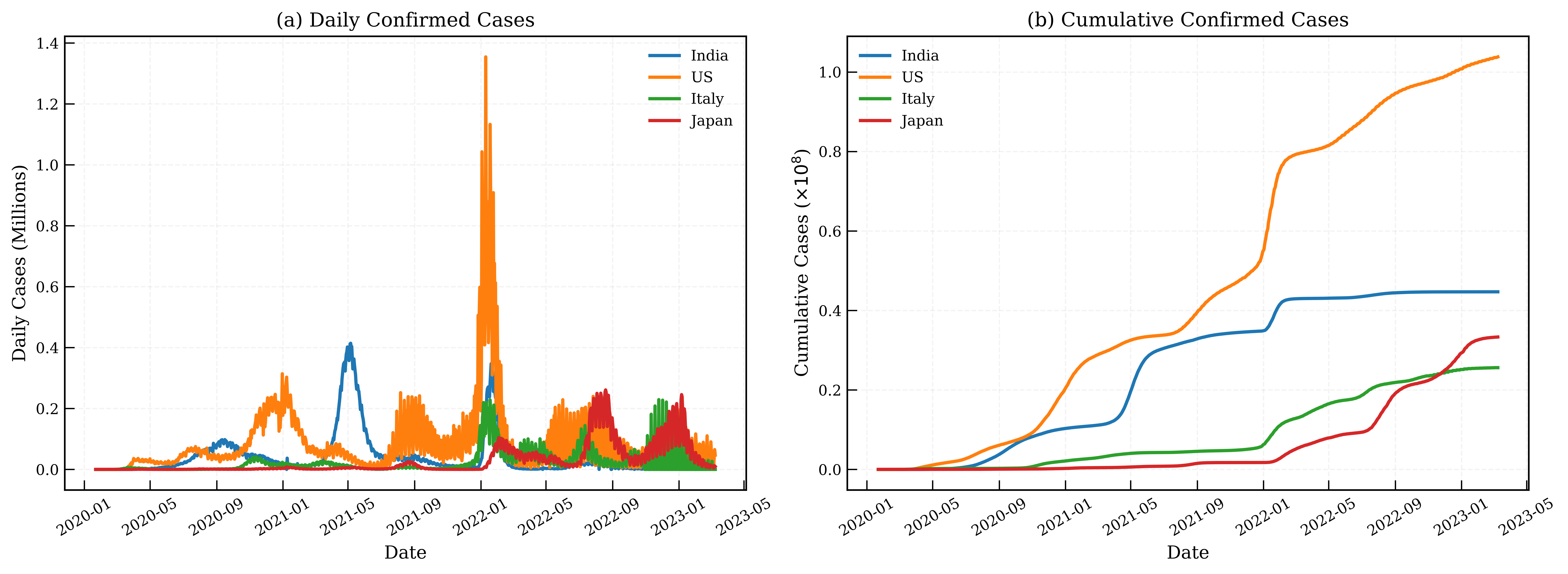
Accurate forecasting of infectious disease spread is essential for public health decision-making. This study compares mechanistic susceptible-exposed-infectious-removed (SEIR) models, machine-learning methods, and hybrid artificial intelligence (AI)-driven epidemiological frameworks using coronavirus disease 2019 (COVID-19) case data from India, the United States, Italy, and Japan. After preprocessing and exploratory analysis, we estimate time-varying transmission rates and develop two hybrid extensions: one predicts beta(t) using machine learning, and the other learns residual errors from the SEIR model. A baseline machine-learning model using lag-based and effective reproduction number (Rt)-driven features is also evaluated. Performance is assessed using mean absolute error (MAE), root mean squared error (RMSE), mean absolute percentage error (MAPE), high-incidence MAPE (on days with observed incidence ge 100 cases), and peak-timing error. With the SEIR transmission-rate spline fitted strictly to training data and all models evaluated on an identical 223-day held-out test window, a simple persistence baseline outperforms the mechanistic SEIR model, both hybrid AI extensions (Tracks A and B), and the pure machine-learning Random Forest model across all four countries (Diebold--Mariano test, p<0.001 in every comparison). The hybrid AI components do not consistently improve forecasting accuracy relative to the SEIR baseline. None of the mechanistic or machine-learning approaches anticipates new epidemic waves beyond the training period, underscoring the difficulty of medium-range epidemic forecasting under genuinely held-out conditions. The comparative evaluation highlights the complementary strengths and limitations of these approaches and provides guidance for future epidemic forecasting models.
Published
How to Cite
Issue
Section
Copyright (c) 2026 Pooja Satwani, Sudhir Kumar Mishra (Author)

This work is licensed under a Creative Commons Attribution 4.0 International License.
How to Cite
Similar Articles
- Mahesh Kumar Singh, Pushpa Choudhary, Arun Kumar Singh, Pushpendra Singh, LWRNPIP: Design of a light weight restrictive non-fungible token based on practically unclonable functions via image signature patterns , Journal of the Nigerian Society of Physical Sciences: Volume 7, Issue 4, November 2025
- Kazeem A. Tijani, Chinwendu. E. Madubueze, Isaac O. Onwubuya, Nkiruka Maria-Assumpta Akabuike, John Olajide Akanni, Mathematical modelling of the dynamical system of military population, focusing on the impact of welfare , Journal of the Nigerian Society of Physical Sciences: Volume 7, Issue 4, November 2025
- Olumide Sunday Adesina, Bayesian Multilevel Models for Count Data , Journal of the Nigerian Society of Physical Sciences: Volume 3, Issue 3, August 2021
- Gabriel James, Anietie Ekong, Etimbuk Abraham, Enobong Oduobuk, Peace Okafor, Analysis of support vector machine and random forest models for predicting the scalability of a broadband network , Journal of the Nigerian Society of Physical Sciences: Volume 6, Issue 3, August 2024
- B. I. Akinnukawe, K. O. Muka, L-Stable Block Hybrid Numerical Algorithm for First-Order Ordinary Differential Equations , Journal of the Nigerian Society of Physical Sciences: Volume 2, Issue 3, August 2020
- Folake Lois Joseph, Adeyemi Sunday Olagunju, Emmanuel Oluseye Adeyefa, Adewale Adeyemi James, Hybrid Block Methods with Constructed Orthogonal Basis for Solution of Third-Order Ordinary Differential Equations , Journal of the Nigerian Society of Physical Sciences: Volume 5, Issue 1, February 2023
- Christian N. Nwaeme, Adewale F. Lukman, Robust hybrid algorithms for regularization and variable selection in QSAR studies , Journal of the Nigerian Society of Physical Sciences: Volume 5, Issue 4, November 2023
- Kazeem adebowale Dawodu, Extension of ADMMAlgorithmin Solving Optimal Control Model Governed by Partial Differential Equation , Journal of the Nigerian Society of Physical Sciences: Volume 3, Issue 2, May 2021
- Chuchu Liang, Majid Khan Majahar Ali, Lili Wu, A novel multi-class classification method for arrhythmias using Hankel dynamic mode decomposition and long short-term memory networks , Journal of the Nigerian Society of Physical Sciences: Volume 7, Issue 2, May 2025
- Sunday Olorunfunmi, Armand Bahini, Adenike Olatinwo, Theoretical Study on 10C Elastic Scattering Cross Sections Using Different Cluster Density Distributions and Different Potentials , Journal of the Nigerian Society of Physical Sciences: Volume 5, Issue 2, May 2023
You may also start an advanced similarity search for this article.