An empirical evaluation of mathematical, machine learning, and hybrid modeling approaches for COVID-19 forecasting
Keywords:
SEIR model, Hybrid modeling, Infectious disease prediction, Epidemic forecasting, COVID-19Abstract
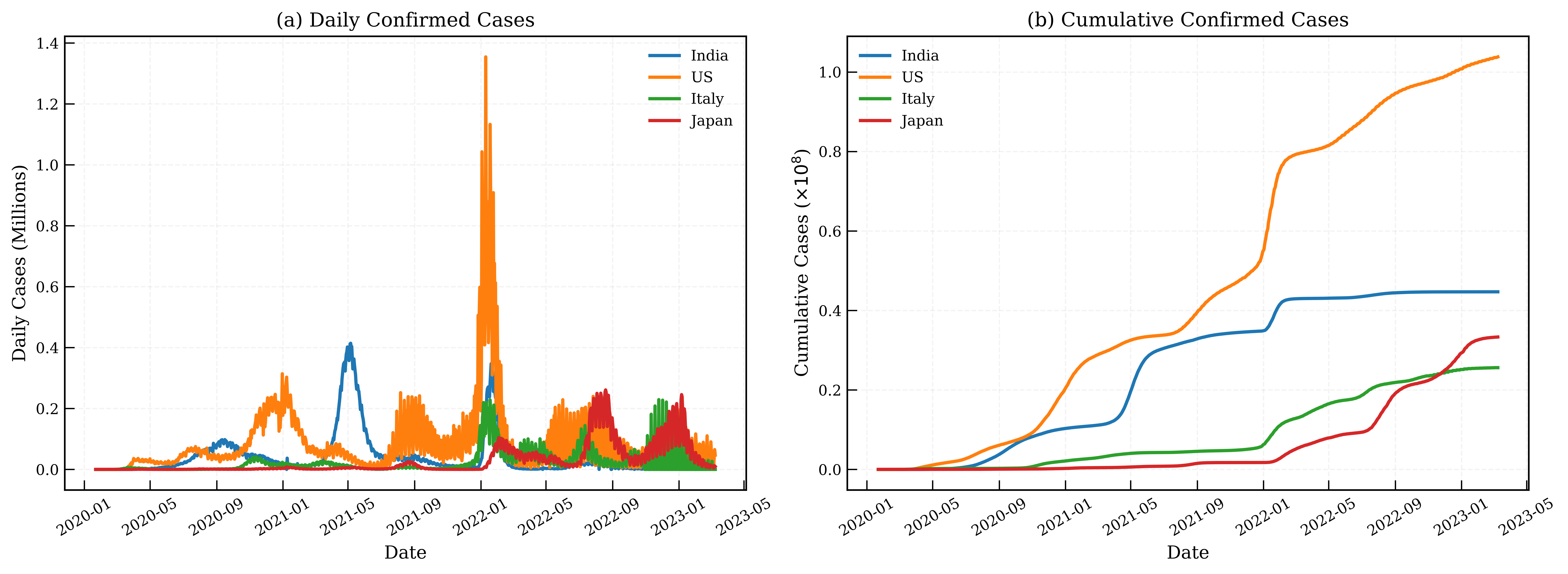
Accurate forecasting of infectious disease spread is essential for public health decision-making. This study compares mechanistic susceptible-exposed-infectious-removed (SEIR) models, machine-learning methods, and hybrid artificial intelligence (AI)-driven epidemiological frameworks using coronavirus disease 2019 (COVID-19) case data from India, the United States, Italy, and Japan. After preprocessing and exploratory analysis, we estimate time-varying transmission rates and develop two hybrid extensions: one predicts beta(t) using machine learning, and the other learns residual errors from the SEIR model. A baseline machine-learning model using lag-based and effective reproduction number (Rt)-driven features is also evaluated. Performance is assessed using mean absolute error (MAE), root mean squared error (RMSE), mean absolute percentage error (MAPE), high-incidence MAPE (on days with observed incidence ge 100 cases), and peak-timing error. With the SEIR transmission-rate spline fitted strictly to training data and all models evaluated on an identical 223-day held-out test window, a simple persistence baseline outperforms the mechanistic SEIR model, both hybrid AI extensions (Tracks A and B), and the pure machine-learning Random Forest model across all four countries (Diebold--Mariano test, p<0.001 in every comparison). The hybrid AI components do not consistently improve forecasting accuracy relative to the SEIR baseline. None of the mechanistic or machine-learning approaches anticipates new epidemic waves beyond the training period, underscoring the difficulty of medium-range epidemic forecasting under genuinely held-out conditions. The comparative evaluation highlights the complementary strengths and limitations of these approaches and provides guidance for future epidemic forecasting models.
Published
How to Cite
Issue
Section
Copyright (c) 2026 Pooja Satwani, Sudhir Kumar Mishra (Author)

This work is licensed under a Creative Commons Attribution 4.0 International License.
How to Cite
Similar Articles
- Folake Lois Joseph, Adeyemi Sunday Olagunju, Emmanuel Oluseye Adeyefa, Adewale Adeyemi James, Hybrid Block Methods with Constructed Orthogonal Basis for Solution of Third-Order Ordinary Differential Equations , Journal of the Nigerian Society of Physical Sciences: Volume 5, Issue 1, February 2023
- Christian N. Nwaeme, Adewale F. Lukman, Robust hybrid algorithms for regularization and variable selection in QSAR studies , Journal of the Nigerian Society of Physical Sciences: Volume 5, Issue 4, November 2023
- Mariya Helen, Prabhakar V, Computational investigation of free convection flow inside inclined square cavities , Journal of the Nigerian Society of Physical Sciences: Volume 4, Issue 2, May 2022
- Yakubu Aliyu, Umar Usman, On Bivariate Nadarajah-Haghighi Distribution derived from Farlie-Gumbel-Morgenstern copula in the Presence of Covariates , Journal of the Nigerian Society of Physical Sciences: Volume 5, Issue 2, May 2023
- Maduabuchi Gabriel Orakwelu, Olumuyiwa Otegbeye, Hermane Mambili-Mamboundou, A class of single-step hybrid block methods with equally spaced points for general third-order ordinary differential equations , Journal of the Nigerian Society of Physical Sciences: Volume 5, Issue 4, November 2023
- Hamza Abubakar, Abdu Sagir Masanawa, Surajo Yusuf, G. I. Boaku, Optimal representation to High Order Random Boolean kSatisability via Election Algorithm as Heuristic Search Approach in Hopeld Neural Networks , Journal of the Nigerian Society of Physical Sciences: Volume 3, Issue 3, August 2021
- Amos Orenyi Bajeh, Mary Olayinka Olaoye, Fatima Enehezei Usman-Hamza, Ikeola Suhurat Olatinwo, Peter ogirima Sadiku, Abdulkadir Bolakale Sakariyah, An adaptive neuro-fuzzy inference system for multinomial malware classification , Journal of the Nigerian Society of Physical Sciences: Volume 7, Issue 1, February 2025
- O. S. Oguntoye, A. M. Okooboh, O. M. Bello, A. H. Usman, S. S. Abdussalam, G. V. Awolola, Antimicrobial Assessment of Different Solvent Extracts of the Root-bark, Stem-bark and Leaves of Acacia ataxacantha Linn. , Journal of the Nigerian Society of Physical Sciences: Volume 1, Issue 1, February 2019
- Charles Otobrise, Godwin Eferurhobo, Prediction of the acentric factor of some halogenated hydrocarbons via group contribution techniques , Journal of the Nigerian Society of Physical Sciences: Volume 6, Issue 4, November 2024
- B. Laxmi, K. Chand, P. Thakur, Hydrodynamic Casson hybrid nanofluid flow across a stretching sheet in the regime of velocity slip and temperature jump,including viscous dissipation, melting, Soret and Dufour effects , Journal of the Nigerian Society of Physical Sciences: Volume 7, Issue 4, November 2025
You may also start an advanced similarity search for this article.