An empirical evaluation of mathematical, machine learning, and hybrid modeling approaches for COVID-19 forecasting
Keywords:
SEIR model, Hybrid modeling, Infectious disease prediction, Epidemic forecasting, COVID-19Abstract
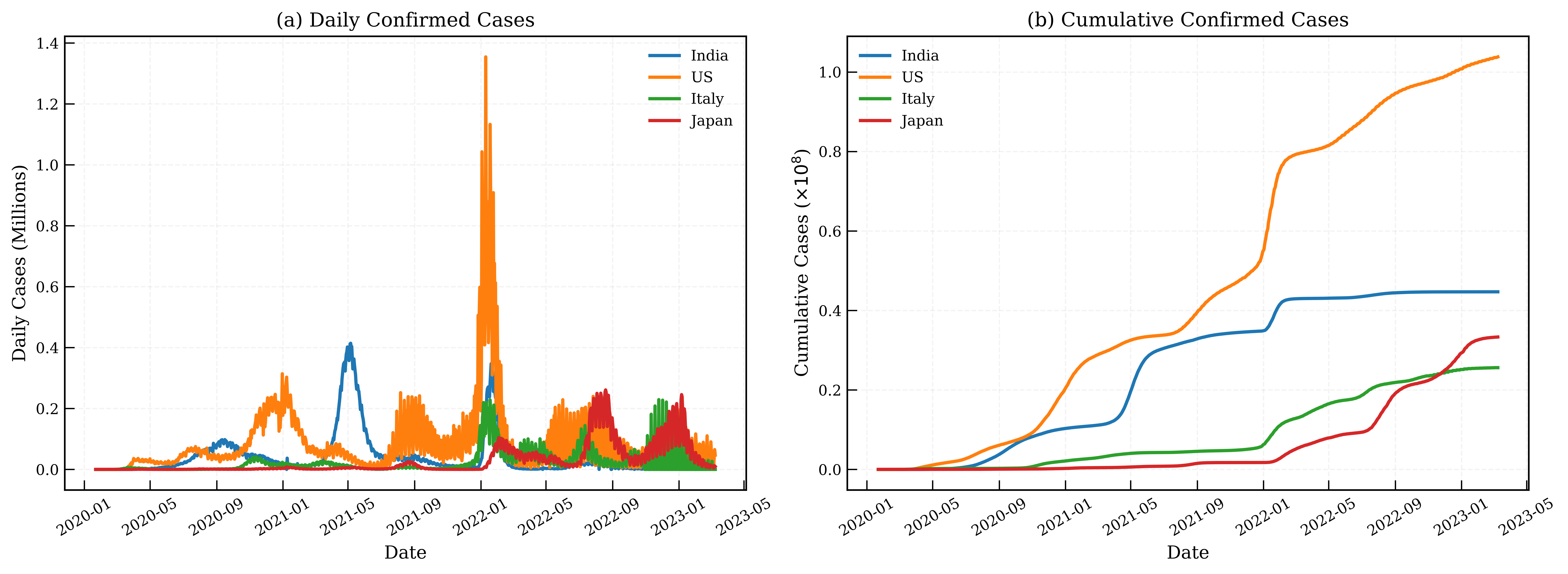
Accurate forecasting of infectious disease spread is essential for public health decision-making. This study compares mechanistic susceptible-exposed-infectious-removed (SEIR) models, machine-learning methods, and hybrid artificial intelligence (AI)-driven epidemiological frameworks using coronavirus disease 2019 (COVID-19) case data from India, the United States, Italy, and Japan. After preprocessing and exploratory analysis, we estimate time-varying transmission rates and develop two hybrid extensions: one predicts beta(t) using machine learning, and the other learns residual errors from the SEIR model. A baseline machine-learning model using lag-based and effective reproduction number (Rt)-driven features is also evaluated. Performance is assessed using mean absolute error (MAE), root mean squared error (RMSE), mean absolute percentage error (MAPE), high-incidence MAPE (on days with observed incidence ge 100 cases), and peak-timing error. With the SEIR transmission-rate spline fitted strictly to training data and all models evaluated on an identical 223-day held-out test window, a simple persistence baseline outperforms the mechanistic SEIR model, both hybrid AI extensions (Tracks A and B), and the pure machine-learning Random Forest model across all four countries (Diebold--Mariano test, p<0.001 in every comparison). The hybrid AI components do not consistently improve forecasting accuracy relative to the SEIR baseline. None of the mechanistic or machine-learning approaches anticipates new epidemic waves beyond the training period, underscoring the difficulty of medium-range epidemic forecasting under genuinely held-out conditions. The comparative evaluation highlights the complementary strengths and limitations of these approaches and provides guidance for future epidemic forecasting models.
Published
How to Cite
Issue
Section
Copyright (c) 2026 Pooja Satwani, Sudhir Kumar Mishra (Author)

This work is licensed under a Creative Commons Attribution 4.0 International License.
How to Cite
Similar Articles
- O. S. Oguntoye, A. M. Okooboh, O. M. Bello, A. H. Usman, S. S. Abdussalam, G. V. Awolola, Antimicrobial Assessment of Different Solvent Extracts of the Root-bark, Stem-bark and Leaves of Acacia ataxacantha Linn. , Journal of the Nigerian Society of Physical Sciences: Volume 1, Issue 1, February 2019
- Charles Otobrise, Godwin Eferurhobo, Prediction of the acentric factor of some halogenated hydrocarbons via group contribution techniques , Journal of the Nigerian Society of Physical Sciences: Volume 6, Issue 4, November 2024
- B. Laxmi, K. Chand, P. Thakur, Hydrodynamic Casson hybrid nanofluid flow across a stretching sheet in the regime of velocity slip and temperature jump,including viscous dissipation, melting, Soret and Dufour effects , Journal of the Nigerian Society of Physical Sciences: Volume 7, Issue 4, November 2025
- Chinwendu Emilian Madubueze, Kazeem A. Tijani, Elijah Iji Ajogi, Madumelu H. C. Madubueze, A mathematical model of cybercrime contagion: impact ofemployment on youth offending , Journal of the Nigerian Society of Physical Sciences: Volume 8, Issue 3, August 2026
- Oluwayemisi Oyeronke Alaba, B. M. Golam Kibria, The Efficiency of the K-L Estimator for the Seemingly Unrelated Regression Model: Simulation and Application , Journal of the Nigerian Society of Physical Sciences: Volume 5, Issue 3, August 2023
- Akindeji Opeyemi Fajana, Adam Muhammed Olawale, Hammed Ajibola Oyesomi, Quantitative reservoir evaluation and hydrocarbon volumetrics :an integrated petrophysical and 3-D static modeling approach in ‘Hamphidex’ field, Niger-Delta, Nigeria , Journal of the Nigerian Society of Physical Sciences: Volume 7, Issue 2, May 2025
- L. G. Salaudeen, D. GABI, M. Garba, H. U. Suru, Deep convolutional neural network based synthetic minority over sampling technique: a forfending model for fraudulent credit card transactions in financial institution , Journal of the Nigerian Society of Physical Sciences: Volume 6, Issue 2, May 2024
- Mark I. Modebei, Olumide O. Olaiya, Ignatius P. Ngwongwo, Computational study of a 3-step hybrid integrators for third order ordinary differential equations with shift of three off-step points , Journal of the Nigerian Society of Physical Sciences: Volume 3, Issue 4, November 2021
- Edikan E. Akpanibah, Udeme O. Ini, An Investor’s Investment Plan with Stochastic Interest Rate under the CEV Model and the Ornstein-Uhlenbeck Process , Journal of the Nigerian Society of Physical Sciences: Volume 3, Issue 3, August 2021
- Emmanuel C. Ukekwe, Adaora A. Obayi, Akpa Johnson, Daniel A. Musa, Jonathan C. Agbo, Optimizing data and voice service delivery for mobile phones based on clients' demand and location using affinity propagation machine learning , Journal of the Nigerian Society of Physical Sciences: Volume 7, Issue 2, May 2025
You may also start an advanced similarity search for this article.