Kaluza–Klein cosmological model with Tsallis holographic dark energy in f (R, T) gravity

Authors

  • K. P. S. Suryanarayan
    Department of Mathematics and Statistics, GSS, GITAM Deemed to be University, Visakhapatnam, India
  • K. V. S. Sireesha
    Department of Mathematics and Statistics, GSS, GITAM Deemed to be University, Visakhapatnam, India
  • R. Sathibabu
    Department of Mathematics and Statistics, GSS, GITAM Deemed to be University, Visakhapatnam, India

Keywords:

Kaluza–Klein metric, Tsallis holographic dark energy, Cosmology, Dark energy, f (R, T) gravity

Abstract

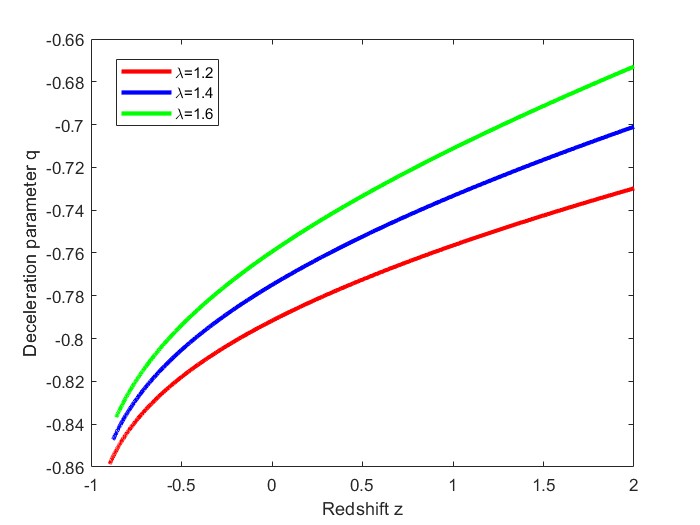
In this study, we analyze a cosmological model based on Tsallis Holographic Dark Energy (THDE) in Kaluza--Klein (KK) spacetime within f(R,T) gravity. Exact solutions to the field equations are derived, and the evolution of the deceleration parameter, energy density, pressure, and equation-of-state (EoS) parameter as functions of redshift is investigated. The model exhibits continuous accelerated expansion, characterized by a negative deceleration parameter throughout the considered redshift range. Here, lambda is the constant associated with the adopted deceleration-parameter parametrization and controls the evolution of the Hubble and deceleration parameters, thereby determining the expansion dynamics of the model. The statefinder analysis shows that the model evolves toward the Lambda cold dark matter (LambdaCDM) fixed point and approaches it asymptotically in the future. Furthermore, the null, weak, and dominant energy conditions (NEC, WEC, and DEC) are satisfied, whereas the strong energy condition (SEC) is violated, consistent with the accelerated expansion of the Universe. The stability of the model is assessed independently using the effective squared speed of sound, which indicates classical instability for the considered parameter set. Overall, the model provides an analytical framework for investigating late-time cosmic acceleration in f(R,T) gravity, while its perturbative and observational viability requires further investigation.
Dimensions

[1] A. G. Riess, A. V. Filippenko, P. Challis, A. Clocchiatti, A. Diercks, P. M. Garnavich, R. I. Gilliland, C. J. Hogan, S. Jha, R. P. Kirshner & B. Leibundgut, ``Observational evidence from supernovae for an accelerating universe and a cosmological constant'', The Astronomical Journal 116 (1998) 1009. https://doi.org/10.1086/300499.

[2] S. Perlmutter, G. Aldering, G. Goldhaber, R. A. Knop, P. Nugent, P. G. Castro, S. Deustua, S. Fabbro, A. Goobar, D. E. Groom & I. M. Hook, ``Measurements of $Omega$ and $Lambda$ from 42 high-redshift supernovae'', The Astrophysical Journal 517 (1999) 565. https://doi.org/10.1086/307221.

[3] Planck Collaboration, N. Aghanim, Y. Akrami, M. Ashdown et al., ``Planck 2018 results. VI. Cosmological parameters'', Astronomy & Astrophysics 641 (2020) A6. https://doi.org/10.1051/0004-6361/201833910.

[4] D. J. Eisenstein, I. Zehavi, D. W. Hogg, R. Scoccimarro, M. R. Blanton, R. C. Nichol, R. Scranton, H. J. Seo, M. Tegmark, Z. Zheng & S. F. Anderson, ``Detection of the baryon acoustic peak in the large-scale correlation function of SDSS luminous red galaxies'', The Astrophysical Journal 633 (2005) 560. https://doi.org/10.1086/466512.

[5] S. Weinberg, ``The cosmological constant problem'', Reviews of Modern Physics 61 (1989) 1. https://doi.org/10.1103/RevModPhys.61.1.

[6] G. 't Hooft, ``Dimensional reduction in quantum gravity'', arXiv:gr-qc/9310026 (1993). https://doi.org/10.48550/arXiv.gr-qc/9310026.

[7] L. Susskind, ``The world as a hologram'', Journal of Mathematical Physics 36 (1995) 6377. https://doi.org/10.1063/1.531249.

[8] A. G. Cohen, D. B. Kaplan & A. E. Nelson, ``Effective field theory, black holes, and the cosmological constant'', Physical Review Letters 82 (1999) 4971. https://doi.org/10.1103/PhysRevLett.82.4971.

[9] C. Tsallis, ``Possible generalization of Boltzmann--Gibbs statistics'', Journal of Statistical Physics 52 (1988) 479. https://doi.org/10.1007/BF01016429.

[10] M. Tavayef, A. Sheykhi, K. Bamba & H. Moradpour, ``Tsallis holographic dark energy'', Physics Letters B 781 (2018) 195. https://doi.org/10.1016/j.physletb.2018.04.001.

[11] J. D. Barrow, ``The area of a rough black hole'', Physics Letters B 808 (2020) 135643. https://doi.org/10.1016/j.physletb.2020.135643.

[12] D. Brout, D. Scolnic, B. Popovic, A. G. Riess et al., ``The Pantheon+ analysis: Cosmological constraints'', The Astrophysical Journal 938 (2022) 110. https://doi.org/10.3847/1538-4357/ac8e04.

[13] DESI Collaboration, A. G. Adame, J. Aguilar et al., ``DESI 2024 VI: Cosmological constraints from the measurements of baryon acoustic oscillations'', Journal of Cosmology and Astroparticle Physics 2025 (2025) 021. https://doi.org/10.1088/1475-7516/2025/02/021.

[14] P. E. Satyanarayana, K. V. S. Sireesha, K. P. S. Suryanarayana & R. Sathibabu, ``Cosmological dynamics of Tsallis holographic dark energy in Saez--Ballester gravity'', East European Journal of Physics 1 (2026) 45. https://doi.org/10.26565/2312-4334-2026-1-04.

[15] T. N. Li, Y. H. Li, G. H. Du, P. J. Wu, L. Feng, J. F. Zhang & X. Zhang, ``Revisiting holographic dark energy after DESI 2024'', European Physical Journal C 85 (2025) 608. https://doi.org/10.1140/epjc/s10052-025-14279-7.

[16] I. Imdiker, M. P. Dk{a}browski & V. Salzano, ``Generalized nonextensive entropy holographic dark energy models verified by cosmological data'', European Physical Journal C 85 (2025) 775. https://doi.org/10.1140/epjc/s10052-025-14498-y.

[17] T. Harko, F. S. N. Lobo, S. Nojiri & S. D. Odintsov, ``$f(R,T)$ gravity'', Physical Review D 84 (2011) 024020. https://doi.org/10.1103/PhysRevD.84.024020.

[18] J. M. Overduin & P. S. Wesson, ``Kaluza--Klein gravity'', Physics Reports 283 (1997) 303. https://doi.org/10.1016/S0370-1573(96)00046-4.

[19] O. Trivedi, M. Khlopov & A. V. Timoshkin, ``Tsallis holographic dark energy with power law ansatz approach'', Symmetry 16 (2024) 446. https://doi.org/10.3390/sym16040446.

[20] C. R. Mahanta & D. Das, ``Tsallis holographic dark energy model in an anisotropic universe with linearly varying deceleration parameter and its correspondence with phantom'', Physics of the Dark Universe 47 (2025) 101755. https://doi.org/10.1016/j.dark.2024.101755.

[21] D. R. K. Reddy & R. Santhi Kumar, ``Kaluza--Klein dark energy cosmological model in scale co-variant theory of gravitation'', Astrophysics and Space Science 349 (2014) 485. https://doi.org/10.1007/s10509-013-1656-2.

[22] R. Santhi Kumar & B. Satyanarayana, ``Accelerating anisotropic cosmological model in $f(R,T)$ theory of gravity'', Indian Journal of Physics 91 (2017) 1293. https://doi.org/10.1007/s12648-017-1017-z.

[23] M. Krishna, K. Sobhanbabu & R. Santhi Kumar, ``Accelerating plane symmetric cosmological model with bulk viscous and cosmic strings in Lyra's geometry'', Indian Journal of Physics 98 (2024) 3733. https://doi.org/10.1007/s12648-024-03100-y.

[24] M. Ramanamurty, R. Santhikumar & K. Sobhanbabu, ``Two fluid scenario for dark energy model with LVDP in a scalar--tensor theory of gravitation'', Indian Journal of Physics 100 (2026) 411. https://doi.org/10.1007/s12648-025-03788-6.

[25] C. B. Collins, E. N. Glass & D. A. Wilkinson, ``Exact spatially homogeneous cosmologies'', General Relativity and Gravitation 12 (1980) 805. https://doi.org/10.1007/BF00763057.

[26] A. Pradhan, J. P. Shahi & C. B. Singh, ``Cosmological models of universe with variable deceleration parameter in Lyra's manifold'', Brazilian Journal of Physics 36 (2006) 1227. https://doi.org/10.1590/S0103-97332006000700020.

[27] Yu. L. Bolotin, V. A. Cherkaskiy, O. A. Lemets, D. A. Yerokhin & L. G. Zazunov, ``Cosmology in terms of the deceleration parameter. Part I'', arXiv:1502.00811 (2015). https://doi.org/10.48550/arXiv.1502.00811.

[28] M. Koussour, N. Myrzakulov, A. H. A. Alfedeel, F. Awad & M. Bennai, ``Modeling cosmic acceleration with a generalized varying deceleration parameter'', Physics of the Dark Universe 42 (2023) 101339. https://doi.org/10.1016/j.dark.2023.101339.

[29] R. K. Tiwari, A. K. Agrawal & B. K. Shukla, ``Bianchi type-VI$_0$ cosmological model with variable deceleration parameter'', Prespacetime Journal 7 (2016) 792. https://prespacetime.com/index.php/pst/article/viewFile/970/939.

[30] A. G. Riess, L.-G. Strolger, J. Tonry, S. Casertano, H. C. Ferguson, B. Mobasher, P. Challis, A. V. Filippenko, S. W. Jha, W. Li, R. Chornock, R. P. Kirshner, B. Leibundgut, M. Dickinson, M. Livio, M. Giavalisco, C. C. Steidel, T. Ben'itez & Z. Tsvetanov, ``Type Ia supernova discoveries at $z>1$ from the Hubble Space Telescope: Evidence for past deceleration and constraints on dark energy evolution'', The Astrophysical Journal 607 (2004) 665. https://doi.org/10.1086/383612.

[31] P. Astier, J. Guy, N. Regnault, R. Pain, E. Aubourg et al., ``The Supernova Legacy Survey: Measurement of $Omega_M$, $Omega_Lambda$ and $w$ from the first year data set'', Astronomy & Astrophysics 447 (2006) 31. https://doi.org/10.1051/0004-6361:20054185.

[32] A. G. Riess, W. Yuan, L. M. Macri, D. Scolnic, D. Brout, S. Casertano, D. O. Jones, Y. Murakami, G. S. Anand, L. Breuval, T. G. Brink, A. V. Filippenko, S. Hoffmann, S. W. Jha, W. D. Kenworthy, J. MacKenty, B. E. Stahl & W. Zheng, ``A comprehensive measurement of the local value of the Hubble constant with 1 km s$^{-1}$ Mpc$^{-1}$ uncertainty from the Hubble Space Telescope and the SH0ES Team'', The Astrophysical Journal Letters 934 (2022) L7. https://doi.org/10.3847/2041-8213/ac5c5b.

[33] M. Li, ``A model of holographic dark energy'', Physics Letters B 603 (2004) 1. https://doi.org/10.1016/j.physletb.2004.10.014.

[34] C. Tsallis & L. J. L. Cirto, ``Black hole thermodynamical entropy'', European Physical Journal C 73 (2013) 2487. https://doi.org/10.1140/epjc/s10052-013-2487-6.

[35] O. Farooq & B. Ratra, ``Hubble parameter measurement constraints on the cosmological deceleration--acceleration transition redshift'', The Astrophysical Journal Letters 766 (2013) L7. https://doi.org/10.1088/2041-8205/766/1/L7.

[36] V. Sahni, T. D. Saini, A. A. Starobinsky & U. Alam, ``Statefinder---A new geometrical diagnostic of dark energy'', JETP Letters 77 (2003) 201. https://doi.org/10.1134/1.1574831.

[37] U. Alam, V. Sahni, T. D. Saini & A. A. Starobinsky, ``Exploring the expanding Universe and dark energy using the statefinder diagnostic'', Monthly Notices of the Royal Astronomical Society 344 (2003) 1057. https://doi.org/10.1046/j.1365-8711.2003.06871.x.

[38] G. F. R. Ellis & M. A. H. MacCallum, ``A class of homogeneous cosmological models'', Communications in Mathematical Physics 12 (1969) 108. https://doi.org/10.1007/BF01645908.

[39] G. F. R. Ellis, ``Republication of: Relativistic cosmology'', General Relativity and Gravitation 41 (2009) 581. https://doi.org/10.1007/s10714-009-0760-7.

[40] J. Garriga & V. F. Mukhanov, ``Perturbations in k-inflation'', Physics Letters B 458 (1999) 219. https://doi.org/10.1016/S0370-2693(99)00602-4.

[41] S. W. Hawking & G. F. R. Ellis, The Large Scale Structure of Space-Time, Cambridge University Press, Cambridge, UK, 1973. https://doi.org/10.1017/CBO9780511524646.

[42] S. M. Carroll, Spacetime and Geometry: An Introduction to General Relativity, Cambridge University Press, Cambridge, UK, 2019. https://doi.org/10.1017/9781108770385.

[43] T. Padmanabhan, ``Cosmological constant---The weight of the vacuum'', Physics Reports 380 (2003) 235. https://doi.org/10.1016/S0370-1573(03)00120-0.

FIG1

Published

2026-09-17

How to Cite

Kaluza–Klein cosmological model with Tsallis holographic dark energy in f (R, T) gravity. (2026). Journal of the Nigerian Society of Physical Sciences, 8(4), 3611. https://doi.org/10.46481/jnsps.2026.3611

Issue

Section

Physics & Astronomy

How to Cite

Kaluza–Klein cosmological model with Tsallis holographic dark energy in f (R, T) gravity. (2026). Journal of the Nigerian Society of Physical Sciences, 8(4), 3611. https://doi.org/10.46481/jnsps.2026.3611

Similar Articles

41-50 of 117

You may also start an advanced similarity search for this article.