Medical waste disposal site selection under uncertainty: An interval-valued neutrosophic CRITIC-MARCOS decision support framework

Authors

  • Yuxu Han
    School of Mathematics and Statistics, Jiangsu Normal University, Xuzhou 221116, China
  • Sukumar Letchmunan
    School of Computer Sciences, Universiti Sains Malaysia, Penang 11800, Malaysia
  • Wulfran Fendzi Mbasso
    Department of Biosciences, Saveetha School of Engineering, Saveetha Institute of Medical and Technical Sciences, Chennai 602105, India
  • Narinderjit Singh Sawaran Singh
    Faculty of Data Science and Information Technology, INTI International University, Nilai 71800, Negeri Sembilan, Malaysia
  • Zokir Mamadiyarov
    Department of Finance and Tourism, Termez University of Economics and Service, Termez 190111, Uzbekistan;
    Department of Economics, Mamun University, Khiva 220900, Uzbekistan;
    Department of Finance, Alfraganus University, Tashkent 100190, Uzbekistan
  • Aseel Smerat
    Hourani Center for Applied Scientific Research, Al-Ahliyya Amman University, Amman 19328, Jordan
  • Zhe Liu
    Research Fellow, Shinawatra University, Pathum Thani 12160, Thailand;
    Department of Mathematics, Saveetha School of Engineering, Saveetha Institute of Medical and Technical Sciences, Chennai 602105, India;
    Centre for Research Impact & Outcome, Chitkara University Institute of Engineering and Technology, Chitkara University, Punjab 140401, India

Keywords:

Interval-valued neutrosophic sets, CRITIC, MARCOS, Decision-making, Medical waste disposal

Abstract

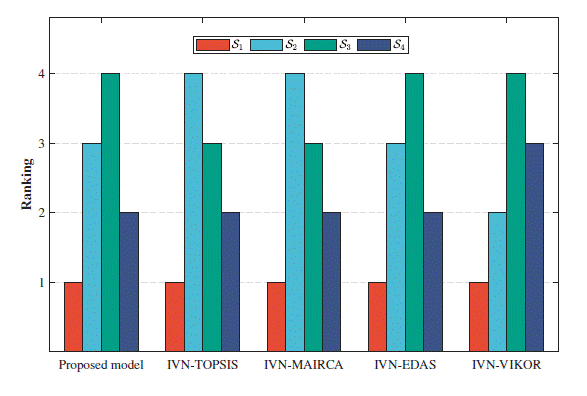
With the ongoing expansion of healthcare services, the amount of medical waste (MW) has been rising steadily, placing increasing pressure on environmental systems and public health. Identifying an appropriate disposal site is challenging because it requires balancing multiple, often conflicting criteria under considerable evaluation uncertainty. This paper develops a hybrid decision-making framework in an interval-valued neutrosophic (IVN) environment by integrating criteria importance through intercriteria correlation (CRITIC) with measurement of alternatives and ranking according to compromise solution (MARCOS). Interval-valued neutrosophic sets represent ambiguity, indeterminacy, and hesitation in expert judgments, while CRITIC derives data-driven criterion weights from aggregated expert evaluations by considering post-deneutrosophication dispersion and inter-criterion conflict. The extended MARCOS method prioritizes alternatives using a utility function that incorporates the ideal and anti-ideal solutions. A secondary-data methodological illustration assesses four candidate locations using nineteen social, economic, environmental, infrastructural, and geological criteria. Comparisons with IVN-TOPSIS, IVN-MAIRCA, IVN-EDAS, and IVN-VIKOR show that all five frameworks identify the same first-ranked site, whereas the ordering of the remaining alternatives is method-sensitive. These comparisons are interpreted at the integrated-framework level because the benchmark methods retain their own weighting and ranking mechanisms.
Dimensions

[1] H. Nematollahi, M. Tuysserkani & A. Nematollahi, ``Medical waste management in the modern healthcare era: A comprehensive review of technologies, environmental impact, and sustainable practices'', Results in Engineering 28 (2025) 107210. https://doi.org/10.1016/j.rineng.2025.107210.

[2] T. Yang, Y. Du, M. Sun, J. Meng & Y. Li, ``Risk management for whole-process safe disposal of medical waste: progress and challenges'', Risk Management and Healthcare Policy 17 (2024) 1503. https://doi.org/10.2147/RMHP.S464268.

[3] M. Adelodun & E. Anyanwu, ``Public health risks associated with environmental radiation from improper medical waste disposal'', International Journal of Multidisciplinary Research and Growth Evaluation 6 (2025) 21. https://doi.org/10.54660/.IJMRGE.2025.6.2.21-32.

[4] A. D. Ciobanu, A. Ozunu, M. T{u{a}}nase, A. Gligor & C. Veres, ``Lean management framework in healthcare: insights and achievements on hazardous medical waste'', Applied Sciences 15 (2025) 6686. https://doi.org/10.3390/app15126686.

[5] S. V. Ajay & K. P. Prathish, ``Dioxins emissions from bio-medical waste incineration: A systematic review on emission factors, inventories, trends and health risk studies'', Journal of Hazardous Materials 465 (2024) 133384. https://doi.org/10.1016/j.jhazmat.2023.133384.

[6] E. {c{C}}etin, I. A. Esenlik{c{c}}i Y{i}ld{i}z, C. {"O}z Ya{c{s}}ar & A. Yulistyorini, ``Life cycle assessment of medical waste management: case study for Istanbul'', Applied Sciences 15 (2025) 4439. https://doi.org/10.3390/app15084439.

[7] E. Ayyildiz & M. Erdogan, ``Literature analysis of the location selection studies related to the waste facilities within MCDM approaches'', Environmental Science and Pollution Research 32 (2025) 19574. https://doi.org/10.1007/s11356-024-34370-y.

[8] J. Chen, S. Zhao, Y. Sun, L. Wu, H. Ping & H. Khalingarajah, ``Efficiency evaluation of smart libraries under distribution-driven uncertainty: A big-data-driven fuzzy SBM--DEA framework'', Big Data and Computing Visions 6 (2026) 83. https://doi.org/10.22105/bdcv.2026.557019.1329.

[9] Y. Nijalingappa, M. Karthik, A. Vasudevan, S. I. Mohammad, R. Siddalingaswamy, M. T. Mudzengi & A. A. Mohammad, ``Assessing eco-efficiency of building materials using type-2 Fuzzy AHP--TOPSIS framework'', Journal of Building Material Science 8 (2026) 23. https://doi.org/10.30564/jbms.v8i2.12600.

[10] A. Tighnavard Balasbaneh, S. Aldrovandi & W. Sher, ``A systematic review of implementing multi-criteria decision-making (MCDM) approaches for the circular economy and cost assessment'', Sustainability 17 (2025) 5007. https://doi.org/10.3390/su17115007.

[11] R. Kumar, ``A comprehensive review of MCDM methods, applications, and emerging trends'', Decision Making Advances 3 (2025) 185. https://doi.org/10.31181/dma31202569.

[12] R. Kumar & D. Pamucar, ``A comprehensive and systematic review of multi-criteria decision-making (MCDM) methods to solve decision-making problems: two decades from 2004 to 2024'', Spectrum of Decision Making and Applications 2 (2025) 177. https://doi.org/10.31181/sdmap21202524.

[13] S. K. Sahoo, B. B. Choudhury & P. R. Dhal, ``A bibliometric analysis of material selection using MCDM methods: trends and insights'', Spectrum of Mechanical Engineering and Operational Research 1 (2024) 189. https://doi.org/10.31181/smeor11202417.

[14] J. A. Adebisi & O. Babatunde, ``Green information and communication technologies implementation in textile industry using multicriteria method'', Journal of the Nigerian Society of Physical Sciences 4 (2022) 165–173. https://doi.org/10.46481/jnsps.2022.518.

[15] S. P. S. S. Sivam, S. Kesavan & T. K. Ajiboye, ``Development of ranking alternatives of micro-cup production from directionally rolled copper rods using the intuitionistic Fuzzy MARCOS method'', Scientific Reports 16 (2026) 9585. https://doi.org/10.1038/s41598-025-29817-2.

[16] S. Dash, S. Chakravarty, N. C. Giri & R. Khargotra, ``Evaluating sustainable wind energy sources with multiple criteria decision-making (MCDM) techniques'', Computers and Electrical Engineering 123 (2025) 110285. https://doi.org/10.1016/j.compeleceng.2025.110285.

[17] L. A. Zadeh, ``Fuzzy sets'', Information and Control 8 (1965) 338. https://doi.org/10.1016/S0019-9958(65)90241-X.

[18] K. T. Atanassov, ``Intuitionistic fuzzy sets'', Fuzzy Sets and Systems 20 (1986) 87. https://doi.org/10.1016/S0165-0114(86)80034-3.

[19] P. A. Ejegwa, I. C. Onyeke, B. T. Terhemen, M. P. Onoja, A. Ogiji & C. U. Opeh, ``Modified Szmidt and Kacprzyk’s intuitionistic fuzzy distances and their applications in decision-making'', Journal of the Nigerian Society of Physical Sciences 4 (2022) 174. https://doi.org/10.46481/jnsps.2022.530.

[20] V. M. Joshi & J. G. Dar, ``A novel parametric intuitionistic fuzzy entropy measure with applications to image edge detection'', Journal of the Nigerian Society of Physical Sciences 8 (2026) 3359. https://doi.org/10.46481/jnsps.2026.3359.

[21] P. A. Ejegwa, M. T. Anum, N. Kausar, A. Nurgaliyeva & M. A. Salman, ``A tendency coefficient-driven Pythagorean fuzzy distance approach for selection problems in higher education and medical waste management'', Scientific Reports 16 (2026) 14751. https://doi.org/10.1038/s41598-026-46844-9.

[22] P. A. Ejegwa, N. W. Chiahemba & M. T. Anum, ``An enhanced Pythagorean fuzzy distance measure and its application in healthcare services'', in Digital healthcare technologies - innovative technologies and changing processes, Sakarya University Press, 2025, pp. 50-69. https://doi.org/10.59537/saupress.2409.

[23] P. A. Ejegwa, Y. Feng, S. Tang, J. M. Agbetayo & X. Dai, ``New Pythagorean fuzzy-based distance operators and their applications in pattern classification and disease diagnostic analysis'', Neural Computing and Applications 35 (2023) 10083. https://doi.org/10.1007/s00521-022-07679-3.

[24] C. O. Nwokoro, P. A. Ejegwa, N. Kausar, M. Terna, K. K. Anum & S. Kadry, ``Fermatean fuzzy distance model for the prediction of glaucoma risk based on clinical data via MCDM methodology'', Discover Applied Sciences 8 (2026) 1. https://doi.org/10.1007/s42452-026-08861-1.

[25] P. A. Ejegwa, M. Anum, N. Kausar & B. Vrioni, ``Some new q-rung orthopair fuzzy distance techniques and their application to medical examination based on decision-making methods'', Journal of Decisions and Operations Research 10 (2025) 547. https://doi.org/10.22105/dmor.2025.530184.1967.

[26] H. Dhumras & A. Sarkar, ``Fractional q-rung picture fuzzy hypersoft sets with trigonometric measures for pattern recognition and TOPSIS decision-making model'', Cluster Computing 29 (2026) 103. https://doi.org/10.1007/s10586-025-05852-6.

[27] K. Atanassov & G. Gargov, ``Interval valued intuitionistic fuzzy sets'', Fuzzy Sets and Systems 31 (1989) 343. https://doi.org/10.1016/0165-0114(89)90205-4.

[28] W. Jiang, Y. Zhong & X. Deng, ``A neutrosophic set based fault diagnosis method based on multi-stage fault template data'', Symmetry 10 (2018) 346. https://doi.org/10.3390/sym10080346.

[29] M. A. Sodenkamp, M. Tavana & D. Di Caprio, ``An aggregation method for solving group multi-criteria decision-making problems with single-valued neutrosophic sets'', Applied Soft Computing 71 (2018) 715. https://doi.org/10.1016/j.asoc.2018.07.020.

[30] P. Rani, J. Ali, R. Krishankumar, A. R. Mishra, F. Cavallaro & K. S. Ravichandran, ``An integrated single-valued neutrosophic combined compromise solution methodology for renewable energy resource selection problem'', Energies 14 (2021) 4594. https://doi.org/10.3390/en14154594.

[31] T. Garai, H. Garg & G. Biswas, ``A fraction ranking-based multi-criteria decision-making method for water resource management under bipolar neutrosophic fuzzy environment'', Artificial Intelligence Review 56 (2023) 14865–14906. https://doi.org/10.1007/s10462-023-10514-3.

[32] R. Hatamleh, D. A. M. Mahmoud, H. Qawaqneh, H. Y. Saleh, A. M. Abd El-latif, E. Almuhur, A. Hussain, A. Mehmood & C. L. Armada, ``Complex triple-valued neutrosophic soft sets and their topological framework with AI-driven signal-template analysis'', Journal of the Nigerian Society of Physical Sciences 8 (2026) 3261. https://doi.org/10.46481/jnsps.2026.3261.

[33] H. Dhumras & R. K. Bajaj, ``On novel Hellinger divergence measure of neutrosophic hypersoft sets in symptomatic detection of COVID-19'', Neutrosophic Sets and Systems 55 (2023) 265. https://doi.org/10.5281/zenodo.7832749.

[34] H. Dhumras, V. Shukla & R. K. Bajaj, On medical diagnosis problem utilizing parametric neutrosophic discriminant measure, 2023 IEEE International Students' Conference on Electrical, Electronics and Computer Science (SCEECS), 2023, pp. 1--5. https://doi.org/10.1109/SCEECS57921.2023.10063138.

[35] H. Y. Zhang, J. Q. Wang & X. H. Chen, ``Interval neutrosophic sets and their application in multicriteria decision making problems'', The Scientific World Journal 2014 (2014) 645953. https://doi.org/10.1155/2014/645953.

[36] O. S. Albahri, A. H. Alamoodi, D. Pamucar, V. Simic, J. Chen, M. A. Mahmoud, A. S. Albahri & I. M. Sharaf, ``Selection of smartphone-based mobile applications for obesity management using an interval neutrosophic vague decision-making framework'', Engineering Applications of Artificial Intelligence 137 (2024) 109191. https://doi.org/10.1016/j.engappai.2024.109191.

[37] S. Salari & A. Karimi, ``Introducing an integrated approach for fire safety assessment in healthcare facilities by interval valued neutrosophic-AHP and Fuzzy inference system'', Heliyon 11 (2025) e41660. https://doi.org/10.1016/j.heliyon.2025.e41660.

[38] C. Toptanci, N. Erginel & I. Acar, ``A fine-kinney-based new approach for occupational health and safety risk assessment using interval-valued neutrosophic MCDM and HOQ model integration'', Soft Computing 29 (2025) 4583. https://doi.org/10.1007/s00500-025-10693-x.

[39] Y. S. T{"u}rkan, E. Alio{u{g}}ullar{i} & D. T{"u}yl{"u}, ``Optimizing location selection for international education fairs: an interval-valued neutrosophic fuzzy technique for order of preference by similarity to ideal solution approach'', Sustainability 16 (2024) 10227. https://doi.org/10.3390/su162310227.

[40] R. Rostamzadeh, M. K. Ghorabaee, K. Govindan, A. Esmaeili & H. B. K. Nobar, ``Evaluation of sustainable supply chain risk management using an integrated fuzzy TOPSIS-CRITIC approach'', Journal of Cleaner Production 175 (2018) 651. https://doi.org/10.1016/j.jclepro.2017.12.071.

[41] J. Mitrovi{'c} Simi{'c}, V. Stevi{'c}, E. K. Zavadskas, V. Bogdanovi{'c}, M. Suboti{'c} & A. Mardani, ``A novel CRITIC-fuzzy FUCOM-DEA-fuzzy MARCOS model for safety evaluation of road sections based on geometric parameters of road'', Symmetry 12 (2020) 2006. https://doi.org/10.3390/sym12122006.

[42] D. K. Tripathi, S. K. Nigam, F. Cavallaro, P. Rani, A. R. Mishra & I. M. Hezam, ``A novel CRITIC-RS-VIKOR group method with intuitionistic Fuzzy information for renewable energy sources assessment'', Group Decision & Negotiation 32 (2023) 1437. https://doi.org/10.1007/s10726-023-09849-7.

[43] O. N. Bili{c{s}}ik, N. H. Duman & E. Ta{c{s}}, ``A novel interval-valued intuitionistic fuzzy CRITIC-TOPSIS methodology: an application for transportation mode selection problem for a glass production company'', Expert Systems with Applications 235 (2024) 121134. https://doi.org/10.1016/j.eswa.2023.121134.

[44] S. H. Mousavi-Nasab & A. Sotoudeh-Anvari, ``A new multi-criteria decision making approach for sustainable material selection problem: A critical study on rank reversal problem'', Journal of Cleaner Production 182 (2018) 466. https://doi.org/10.1016/j.jclepro.2018.02.062.

[45] X. Liu & Y. Liu, ``Sensitivity analysis of the parameters for preference functions and rank reversal analysis in the PROMETHEE II method'', Omega 128 (2024) 103116. https://doi.org/10.1016/j.omega.2024.103116.

[46] R. Raza, A. T. Ab Ghani & L. Abdullah, ``Extension of hesitant fuzzy weight geometric (HFWG)-VIKOR method under hesitant fuzzy information'', Journal of the Nigerian Society of Physical Sciences 6 (2024) 2157. https://doi.org/10.46481/jnsps.2024.2157.

[47] Ž. Stević, D. Pamučar, A. Puška & P. Chatterjee, ``Sustainable supplier selection in healthcare industries using a new MCDM method: Measurement of alternatives and ranking according to compromise solution (MARCOS)'', Computers & Industrial Engineering 140 (2020) 106231. https://doi.org/10.1016/j.cie.2019.106231.

[48] X. Peng, H. Garg & Z. Luo, ``When content-centric networking meets multi-criteria group decision-making: Optimal cache placement policy achieved by MARCOS with q-rung orthopair fuzzy set pair analysis '', Engineering Applications of Artificial Intelligence 123 (2023) 106231. https://doi.org/10.1016/j.engappai.2023.106231.

[49] S. Salimian, S. M. Mousavi & J. Antucheviciene, ``An interval-valued intuitionistic fuzzy model based on extended VIKOR and MARCOS for sustainable supplier selection in organ transplantation networks for healthcare devices'', Sustainability 14 (2022) 3795. https://doi.org/10.3390/su14073795.

[50] E. {c{C}}ak{i}r, M. A. Ta{c{s}} & Z. Ulukan, Neutrosophic fuzzy MARCOS approach for sustainable hybrid electric vehicle assessment, 2021 IEEE International Conference on Systems, Man, and Cybernetics (SMC), 2021, pp. 3423--3428. https://doi.org/10.1109/SMC52423.2021.9659199.

[51] F. Ecer, G. Tanr{i}verdi, M. Ya{c{s}}ar & O. F. G{"o}r{c{c}}{"u}n, ``Sustainable aviation fuel supplier evaluation for airlines through LOPCOW and MARCOS approaches with interval-valued fuzzy neutrosophic information'', Journal of Air Transport Management 123 (2025) 102705. https://doi.org/10.1016/j.jairtraman.2024.102705.

[52] E. Bolturk & C. Kahraman, ``A novel interval-valued neutrosophic AHP with cosine similarity measure'', Soft Computing 22 (2018) 4941--4958. https://doi.org/10.1007/s00500-018-3140-y.

[53] R. S. U. Haq, M. Saeed, N. Mateen, F. Siddiqui & S. Ahmed, ``An interval-valued neutrosophic based MAIRCA method for sustainable material selection'', Engineering Applications of Artificial Intelligence 123 (2023) 106177. https://doi.org/10.1016/j.engappai.2023.106177.

[54] M. Samast{i}, Y. S. T{"u}rkan, M. G{"u}ler, M. N. Ciner & E. Naml{i}, ``Site selection of medical waste disposal facilities using the interval-valued neutrosophic fuzzy EDAS method: the case study of Istanbul'', Sustainability 16 (2024) 2881. https://doi.org/10.3390/su16072881.

[55] Ş. {c{S}}ener, E. {c{S}}ener, B. Nas & R. Karag{"u}zel, ``Combining AHP with GIS for landfill site selection: a case study in the lake Bey{c{s}}ehir catchment area (Konya, Turkey)'', Waste Management 30 (2010) 2037. https://doi.org/10.1016/j.wasman.2010.05.024.

[56] H. Ersoy & F. Bulut, ``Spatial and multi-criteria decision analysis-based methodology for landfill site selection in growing urban regions'', Waste Management & Research 27 (2009) 489. https://doi.org/10.1177/0734242X08098430.

[57] D. Khan & S. R. Samadder, ``Municipal solid waste management using geographical information system aided methods: A mini review'', Waste Management & Research: The Journal for a Sustainable Circular Economy 32 (2014) 1049. https://doi.org/10.1177/0734242X14554644.

[58] M. Wolsink, ``Contested environmental policy infrastructure: socio-political acceptance of renewable energy, water, and waste facilities'', Environmental Impact Assessment Review 30 (2010) 302. https://doi.org/10.1016/j.eiar.2010.01.001.

[59] Z. Maafa & I. Badi, ``Integrating multi-criteria decision-making and geographic information systems in landfill site selection: A comprehensive review'', International Journal of Sustainable Development Goals 1 (2025) 289. https://doi.org/10.59543/ijsdg.v1i.15325.

[60] K. R. Donevska, P. V. Gorsevski, M. Jovanovski & I. Pe{v{s}}evski, ``Regional non-hazardous landfill site selection by integrating fuzzy logic, AHP and geographic information systems'', Environmental Earth Sciences 67 (2012) 121. https://doi.org/10.1007/s12665-011-1485-y.

[61] M. Ekmek{c{c}}io{u{g}}lu, T. Kaya & C. Kahraman, ``Fuzzy multicriteria disposal method and site selection for municipal solid waste'', Waste Management 30 (2010) 1729. https://doi.org/10.1016/j.wasman.2010.02.031.

[62] N. B. Chang, G. Parvathinathan & J. B. Breeden, ``Combining GIS with fuzzy multicriteria decision-making for landfill siting in a fast-growing urban region'', Journal of Environmental Management 87 (2008) 139. https://doi.org/10.1016/j.jenvman.2007.01.011.

[63] Ş. {c{S}}ener, E. Sener & R. Karag{"u}zel, ``Solid waste disposal site selection with GIS and AHP methodology: a case study in senirkent--uluborlu (isparta) basin, Turkey'', Environmental Monitoring and Assessment 173 (2011) 533. https://doi.org/10.1007/s10661-010-1403-x.

[64] A. Pu{v{s}}ka, A. {v{S}}tili{'c} & V. Stevi{'c}, ``A comprehensive decision framework for selecting distribution center locations: a hybrid improved fuzzy SWARA and fuzzy CRADIS approach'', Computation 11 (2023) 73. https://doi.org/10.3390/computation11040073.

[65] H. A. Hariz, C. C. D{"o}nmez & B. Sennaroglu, ``Siting of a central healthcare waste incinerator using GIS-based multi-criteria decision analysis'', Journal of Cleaner Production 166 (2017) 1031. https://doi.org/10.1016/j.jclepro.2017.08.091.

[66] J. J. Kao & H. Y. Lin, ``Multifactor spatial analysis for landfill siting'', Journal of Environmental Engineering 122 (1996) 902. https://doi.org/10.1061/(ASCE)0733-9372(1996)122:10(902).

[67] E. Celik, ``Analyzing the shelter site selection criteria for disaster preparedness using best--worst method under interval type-2 fuzzy sets'', Sustainability 16 (2024) 2127. https://doi.org/10.3390/su16052127.

[68] N. Y. Aydin, E. Kentel & H. S. Duzgun, ``GIS-based site selection methodology for hybrid renewable energy systems: A case study from western Turkey'', Energy Conversion and Management 70 (2013) 90. https://doi.org/10.1016/j.enconman.2013.02.004.

[69] H. Yousefi, Z. Javadzadeh, Y. Noorollahi & A. Yousefi-Sahzabi, ``Landfill site selection using a multi-criteria decision-making method: a case study of the Salafcheghan Special Economic Zone, Iran '', Sustainability 10 (2018) 1107. https://doi.org/10.3390/su10041107.

[70] Y. H. Huang, G. W. Wei & C. Wei, ``VIKOR method for interval neutrosophic multiple attribute group decision-making'', Information 8 (2017) 144. https://doi.org/10.3390/info8040144.

FIG3

Published

2026-09-24

How to Cite

Medical waste disposal site selection under uncertainty: An interval-valued neutrosophic CRITIC-MARCOS decision support framework. (2026). Journal of the Nigerian Society of Physical Sciences, 8(4), 3644. https://doi.org/10.46481/jnsps.2026.3644

Issue

Section

Mathematics & Statistics

How to Cite

Medical waste disposal site selection under uncertainty: An interval-valued neutrosophic CRITIC-MARCOS decision support framework. (2026). Journal of the Nigerian Society of Physical Sciences, 8(4), 3644. https://doi.org/10.46481/jnsps.2026.3644

Similar Articles

21-30 of 110

You may also start an advanced similarity search for this article.

Most read articles by the same author(s)