Factorization-driven operator framework for Delta_(delta) Gould–Hopper Appell polynomial families and their zeros via graphical representation
Keywords:
Δδ Gould–Hopper Appell polynomials, Recurrence relation, Shift operators, Difference equations, Complex zerosAbstract
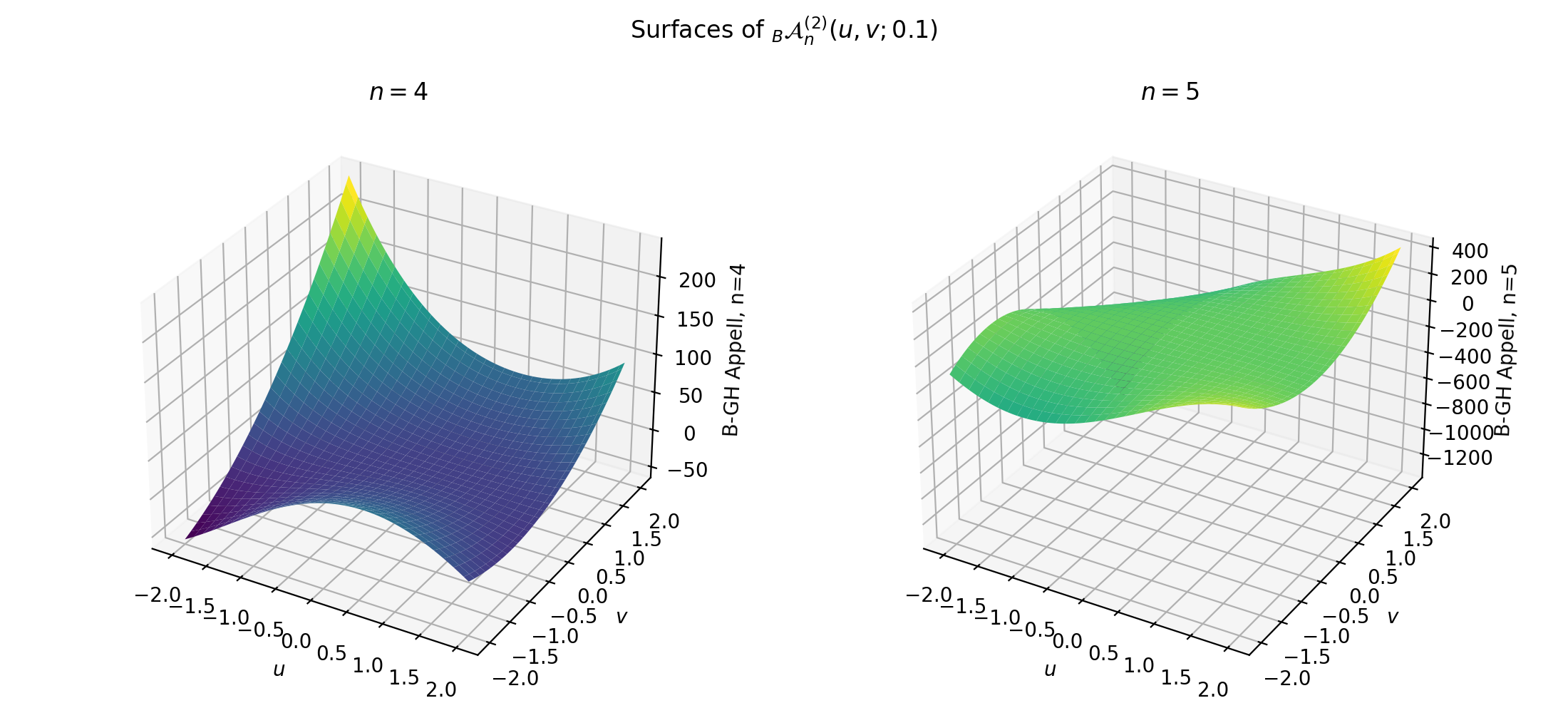
This article develops a factorization-based operator framework for two-variable discrete Gould--Hopper--Appell polynomials within Delta_(delta) -calculus. Following the Infeld--Hull factorization principle, the framework employs degree-dependent sequences of operators, rather than a single pair of ordinary quasi-monomial operators. From the generating function, we derive the recurrence relation, lowering and raising operators, and normalized integro-type operators. Their successive degree-matched compositions yield explicit difference, integro-difference, and partial-difference equations. Exact triangular Volterra integral representations are also established through the associated differential representation. The general results are specialized to Gould--Hopper--Bernoulli, Gould--Hopper--Euler, and Gould--Hopper--Genocchi families, with the Genocchi case treated separately. Numerical investigations of complex zeros, polynomial surfaces, generating-function reconstruction, and quantitative convergence as delta to 0 complement the analytical results and illustrate the discrete-to-continuous behavior of the proposed polynomial families.
References
[1] M. Y. Almusawa, ``Exploring the characteristics of $Delta_h$ bivariate Appell polynomials: An in-depth investigation and extension through fractional operators'', Fractal and Fractional 8 (2024) 67. https://doi.org/10.3390/fractalfract8010067.
[2] S. A. Wani, S. Khan & S. Naikoo, ``Differential and integral equations for the Laguerre--Gould--Hopper-based Appell and related polynomials'', Boletín de la Sociedad Matemática Mexicana 26 (2020) 617. https://doi.org/10.1007/s40590-019-00239-1.
[3] W. Ramírez, C. Cesarano, S. A. Wani, S. Yousuf & D. Bedoya, ``About properties and the monomiality principle of Bell-based Apostol--Bernoulli-type polynomials'', Carpathian Mathematical Publications 16 (2024) 379. https://doi.org/10.15330/cmp.16.2.379-390.
[4] S. A. Wani, S. Khan & T. Nahid, ``Gould--Hopper based Frobenius--Genocchi polynomials and their generalized form'', Afrika Matematika 31 (2020) 1397. https://doi.org/10.1007/s13370-020-00804-2.
[5] B. S. T. Alkahtani, I. Alazman & S. A. Wani, ``Some families of differential equations associated with multivariate Hermite polynomials'', Fractal and Fractional 7 (2023) 390. https://doi.org/10.3390/fractalfract7050390.
[6] M. A. "{O}zarslan & B. Yilmaz Yac{s}ar, ``A set of finite order differential equations for the Appell polynomials'', Journal of Computational and Applied Mathematics 259 (2014) 108. https://doi.org/10.1016/j.cam.2013.08.006.
[7] H. M. Srivastava, M. A. "{O}zarslan & B. Yilmaz, ``Some families of differential equations associated with the Hermite-based Appell polynomials and other classes of Hermite-based polynomials'', Filomat 28 (2014) 695. https://doi.org/10.2298/FIL1404695S.
[8] M. A. "{O}zarslan, ``Unified Apostol--Bernoulli, Euler and Genocchi polynomials'', Computers & Mathematics with Applications 62 (2011) 2452. https://doi.org/10.1016/j.camwa.2011.07.031.
[9] S. Khan & M. Riyasat, ``Differential and integral equations for the 2-iterated Appell polynomials'', Journal of Computational and Applied Mathematics 306 (2016) 116. https://doi.org/10.1016/j.cam.2016.03.039.
[10] L. Infeld & T. E. Hull, ``The factorization method'', Reviews of Modern Physics 23 (1951) 21. https://doi.org/10.1103/RevModPhys.23.21.
[11] M. X. He & P. E. Ricci, ``Differential equation of Appell polynomials via the factorization method'', Journal of Computational and Applied Mathematics 139 (2002) 231. https://doi.org/10.1016/S0377-0427(01)00423-X.
[12] J. F. Steffensen, ``The poweroid, an extension of the mathematical notion of power'', Acta Mathematica 73 (1941) 333. https://doi.org/10.1007/BF02392231.
[13] G. Dattoli, C. Cesarano & D. Sacchetti, ``A note on the monomiality principle and generalized polynomials'', Rendiconti di Matematica e delle sue Applicazioni 21 (2001) 311. https://hdl.handle.net/11573/79359.
[14] P. Appell, ``Sur une classe de polynômes'', Annales Scientifiques de l'École Normale Supérieure 9 (1880) 119. https://doi.org/10.24033/asens.186.
[15] H. M. Srivastava & J. Choi, Zeta and $q$-zeta functions and associated series and integrals, Elsevier, Amsterdam, Netherlands, 2012. https://doi.org/10.1016/C2010-0-67023-4.
[16] A. Erdelyi, W. Magnus, F. Oberhettinger & F. G. Tricomi, Higher transcendental functions, Vol. III, McGraw-Hill, New York, USA, 1955. https://www.scribd.com/document/449835237/H-Bateman-A-Erdelyi-Et-Al-Higher-Transcendental-Functions-3-1955-McGraw-Hill.
[17] J. Sándor & B. Crstici, Handbook of number theory II, Kluwer Academic Publishers, Dordrecht, Netherlands, 2004. https://doi.org/10.1007/1-4020-2547-5.
[18] L. Aceto, R. Malonek & G. Tomaz, ``A unified matrix approach to the representation of Appell polynomials'', Integral Transforms and Special Functions 26 (2015) 426. https://doi.org/10.1080/10652469.2015.1013035.
[19] G. Ajileye & A. A. James, ``Collocation method for the numerical solution of multi-order fractional differential equations'', Journal of the Nigerian Society of Physical Sciences 5 (2023) 1075. https://doi.org/10.46481/jnsps.2023.1075.
[20] J. Sunday, J. N. Ndam & L. J. Kwari, ``An accuracy-preserving block hybrid algorithm for the integration of second-order physical systems with oscillatory solutions'', Journal of the Nigerian Society of Physical Sciences 5 (2023) 1017. https://doi.org/10.46481/jnsps.2023.1017.
[21] J. Ndam & O. Adedire, ``Comparison of the solution of the Van der Pol equation using the modified Adomian decomposition method and truncated Taylor series method'', Journal of the Nigerian Society of Physical Sciences 2 (2020) 106. https://doi.org/10.46481/jnsps.2020.44.
Published
How to Cite
Issue
Section
Copyright (c) 2026 Shivtej Annaso Patil, Waseem Ahmad Khan, Wael Mahmoud Mohammad Salameh, Prakash Jadhav, Shahid Ahmad Wani (Author)

This work is licensed under a Creative Commons Attribution 4.0 International License.