Geohydraulic characteristics and groundwater vulnerability assessment of tropically weathered and fractured gneissic aquifers using combined georesistivity and geostatistical methods
Keywords:
ERT, Schlumberger VES, geoelectrohydraulic method, regression analysis, groundwater vulnerability, gneissic aquiferAbstract
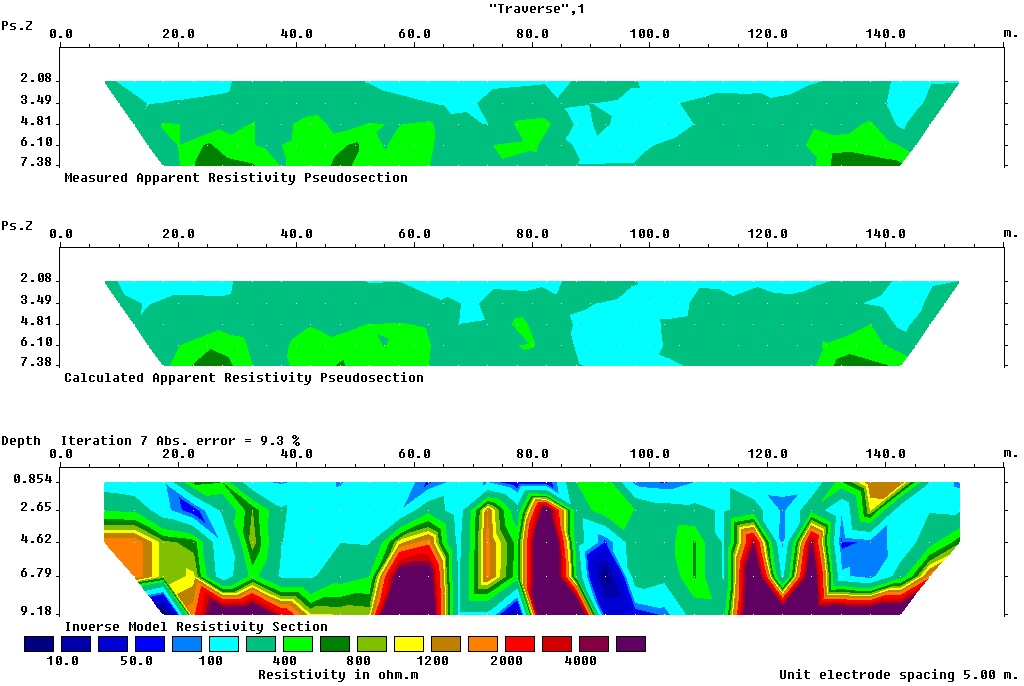
Sustainable groundwater yield in aquifers depends on the protective capacity of the subsurface lithologies and conduit systems. Electrical resistivity tomography (ERT) and its Schlumberger vertical electrical sounding (VES) technique were employed to assess the groundwater yield of aquifer units and their vulnerability to contaminants in Araromi (Akungba-Akoko), southwestern Nigeria. Geohydraulic parameters: aquifer resistivity (\rho0), hydraulic conductivity (K), transmissivity (T), permeability (\Psi), hydraulic resistance (KR), and longitudinal conductance (S) were also evaluated. In addition, regression analysis was utilized to establish the empirical relationships between the K and other geohydraulic parameters, with their percentage contributions to posing vulnerability risk. The georesistivity results revealed four distinct layers: topsoil, weathered layer, partially weathered/fractured bedrock unit, and fresh bedrock. The K model regression-assisted analysis showed that the \rho, T, \Psi, and S contributed about 97.8%, 14%, 99.9%, and 11.5%, respectively, to the estimated aquifers’ K values for the study area. Except for T and S, the regression results had moderate to strong positive correlations with K; hence, this illuminates the essentiality of K in assessing groundwater potential and vulnerability. The aquifer units have low to moderate groundwater yield based on T values (1.67-17.57 m/day) caused by the generally thin overburden (<4 m). However, the deep-weathered and fractured aquifer units with depths ranging from 39-55 m could supply high groundwater yield for sustainable abstraction. The estimated S values (0.0226-0.1926 mhos) for aquifer protective capacity ratings rated the aquifer units in the area as poor to weak. Based on the estimated low logarithm of KR (log KR) values of 0.79-2.25 years, these aquifers have extremely high to moderate aquifer vulnerability index. As a result, prospective wells/boreholes in the study area and settings with similar geohydraulic and vulnerability characteristics should be developed adequately to prevent the infiltration of surface contaminants for potable groundwater abstraction.
Published
How to Cite
Issue
Section
Copyright (c) 2022 A. S. Akingboye

This work is licensed under a Creative Commons Attribution 4.0 International License.
How to Cite
Similar Articles
- Baba Alfa, Yakubu Adamu, Daniel Alberto Pena Perez, Optimal Power Point on the I-V Curve of a Photovoltaic Solar System (Modelling and Analysis) , Journal of the Nigerian Society of Physical Sciences: Volume 2, Issue 2, May 2020
- Nahid Salma, Majid Khan Majahar Ali, Raja Aqib Shamim, Machine learning-based feature selection for ultra-high-dimensional survival data: a computational approach , Journal of the Nigerian Society of Physical Sciences: Volume 7, Issue 3, August 2025
- T. M. J. Abdulkadhim, S. A. A. Alsaati, M. H. Shinen, Theoretical Investigation of Diameter Effects and Edge Configuration on the Optical Properties of Graphdiyne Nanotubes in the Presence of Electric Field , Journal of the Nigerian Society of Physical Sciences: Volume 5, Issue 2, May 2023
- O. E. Ojo, M. K. Kareem, O. Samuel, C. O. Ugwunna, An Internet-of-Things based Real-time Monitoring System for Smart Classroom , Journal of the Nigerian Society of Physical Sciences: Volume 4, Issue 2, May 2022
- Christian N. Nwaeme, Adewale F. Lukman, Robust hybrid algorithms for regularization and variable selection in QSAR studies , Journal of the Nigerian Society of Physical Sciences: Volume 5, Issue 4, November 2023
- Yazid Amri, Mohammed Abdelkader Belalem, Nedjimi Mohammed Said, Guerguer Louiza, Salah Tlili, Corrosion inhibition of carbon steel XC70 in 1M HCl solution using Balanite Aegyptiaca extracts as an eco-friendly inhibitor , Journal of the Nigerian Society of Physical Sciences: Volume 7, Issue 4, November 2025
- Yakubu Aliyu, Umar Usman, On Bivariate Nadarajah-Haghighi Distribution derived from Farlie-Gumbel-Morgenstern copula in the Presence of Covariates , Journal of the Nigerian Society of Physical Sciences: Volume 5, Issue 2, May 2023
- Opeyemi O. Enoch, Catherine O. Alakofa , Lukman O. Salaudeen , Odd Order Integrator with Two Complex Functions Control Parameters for Solving Systems of Initial Value Problems , Journal of the Nigerian Society of Physical Sciences: Volume 5, Issue 1, February 2023
- Joel Ndam, O. Adedire, Comparison of the Solution of the Van der Pol Equation Using the Modified Adomian Decomposition Method and Truncated Taylor Series Method , Journal of the Nigerian Society of Physical Sciences: Volume 2, Issue 2, May 2020
- Kazeem A. Tijani, Chinwendu E. Madubueze, Reuben I. Gweryina, Typhoid fever dynamical model with cost-effective optimalcontrol , Journal of the Nigerian Society of Physical Sciences: Volume 5, Issue 4, November 2023
You may also start an advanced similarity search for this article.