Geohydraulic characteristics and groundwater vulnerability assessment of tropically weathered and fractured gneissic aquifers using combined georesistivity and geostatistical methods
Keywords:
ERT, Schlumberger VES, geoelectrohydraulic method, regression analysis, groundwater vulnerability, gneissic aquiferAbstract
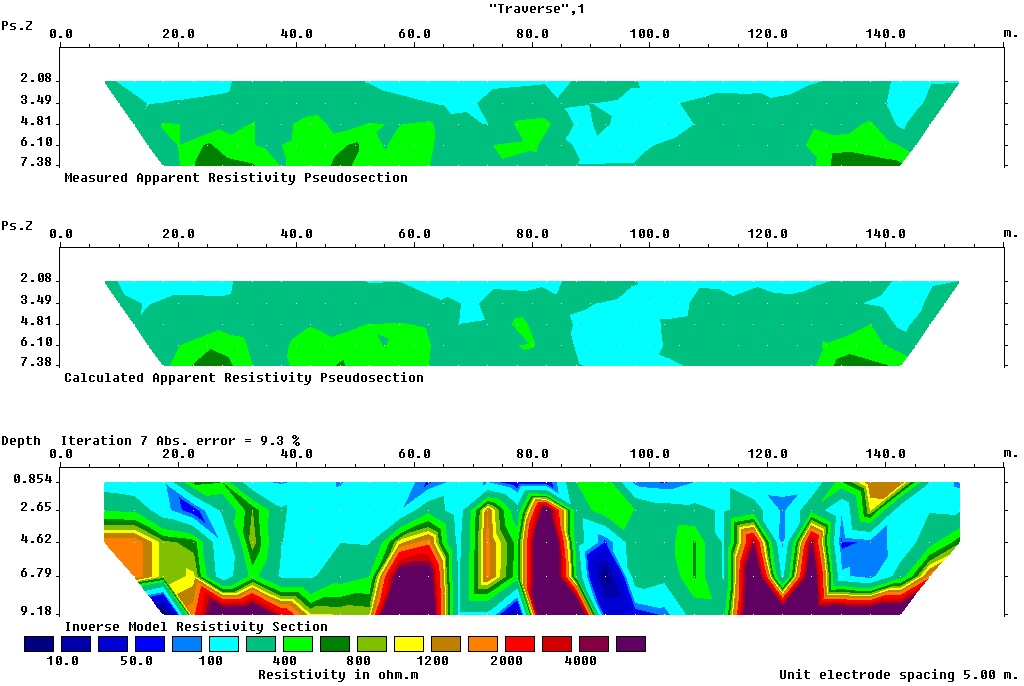
Sustainable groundwater yield in aquifers depends on the protective capacity of the subsurface lithologies and conduit systems. Electrical resistivity tomography (ERT) and its Schlumberger vertical electrical sounding (VES) technique were employed to assess the groundwater yield of aquifer units and their vulnerability to contaminants in Araromi (Akungba-Akoko), southwestern Nigeria. Geohydraulic parameters: aquifer resistivity (\rho0), hydraulic conductivity (K), transmissivity (T), permeability (\Psi), hydraulic resistance (KR), and longitudinal conductance (S) were also evaluated. In addition, regression analysis was utilized to establish the empirical relationships between the K and other geohydraulic parameters, with their percentage contributions to posing vulnerability risk. The georesistivity results revealed four distinct layers: topsoil, weathered layer, partially weathered/fractured bedrock unit, and fresh bedrock. The K model regression-assisted analysis showed that the \rho, T, \Psi, and S contributed about 97.8%, 14%, 99.9%, and 11.5%, respectively, to the estimated aquifers’ K values for the study area. Except for T and S, the regression results had moderate to strong positive correlations with K; hence, this illuminates the essentiality of K in assessing groundwater potential and vulnerability. The aquifer units have low to moderate groundwater yield based on T values (1.67-17.57 m/day) caused by the generally thin overburden (<4 m). However, the deep-weathered and fractured aquifer units with depths ranging from 39-55 m could supply high groundwater yield for sustainable abstraction. The estimated S values (0.0226-0.1926 mhos) for aquifer protective capacity ratings rated the aquifer units in the area as poor to weak. Based on the estimated low logarithm of KR (log KR) values of 0.79-2.25 years, these aquifers have extremely high to moderate aquifer vulnerability index. As a result, prospective wells/boreholes in the study area and settings with similar geohydraulic and vulnerability characteristics should be developed adequately to prevent the infiltration of surface contaminants for potable groundwater abstraction.
Published
How to Cite
Issue
Section
Copyright (c) 2022 A. S. Akingboye

This work is licensed under a Creative Commons Attribution 4.0 International License.
How to Cite
Similar Articles
- Waheed B. Yahya, Yusuf Bello, Abdulrazaq AbdulRaheem, Model Fitness and Predictive Accuracy in Linear Mixed-Effects Models with Latent Clusters , Journal of the Nigerian Society of Physical Sciences: Volume 5, Issue 3, August 2023
- Thomas U. Onoja, Benson A. E. Afere, Ayodele Gabriel Fasanya, Sunday Yomi, Bolarinwa Bolaji, Transmission dynamics of dengue–Zika co-infection with antibody-dependent enhancement, cross-immunity, and vaccination: backward bifurcation analysis and data calibration , Journal of the Nigerian Society of Physical Sciences: Volume 8, Issue 3, August 2026
- Ahmed Fadhil Noaman, Zaid Adil Abdalkareem, Bareq Baqi Salman, Application of the SEE transform with the Adomian decomposition method to a nonlinear tumor growth model , Journal of the Nigerian Society of Physical Sciences: Volume 8, Issue 3, August 2026
- Lek Ming Lim, Yang Lu, Ahmad Sufril Azlan Mohamed, Majid Khan Majahar Ali, Data safety prediction using YOLOv7+G3HN for traffic roads , Journal of the Nigerian Society of Physical Sciences: Volume 6, Issue 3, August 2024
- Omowumi F. Lawal, Tunde T. Yusuf, Afeez Abidemi, On mathematical modelling of optimal control of typhoid fever with efficiency analysis , Journal of the Nigerian Society of Physical Sciences: Volume 6, Issue 4, November 2024
- K. Lekhana, K. T. Shivaram, Applications of quadrilateral finite element meshes with four-node, eight-node, and twelve-node for efficient microwave energy transfer in curved waveguides , Journal of the Nigerian Society of Physical Sciences: Volume 8, Issue 3, August 2026
- Misbaudeen Abdul-Hammed, Ibrahim Olaide Adedotun, Tolulope Irapada Afolabi Afolabi, Ubeydat Temitope Ismail, Praise Toluwalase Akande, Balqees Funmilayo Issa, Analysis of the Bioactive Compounds from Carica papaya in the Management of Psoriasis using Computational Techniques , Journal of the Nigerian Society of Physical Sciences: Volume 5, Issue 1, February 2023
- A. Y. Jimoh, M. B. Saadu, A. A. Adetoro, J. Ajadi, T. Issa, U. Issa, Sedimentological and geochemical evaluation of sandstones of the Ilaro formation, Dahomey Basin, Southwestern Nigeria : Insights into paleoenvironments, provenance, and tectonic settings , Journal of the Nigerian Society of Physical Sciences: Volume 6, Issue 1, February 2024
- Adeniyi F. Fagbamigbe, Gomolemo K. Basele, Boikanyo Makubate, Broderick O. Oluyede, Application of the Exponentiated Log-Logistic Weibull Distribution to Censored Data , Journal of the Nigerian Society of Physical Sciences: Volume 1, Issue 1, February 2019
- Gurpreet Tuteja, Tapshi Singh, Comments on “The Solution of a Mathematical Model for Dengue Fever Transmission Using Differential Transformation Method: J. Nig. Soc. Phys. Sci. 1 (2019) 82-87” , Journal of the Nigerian Society of Physical Sciences: Volume 3, Issue 2, May 2021
You may also start an advanced similarity search for this article.