Geohydraulic characteristics and groundwater vulnerability assessment of tropically weathered and fractured gneissic aquifers using combined georesistivity and geostatistical methods
Keywords:
ERT, Schlumberger VES, geoelectrohydraulic method, regression analysis, groundwater vulnerability, gneissic aquiferAbstract
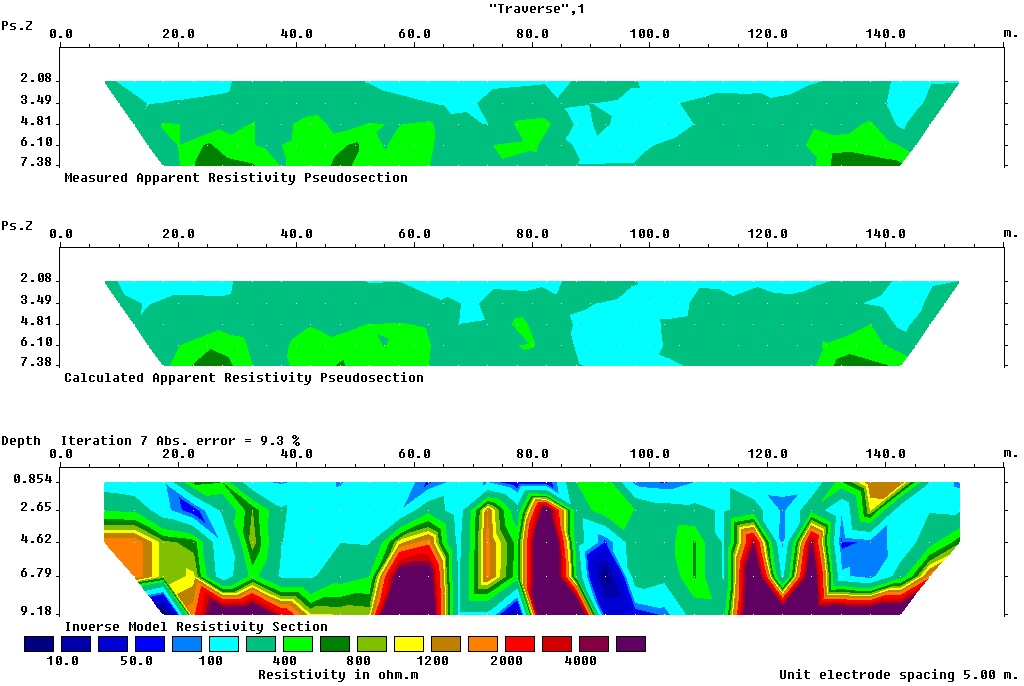
Sustainable groundwater yield in aquifers depends on the protective capacity of the subsurface lithologies and conduit systems. Electrical resistivity tomography (ERT) and its Schlumberger vertical electrical sounding (VES) technique were employed to assess the groundwater yield of aquifer units and their vulnerability to contaminants in Araromi (Akungba-Akoko), southwestern Nigeria. Geohydraulic parameters: aquifer resistivity (\rho0), hydraulic conductivity (K), transmissivity (T), permeability (\Psi), hydraulic resistance (KR), and longitudinal conductance (S) were also evaluated. In addition, regression analysis was utilized to establish the empirical relationships between the K and other geohydraulic parameters, with their percentage contributions to posing vulnerability risk. The georesistivity results revealed four distinct layers: topsoil, weathered layer, partially weathered/fractured bedrock unit, and fresh bedrock. The K model regression-assisted analysis showed that the \rho, T, \Psi, and S contributed about 97.8%, 14%, 99.9%, and 11.5%, respectively, to the estimated aquifers’ K values for the study area. Except for T and S, the regression results had moderate to strong positive correlations with K; hence, this illuminates the essentiality of K in assessing groundwater potential and vulnerability. The aquifer units have low to moderate groundwater yield based on T values (1.67-17.57 m/day) caused by the generally thin overburden (<4 m). However, the deep-weathered and fractured aquifer units with depths ranging from 39-55 m could supply high groundwater yield for sustainable abstraction. The estimated S values (0.0226-0.1926 mhos) for aquifer protective capacity ratings rated the aquifer units in the area as poor to weak. Based on the estimated low logarithm of KR (log KR) values of 0.79-2.25 years, these aquifers have extremely high to moderate aquifer vulnerability index. As a result, prospective wells/boreholes in the study area and settings with similar geohydraulic and vulnerability characteristics should be developed adequately to prevent the infiltration of surface contaminants for potable groundwater abstraction.
Published
How to Cite
Issue
Section
Copyright (c) 2022 A. S. Akingboye

This work is licensed under a Creative Commons Attribution 4.0 International License.
How to Cite
Similar Articles
- Obiora Cornelius Collins, Mathematical model analysis for maize yield under co-infection of maize streak virus and maize stripe virus diseases with control measures , Journal of the Nigerian Society of Physical Sciences: Volume 8, Issue 2, May 2026
- RETRACTION NOTICE: Preparation and Characterization of High Performance Dye Sensitized Solar Cells with Silver Nanoparticles in nanocomposite Photoanode , Journal of the Nigerian Society of Physical Sciences: Volume 8, Issue 2, May 2026
- C. E. Duru, C. E. Enyoh, I. A. Duru, M. C. Enedoh, Degradation of PET Nanoplastic Oligomers at the Novel PHL7 Target:Insights from Molecular Docking and Machine Learning , Journal of the Nigerian Society of Physical Sciences: Volume 5, Issue 1, February 2023
- Emmanuel Gbenga Dada, Aishatu Ibrahim Birma, Abdulkarim Abbas Gora, Ensemble machine learning algorithm for cost-effective and timely detection of diabetes in Maiduguri, Borno State , Journal of the Nigerian Society of Physical Sciences: Volume 6, Issue 4, November 2024
- Adamu Shitu Hassan, Nafiu Hussaini, Analysis of an HIV - HCV simultaneous infection model with time delay , Journal of the Nigerian Society of Physical Sciences: Volume 3, Issue 1, February 2021
- Vanita R. Raikar, Lakshminarayanachari K, K. Bharathi, C. Bhaskar , Mathematical advection-diffusion model of primary and secondary pollutants emitted from the point source with mesoscale wind and removal mechanisms , Journal of the Nigerian Society of Physical Sciences: Volume 7, Issue 2, May 2025
- Mahesh Kumar Singh, Pushpa Choudhary, Arun Kumar Singh, Pushpendra Singh, LWRNPIP: Design of a light weight restrictive non-fungible token based on practically unclonable functions via image signature patterns , Journal of the Nigerian Society of Physical Sciences: Volume 7, Issue 4, November 2025
- O. Oderinde, C. L. Mgbechidinma, A. O. Agbeja, A. A. Ajayi, A. O. Ogundiran, O. O. Olaide, O. A. Orelaja, C. A. Mgbechidimma, C. O. Ajanaku, K. D. Oyeyemi, Appraising raw exhaust pollutant gases emissions from industrial generators using statistics and machine learning approaches , Journal of the Nigerian Society of Physical Sciences: Volume 7, Issue 4, November 2025
- Ayomide Hassan Labulo, Elijah Temitope Adesuji, Charles Ojiefoh Oseghale, Elias Emeka Elemike, Adamu Usman, Akinola Kehinde Akinola, Enock Olugbenga Dare, Corrigendum to "Effect of benzophenone on the physicochemical properties of N-CNTs synthesized from 1-ferrocenylmethyl (2-methylimidazole) catalyst" [J. Nig. Soc. Phys. Sci. 2 (2020) 205-217] , Journal of the Nigerian Society of Physical Sciences: Volume 3, Issue 2, May 2021
- Terver Daniel, F. Eriba-Idoko, J. O. Tsor, S. T. Kungur, E. O. Enokela, F. Gbaorun, E. C. Hemba, A. A. McAsule, N. S. Akiiga, P. O. Ushie, Effects of Repeated Frying on Physical Properties of Cooking Oil obtained from Local Markets in Makurdi Metropolis, Benue State, Nigeria. , Journal of the Nigerian Society of Physical Sciences: Volume 3, Issue 4, November 2021
You may also start an advanced similarity search for this article.