Forecasting of the epidemiological situation: Case of COVID-19 in Morocco
Keywords:
ARIMA, COVID-19, Pandemic, FBProphet, Time series forecastingAbstract
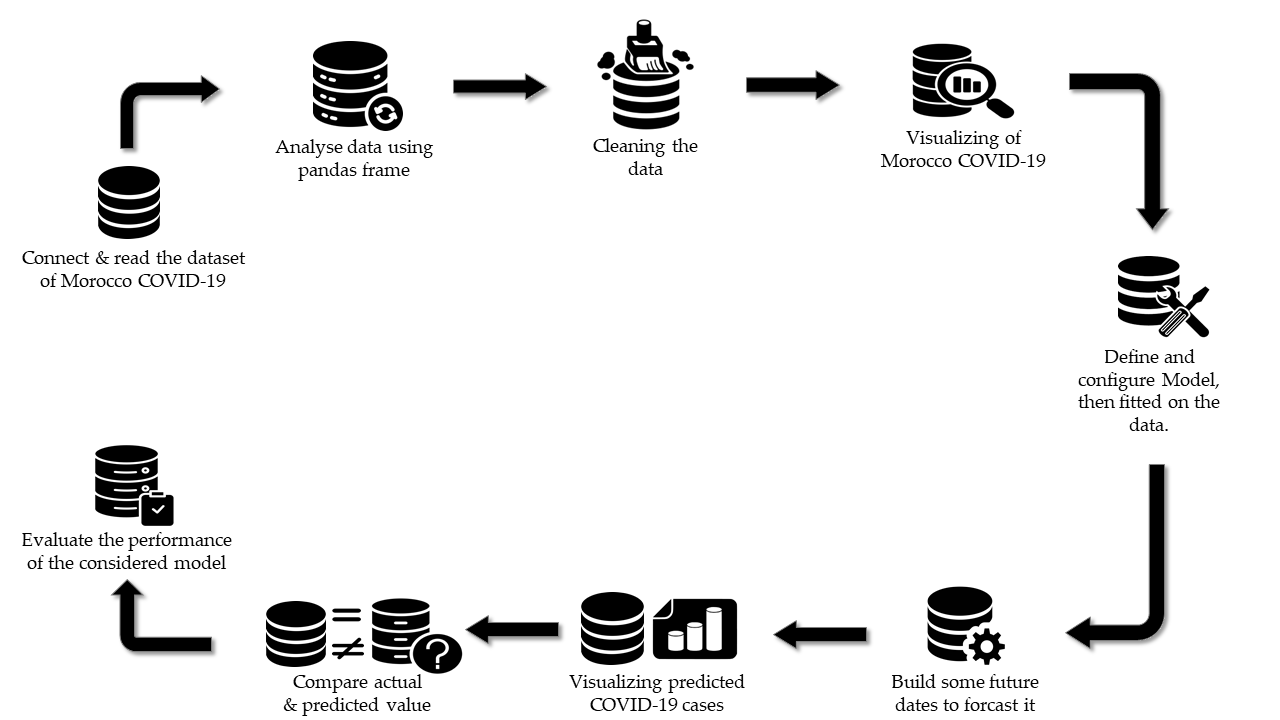
Since the coronavirus pandemic started, many people have died due to the disease. The epidemic has been challenging to predict, as it progresses and spreads throughout the world. We used Auto-Regressive Integrated Moving Average (ARIMA) models to predict the outbreak of COVID-19 in the upcoming months in Morocco. In this work, we measured the effective reproduction number using the real data and the forecasted data produced by the two commonly used approaches, to reveal how effective the measures taken by the Moroccan government have been in controlling the COVID-19 outbreak. The prediction results for the next few months show a strong evolution in the number of confirmed and death cases in Morocco. We study the spread of COVID-19 in Morocco to see how many cases are discovered, recovered, and dead, and the forecasting of further cases is used as a basic novel method. It is based on time series models. We used coronavirus outbreak data from March 02, 2020, to August 04, 2021. ARIMA (Autoregressive integrated moving average) and Prophet time-series models are used to forecast the development of COVID-19, which is not a novel method. The mean absolute error, root mean square error, and coefficient of determination R2 were computed to assess the model's performance. Our study aims to provide a better understanding of the infectious disease outbreak that affected Morocco. It also provides information on the disease outbreak's epidemiology. Our study shows that the FBProphet model is more accurate in predicting the prevalence of COVID-19. It can help guide the government's efforts to prevent the virus' spread.
Published
How to Cite
Issue
Section
Copyright (c) 2022 El Mehdi Chouit, Mohamed RACHDI, Mostapha BELLAFKIH, Brahim RAOUYANE

This work is licensed under a Creative Commons Attribution 4.0 International License.
How to Cite
Similar Articles
- Jabar Hassan, Haider Majeed, Ghassan Ezzulddin Arif, System of Non-Linear Volterra Integral Equations in a Direct-Sum of Hilbert Spaces , Journal of the Nigerian Society of Physical Sciences: Volume 4, Issue 4, November 2022
- F. U. Salifu, O. A. Oladipo, E. O. Ebock, B. Nava, Deep neural network model for vertical total electron content prediction at a single low latitude station , Journal of the Nigerian Society of Physical Sciences: Volume 7, Issue 4, November 2025
- B. I. Akinnukawe, K. O. Muka, L-Stable Block Hybrid Numerical Algorithm for First-Order Ordinary Differential Equations , Journal of the Nigerian Society of Physical Sciences: Volume 2, Issue 3, August 2020
- Samsudeen Olanrewaju Azeez, Akeem Adebayo Jimoh, Ismaila Olalekan Saheed, Kabir Opeyemi Otun, Aliru Olajide Mustapha, Folahan Amoo Adekola, Optimization by Box Behnken Design for Eosin Yellow Dye Removal from Aqueous Medium using Date Palm Seeds-Porous Carbon@TiO2 Blend , Journal of the Nigerian Society of Physical Sciences: Volume 4, Issue 2, May 2022
- Monika Saini, Ashish Kumar, Vijay Singh Maan, Deepak Sinwar, Efficient and Intelligent Decision Support System for Smart Irrigation , Journal of the Nigerian Society of Physical Sciences: Volume 4, Issue 4, November 2022
- A. E. Ibor, D. O. Egete, A. O. Otiko, D. U. Ashishie, Detecting network intrusions in cyber-physical systems using deep autoencoder-based dimensionality reduction approach anddeep neural networks , Journal of the Nigerian Society of Physical Sciences: Volume 7, Issue 3, August 2025
- Oboti Nwamaka Peace, Osita Miracle Nwakeze, Sunday Stephen Okika, Okafor Chinedu Martin, Agubosim Chuka Charles, Privacy-preserving federated learning with MobileViT for chest X-ray classification in Nigerian hospitals , Journal of the Nigerian Society of Physical Sciences: Volume 8, Issue 4, November 2026 (in progress)
- Daud Olaoluwa, Abdulhadi E. Abdulmalik, Taoreed A. Muraina, Sadisu Girigisu, Ayo F. Balogun, Dissolution of a Nigerian sourced Muscovite ore for use as an ingredient in paint production , Journal of the Nigerian Society of Physical Sciences: Volume 2, Issue 3, August 2020
- K. Nandhini, V. Vidhya, An Alleviation of Cloud Congestion Analysis of Fluid Retrial User on Matrix Analytic Method in IoT-based Application , Journal of the Nigerian Society of Physical Sciences: Volume 5, Issue 2, May 2023
- Muhammad Dahiru Liman, Salamatu Ibrahim Osanga, Esther Samuel Alu, Sa'adu Zakariya, Regularization Effects in Deep Learning Architecture , Journal of the Nigerian Society of Physical Sciences: Volume 6, Issue 2, May 2024
You may also start an advanced similarity search for this article.