Modeling of Self Potential (SP) Anomalies over a Polarized Rod with Finite Depth Extents
Keywords:
Modeling, self potential, polarized rod, geologic dip, depth of burialAbstract
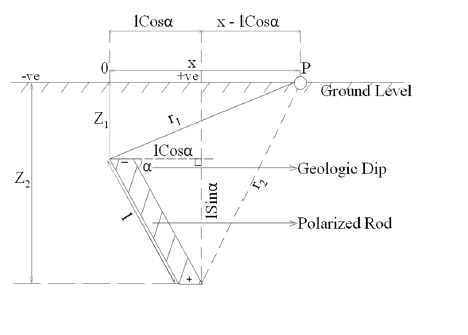
Modeling is a powerful tool used by Geoscientists to provide pre-knowledge about the expectations of any geophysical field measurements. This study generates Self Potential (SP) anomalies over a typical dike-like structure to observe the influence of depth of burial and dip on SP anomalies. A computer program was developed from the potential distribution equation of an inclined polarized rod with a limited depth extent using Visual Basic (VB) programming language to produce synthetic data for potential distribution. The potential distribution data were used to generate theoretical SP anomaly curves for a polarized rod for varying depth of burial and dip. Twenty SP anomaly curves were generated with different dip values and depth of burial and from these curves, superimposed curves were also generated. The anomalies were analyzed for the effect of depth of burial and attitude or dip. The SP anomaly curves generated show that an increase in depth of burial causes a reduction in the peak negative amplitude of SP anomaly curves. For inclined polarized rod at relatively shallow depth (<2.0 m), the peak negative amplitude remains virtually the same with a positive shoulder over the down dip side of the target. Also as the dip angle decreases from 90o for a fixed depth of burial, the anomaly curves become asymmetrical. At 0o, the distance between the peak negative and peak positive amplitude of the anomaly curve is equal to the linear extent of the rod. Therefore, this study shows that the depth of burial inversely influences the amplitude of self-potential (SP) anomalies while the dip angle affects the form or symmetry of anomaly curves.
Published
How to Cite
Issue
Section
Copyright (c) 2019 Journal of the Nigerian Society of Physical Sciences

This work is licensed under a Creative Commons Attribution 4.0 International License.
How to Cite
Similar Articles
- Emmanuel Agboeze, Henry Okechukwu Agboeze, Theresa Orieji Uchechukwu, Anayo Vitus Ofordile, Chukwuebuka Gabriel Eze, Environmental and health risk assessment of cadmium, zinc,iron, copper in crops and soil at Enugu State dumpsite , Journal of the Nigerian Society of Physical Sciences: Volume 8, Issue 1, February 2026
- Ibukun Akinsola, Alabi Aderemi Babatunde, Adedayo Kayode Seun, Nicola Coppede, Characterizations of Galena as Potential Photosensitizer in a Natural Dye-Sensitized Solar Cell , Journal of the Nigerian Society of Physical Sciences: Volume 3, Issue 2, May 2021
- Tertsea Igbawua, Aondongu Alexander Tyovenda, Terver Sombo, Idugba Mathias Echi, Spatio-temporal assessment of aerosol-induced atmospheric heating rates in Nigeria , Journal of the Nigerian Society of Physical Sciences: Volume 7, Issue 2, May 2025
- Elsammani Ali Shokralla, Improving the thermal stability and dielectric properties of epoxy/phenolic resin type (novolac) composites by incorporating carbon nanofibers (CNFs) , Journal of the Nigerian Society of Physical Sciences: Volume 7, Issue 1, February 2025
- E. Omugbe, E. P. Inyang, A. Jahanshir, C. A. Onate, C. N. Isonguyo, E. S. Eyube, U. S. Okorie, R. Horchani, A. N. Ikot, Expectation values and Fisher information theoretic measures of heavy flavoured mesons , Journal of the Nigerian Society of Physical Sciences: Volume 7, Issue 1, February 2025
- P. R. Jubu, A. D. Otor, A. N. Abutu, A. O. Aransiola, C. Amakom, K. I. Udofia, I. K. Nwokolo, A. A. Goje, I. I. Ayogu, M. M. Gururani, E. E. Oguzie, Numerical simulation of Cs2TiBr6-based all-inorganic photovoltaic perovskite solar cell employing SCAPS-1D software , Journal of the Nigerian Society of Physical Sciences: Volume 8, Issue 3, August 2026
- Peter Chibuike Okoye, Samuel Ogochukwu Azi, Taoreed O. Owolabi, Perovskite tetragonality modeling for functional properties enhancement using Newtonian search based support vector regression computational method , Journal of the Nigerian Society of Physical Sciences: Volume 4, Issue 1, February 2022
- Boikanyo Makubate, Marang Pearl Matsuokwane, Lesego Gabaitiri, Broderick O. Oluyede, Simbarashe Chamunorwa, The Type II Topp-Leone-G Power Series Distribution with Applications on Bladder Cancer , Journal of the Nigerian Society of Physical Sciences: Volume 4, Issue 3, August 2022
- Gabriel James, Ime Umoren, Anietie Ekong, Saviour Inyang, Oscar Aloysius, Analysis of support vector machine and random forest models for classification of the impact of technostress in covid and post-covid era , Journal of the Nigerian Society of Physical Sciences: Volume 6, Issue 3, August 2024
- Ebere Uzoka Chidi, Edward Anoliefo, Collins Udanor, Asogwa Tochukwu Chijindu, Lois Onyejere Nwobodo, A blind navigation guide model for obstacle avoidance using distance vision estimation based YOLO-V8n , Journal of the Nigerian Society of Physical Sciences: Volume 7, Issue 1, February 2025
You may also start an advanced similarity search for this article.