Model Fitness and Predictive Accuracy in Linear Mixed-Effects Models with Latent Clusters
Keywords:
Clustered data, Primal and dual clusters, Linear mixed-effects models, Model fitness, Predictive accuracyAbstract
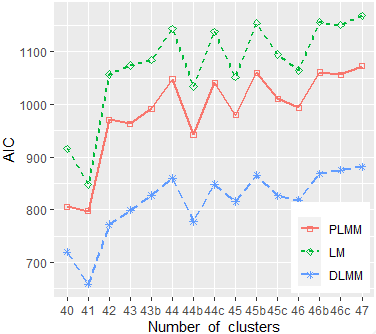
In clustered data, observations within a cluster show similarity between themselves because they share common features different from observations in the other clusters. In a given population, different clustering may surface because correlation may occur across more than one dimension. The existing multilevel analysis techniques of the primal linear mixed-effect models are limited to natural clusters which are often not realistic to capture in real-life situations. Therefore, this paper proposes dual linear mixed models (DLMMs) for modeling unobserved latent clusters when such are present in data sets to yield appreciable gains in model fitness and predictive accuracy. The methodology explored the development and analysis of the dual linear mixed models (DLMMs) based on the derived latent clusters from the natural clusters using multivariate cluster analysis. A published data set on political analysis was used to demonstrate the efficiency of the proposed models. The proposed DLMMs have yielded minimum values of the models' assessment criteria (Akaike information criterion, Bayesian information criterion, and root mean squared error), and hence, outperformed the classical PLMMs in terms of model fitness and predictive accuracy.
Published
How to Cite
Issue
Section
Copyright (c) 2023 Yusuf Bello, Waheed Yahya, B., Professor

This work is licensed under a Creative Commons Attribution 4.0 International License.
How to Cite
Similar Articles
- E. C. Duru, M. C. Anyanwu , T. N. Nnamani , C. N. Nwosu, G. C. E. Mbah, Semi-analytical solution and numerical simulations of a coinfection model of Malaria and Zika virus disease , Journal of the Nigerian Society of Physical Sciences: Volume 7, Issue 2, May 2025
- Peter Chibuike Okoye, Samuel Ogochukwu Azi, Taoreed O. Owolabi, Perovskite tetragonality modeling for functional properties enhancement using Newtonian search based support vector regression computational method , Journal of the Nigerian Society of Physical Sciences: Volume 4, Issue 1, February 2022
- Tolulope Latunde, Opeyemi Odunayo Esan, Joseph Oluwaseun Richard, Damilola Deborah Dare, Analysis of a Stochastic Optimal Control for Pension Funds and Application to Investments in Lower Middle-Income Countries , Journal of the Nigerian Society of Physical Sciences: Volume 2, Issue 1, February 2020
- Kazeem A. Tijani, Chinwendu. E. Madubueze, Isaac O. Onwubuya, Nkiruka Maria-Assumpta Akabuike, John Olajide Akanni, Mathematical modelling of the dynamical system of military population, focusing on the impact of welfare , Journal of the Nigerian Society of Physical Sciences: Volume 7, Issue 4, November 2025
- Peter Urane Achimugwu, Mathew Ngugi Kinyanjui, David Mumo Malonza, Analysis of a fractional order climate model due to excessive emission and accumulation of carbon dioxide in the atmosphere , Journal of the Nigerian Society of Physical Sciences: Volume 5, Issue 4, November 2023
- L. Adamu, N. Hussaini, An Epidemic Model of Zoonotic Visceral Leishmaniasis with Time Delay , Journal of the Nigerian Society of Physical Sciences: Volume 1, Issue 1, February 2019
- Rauf I. Rauf, Ayinde Kayode, Bello A. Hamidu, Bodunwa O. Kikelomo, Alabi O. Olusegun, Enhanced methods for multicollinearity mitigation in stochastic frontier analysis estimation , Journal of the Nigerian Society of Physical Sciences: Volume 6, Issue 4, November 2024
- Adeyemi Olukayode Binuyo, Eigenvalue Elasticity and Sensitivity Analyses of the Transmission Dynamic Model of Corruption , Journal of the Nigerian Society of Physical Sciences: Volume 1, Issue 1, February 2019
- T. O Lawal, O. Fawale, J. A. Sunday, G. B. Egbeyale, Interpretation of airborne radiometric data of flamingo field, Southwestern Nigeria , Journal of the Nigerian Society of Physical Sciences: Volume 7, Issue 1, February 2025
- B. Laxmi, K. Chand, P. Thakur, Hydrodynamic Casson hybrid nanofluid flow across a stretching sheet in the regime of velocity slip and temperature jump,including viscous dissipation, melting, Soret and Dufour effects , Journal of the Nigerian Society of Physical Sciences: Volume 7, Issue 4, November 2025
You may also start an advanced similarity search for this article.