Analysis of a fractional order climate model due to excessive emission and accumulation of carbon dioxide in the atmosphere
Keywords:
Climate change, Fractional order, Carbon dioxide, Excessive emissionAbstract
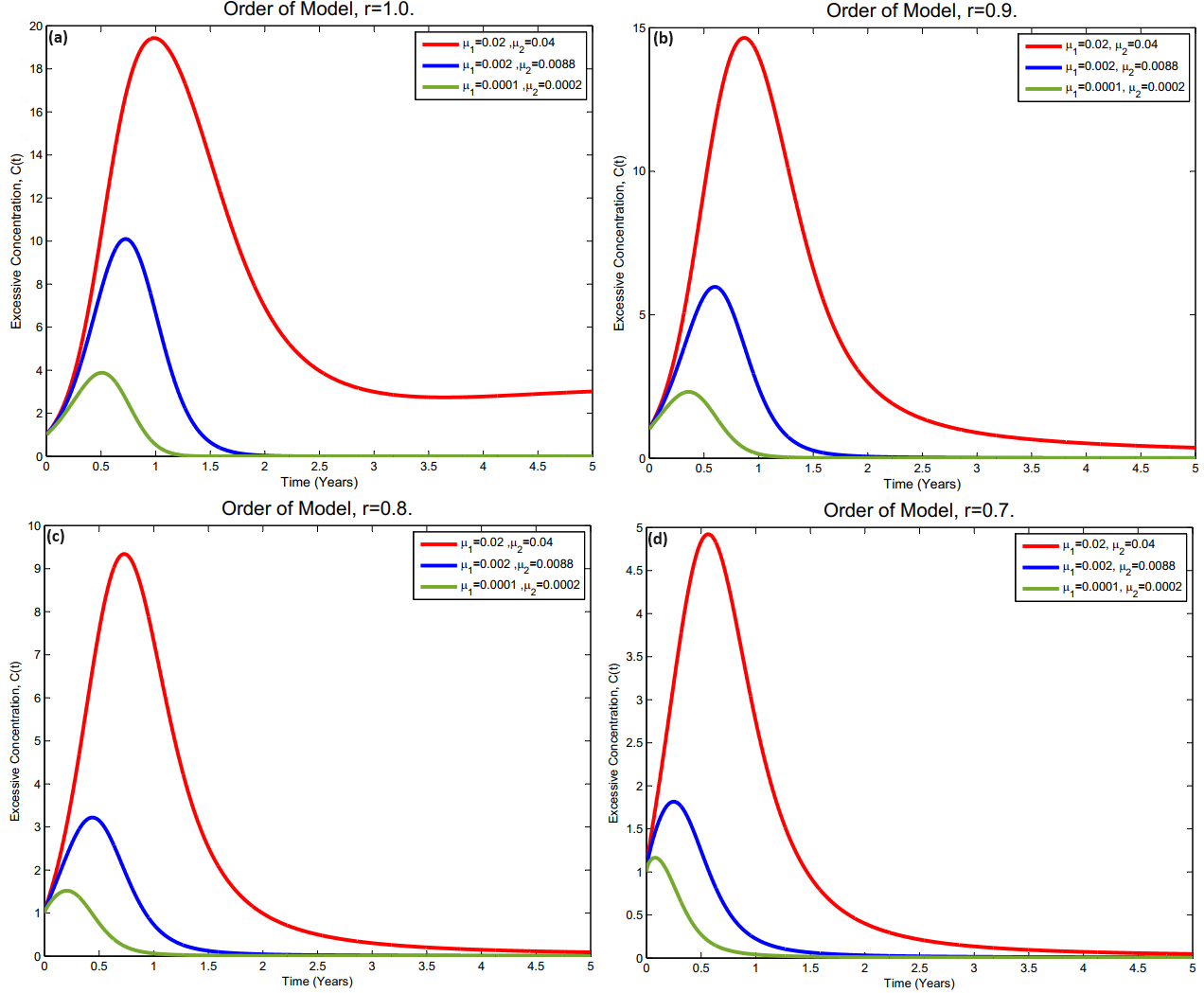
The devastating consequences of climate change on our planet cannot be taken lightly. Greenhouse gas emissions due to the various activities of the increasing human population are solely responsible for this change. The chief and most significant of these gases is carbon dioxide. A fractional-order model of five compartments is considered. The uniqueness and existence, the positivity, and the boundedness of the model solution are established. The equilibrium points of the model are given. By formulating different Lyapunov functions, the global stability of the four equilibrium points was determined. The numerical simulation of the model was done using the Predict-Evaluate-Correct-Evaluate method of Adam-Bashforth-Moulton by considering four different orders of 0.7, 0.8, 0.9, and 1.0. According to the results, excessive concentrations of carbon dioxide in the atmosphere can be reduced by the joint employment of mitigation measures.
Published
How to Cite
Issue
Section
Copyright (c) 2023 Peter Urane Achimugwu, Mathew Ngugi Kinyanjui, David Mumo Malonza

This work is licensed under a Creative Commons Attribution 4.0 International License.
How to Cite
Similar Articles
- S. Adamu, O. O. Aduroja, A. S. Onanaye, M. R. Odekunle, Iterative method for the numerical solution of optimal control model for mosquito and insecticide , Journal of the Nigerian Society of Physical Sciences: Volume 6, Issue 2, May 2024
- Vanita R. Raikar, Lakshminarayanachari K, K. Bharathi, C. Bhaskar , Mathematical advection-diffusion model of primary and secondary pollutants emitted from the point source with mesoscale wind and removal mechanisms , Journal of the Nigerian Society of Physical Sciences: Volume 7, Issue 2, May 2025
- Baba Alfa, Yakubu Adamu, Daniel Alberto Pena Perez, Optimal Power Point on the I-V Curve of a Photovoltaic Solar System (Modelling and Analysis) , Journal of the Nigerian Society of Physical Sciences: Volume 2, Issue 2, May 2020
- O. E. Osafile, O. N. Nenuwe, Lattice Dynamics and thermodynamic Responses of XNbSn Half-Heusler Semiconductors: A First-Principles Approach , Journal of the Nigerian Society of Physical Sciences: Volume 3, Issue 2, May 2021
- Odilon Joseph TOWANOU, Hagninou Elagnon Venance Donnou, Gabin Koto N’Gobi, Augustin Enonsi Leode, Basile Kounouh´ewa, Solar Energy Storage by Fuel Cell Technology at Abomey-Calavi (Benin) , Journal of the Nigerian Society of Physical Sciences: Volume 5, Issue 2, May 2023
- Amos Orenyi Bajeh, Mary Olayinka Olaoye, Fatima Enehezei Usman-Hamza, Ikeola Suhurat Olatinwo, Peter ogirima Sadiku, Abdulkadir Bolakale Sakariyah, An adaptive neuro-fuzzy inference system for multinomial malware classification , Journal of the Nigerian Society of Physical Sciences: Volume 7, Issue 1, February 2025
- Folake Lois Joseph, Adeyemi Sunday Olagunju, Emmanuel Oluseye Adeyefa, Adewale Adeyemi James, Hybrid Block Methods with Constructed Orthogonal Basis for Solution of Third-Order Ordinary Differential Equations , Journal of the Nigerian Society of Physical Sciences: Volume 5, Issue 1, February 2023
- Faustina Onyeyirichi Iniaghe, Paschal Okiroro Iniaghe, Godswill Okeoghene Tesi, Wisdom Ivwurie, Cattle rumen content, rice husk and cow horn biochars as amendments for enhanced remediation of petroleum-hydrocarbon-contaminated soil: physicochemical characterization and performance evaluation , Journal of the Nigerian Society of Physical Sciences: Volume 8, Issue 2, May 2026
- Adefunke Bosede Familua, Ezekiel Olaoluwa Omole, Luke Azeta Ukpebor, A Higher-order Block Method for Numerical Approximation of Third-order Boundary Value Problems in ODEs , Journal of the Nigerian Society of Physical Sciences: Volume 4, Issue 3, August 2022
- Charles Otobrise, Godwin Eferurhobo, Prediction of the acentric factor of some halogenated hydrocarbons via group contribution techniques , Journal of the Nigerian Society of Physical Sciences: Volume 6, Issue 4, November 2024
You may also start an advanced similarity search for this article.