A study of growth of COVID-19 with super-spreaders using the modified SIR model including iceberg phenomenon
Keywords:
SIR model, COVID-19, Super-spreaders, Super Spreading Event, Iceberg phenomenon in epidemiology, Basic reproduction numberAbstract
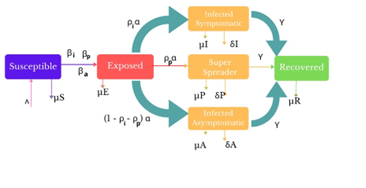
This paper explores the dynamics of COVID-19 transmission, particularly focusing on super-spreaders, through the lens of the SIR model. The model comprises six compartments representing susceptible, exposed, symptomatic infected, super-spreader, asymptomatic infected, and recovered individuals. Utilizing a set of non-linear, interdependent differential equations, we numerically solve for model parameters to examine the influence of super-spreaders on infection spread within the population. We calculate the basic reproduction number (R0) and discuss the stability of disease-free equilibrium. Our findings underscore the significant role played by super-spreaders and asymptomatic individuals in disease dissemination. Drawing on the epidemiological concept of the iceberg phenomenon, we offer insights into super-spreader events (SSEs) in India and their ramifications.
Published
How to Cite
Issue
Section
Copyright (c) 2024 Gurpreet Singh Tuteja, Tapshi Lal

This work is licensed under a Creative Commons Attribution 4.0 International License.
How to Cite
Similar Articles
- Mahesh Kumar Singh, Pushpa Choudhary, Arun Kumar Singh, Pushpendra Singh, LWRNPIP: Design of a light weight restrictive non-fungible token based on practically unclonable functions via image signature patterns , Journal of the Nigerian Society of Physical Sciences: Volume 7, Issue 4, November 2025
- Emmanuel Gbenga Dada, Aishatu Ibrahim Birma, Abdulkarim Abbas Gora, Ensemble machine learning algorithm for cost-effective and timely detection of diabetes in Maiduguri, Borno State , Journal of the Nigerian Society of Physical Sciences: Volume 6, Issue 4, November 2024
- Sulaiman Awwal Akinwunmi, David Opeoluwa Oyewola, Spectral convolution of star-like transformation semigroups for modeling telecommunication signal strength and user experience in Gombe state, Nigeria , Journal of the Nigerian Society of Physical Sciences: Volume 8, Issue 2, May 2026
- Rauf I. Rauf, Ayinde Kayode, Bello A. Hamidu, Bodunwa O. Kikelomo, Alabi O. Olusegun, Enhanced methods for multicollinearity mitigation in stochastic frontier analysis estimation , Journal of the Nigerian Society of Physical Sciences: Volume 6, Issue 4, November 2024
- M. Siddalinga Prasad, An exploration of thermal characteristics of a permeable inclined moving inverted exponential fully wet magnetized stretching/shrinking fin , Journal of the Nigerian Society of Physical Sciences: Volume 7, Issue 4, November 2025
- Olumide Sunday Adesina, Bayesian Multilevel Models for Count Data , Journal of the Nigerian Society of Physical Sciences: Volume 3, Issue 3, August 2021
- Tolulope Latunde, Opeyemi Odunayo Esan, Joseph Oluwaseun Richard, Damilola Deborah Dare, Analysis of a Stochastic Optimal Control for Pension Funds and Application to Investments in Lower Middle-Income Countries , Journal of the Nigerian Society of Physical Sciences: Volume 2, Issue 1, February 2020
- Atiek Iriany, Wigbertus Ngabu, Henny Pramoedyo, Amarifai, Geographically weighted regression random forest for modeling soil particles , Journal of the Nigerian Society of Physical Sciences: Volume 8, Issue 2, May 2026
- Adeyemi Olukayode Binuyo, Eigenvalue Elasticity and Sensitivity Analyses of the Transmission Dynamic Model of Corruption , Journal of the Nigerian Society of Physical Sciences: Volume 1, Issue 1, February 2019
- Adefemi Adeniran, A. A. Sodipo, C. G. Udomboso, A Modifed Forced Randomized Response Model , Journal of the Nigerian Society of Physical Sciences: Volume 2, Issue 1, February 2020
You may also start an advanced similarity search for this article.