A study of growth of COVID-19 with super-spreaders using the modified SIR model including iceberg phenomenon
Keywords:
SIR model, COVID-19, Super-spreaders, Super Spreading Event, Iceberg phenomenon in epidemiology, Basic reproduction numberAbstract
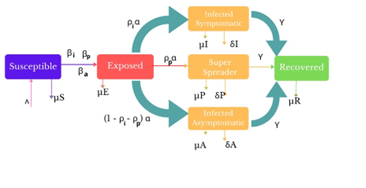
This paper explores the dynamics of COVID-19 transmission, particularly focusing on super-spreaders, through the lens of the SIR model. The model comprises six compartments representing susceptible, exposed, symptomatic infected, super-spreader, asymptomatic infected, and recovered individuals. Utilizing a set of non-linear, interdependent differential equations, we numerically solve for model parameters to examine the influence of super-spreaders on infection spread within the population. We calculate the basic reproduction number (R0) and discuss the stability of disease-free equilibrium. Our findings underscore the significant role played by super-spreaders and asymptomatic individuals in disease dissemination. Drawing on the epidemiological concept of the iceberg phenomenon, we offer insights into super-spreader events (SSEs) in India and their ramifications.
Published
How to Cite
Issue
Section
Copyright (c) 2024 Gurpreet Singh Tuteja, Tapshi Lal

This work is licensed under a Creative Commons Attribution 4.0 International License.
How to Cite
Similar Articles
- Olumide Sunday Adesina, Bayesian Multilevel Models for Count Data , Journal of the Nigerian Society of Physical Sciences: Volume 3, Issue 3, August 2021
- Tolulope Latunde, Opeyemi Odunayo Esan, Joseph Oluwaseun Richard, Damilola Deborah Dare, Analysis of a Stochastic Optimal Control for Pension Funds and Application to Investments in Lower Middle-Income Countries , Journal of the Nigerian Society of Physical Sciences: Volume 2, Issue 1, February 2020
- Sunday Olorunfunmi, Armand Bahini, Adenike Olatinwo, Theoretical Study on 10C Elastic Scattering Cross Sections Using Different Cluster Density Distributions and Different Potentials , Journal of the Nigerian Society of Physical Sciences: Volume 5, Issue 2, May 2023
- Olumide S. Adesina, Adedayo F. Adedotuun, Kayode S. Adekeye, Ogbu F. Imaga, Adeleke J. Adeyiga, Toluwalase J. Akingbade, On logistic regression versus support vectors machine using vaccination dataset , Journal of the Nigerian Society of Physical Sciences: Volume 6, Issue 1, February 2024
- Santosh Kumar Upadhyay, Rajesh Prasad, Efficient-ViT B0Net: A high-performance light weight transformer for rice leaf disease recognition and classification , Journal of the Nigerian Society of Physical Sciences: Volume 7, Issue 4, November 2025
- Samson Olaniyi, Furaha M. Chuma, Sulaimon F. Abimbade, Asymptotic stability analysis of a fractional epidemic model for Ebola virus disease in Caputo sense , Journal of the Nigerian Society of Physical Sciences: Volume 7, Issue 1, February 2025
- Nikita Bhardwaj, Monika Saini, Ashish Kumar, Estimation of reliability characteristics of single-unit repairable system with preventive maintenance and server arrival time , Journal of the Nigerian Society of Physical Sciences: Volume 8, Issue 2, May 2026
- Pragati, Rajneesh Kumar, Sachin Kaushal, Effect of a moving thermal load in a modified couple stress medium with double porosity and hyperbolic two-temperature theory , Journal of the Nigerian Society of Physical Sciences: Volume 8, Issue 1, February 2026
- Felix Yakubu Eguda, Andrawus James, Sunday Babuba, The Solution of a Mathematical Model for Dengue Fever Transmission Using Differential Transformation Method , Journal of the Nigerian Society of Physical Sciences: Volume 1, Issue 3, August 2019
- Onyeke Idoko Charles, John Kolo Alhassan, Mohammed Danlami Abdulmalik, Kehinde Dele Tolorunse, A hybrid process-based and neural network post-processing model for cowpea yield prediction under climate variability in North Central Nigeria , Journal of the Nigerian Society of Physical Sciences: Volume 8, Issue 2, May 2026
You may also start an advanced similarity search for this article.