A study of growth of COVID-19 with super-spreaders using the modified SIR model including iceberg phenomenon
Keywords:
SIR model, COVID-19, Super-spreaders, Super Spreading Event, Iceberg phenomenon in epidemiology, Basic reproduction numberAbstract
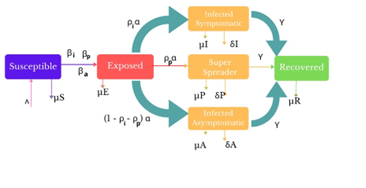
This paper explores the dynamics of COVID-19 transmission, particularly focusing on super-spreaders, through the lens of the SIR model. The model comprises six compartments representing susceptible, exposed, symptomatic infected, super-spreader, asymptomatic infected, and recovered individuals. Utilizing a set of non-linear, interdependent differential equations, we numerically solve for model parameters to examine the influence of super-spreaders on infection spread within the population. We calculate the basic reproduction number (R0) and discuss the stability of disease-free equilibrium. Our findings underscore the significant role played by super-spreaders and asymptomatic individuals in disease dissemination. Drawing on the epidemiological concept of the iceberg phenomenon, we offer insights into super-spreader events (SSEs) in India and their ramifications.
Published
How to Cite
Issue
Section
Copyright (c) 2024 Gurpreet Singh Tuteja, Tapshi Lal

This work is licensed under a Creative Commons Attribution 4.0 International License.
How to Cite
Similar Articles
- Umaru Hassan, Mohd Tahir Ismail, Improving forecasting accuracy using quantile regression neural network combined with unrestricted mixed data sampling , Journal of the Nigerian Society of Physical Sciences: Volume 5, Issue 4, November 2023
- Peter Chibuike Okoye, Samuel Ogochukwu Azi, Taoreed O. Owolabi, Perovskite tetragonality modeling for functional properties enhancement using Newtonian search based support vector regression computational method , Journal of the Nigerian Society of Physical Sciences: Volume 4, Issue 1, February 2022
- Kanak Saini, Monika Saini, Ashish Kumar, Dinesh Kumar Saini, Availability predictions of solar power plants using multiple regression and neural networks: an analytical study , Journal of the Nigerian Society of Physical Sciences: Volume 7, Issue 2, May 2025
- A. M. Olaosun, C. A. Aborisade, D. E. Shian, P. T. Osuolale, Comprehensive study of photon and proton interactions to interpret the radiation parameters of boron derivative drugs for chemoradiotherapy , Journal of the Nigerian Society of Physical Sciences: Volume 7, Issue 2, May 2025
- A. F. Adedotun, T. Latunde, O. A. Odusanya, Modelling and Forecasting Climate Time Series with State-Space Model , Journal of the Nigerian Society of Physical Sciences: Volume 2, Issue 3, August 2020
- Kabiru Lere Najib, Adamu Shitu Hassan, Food and environmental degradation as causative agents of honey bee colonies decline: Mathematical model approach , Journal of the Nigerian Society of Physical Sciences: Volume 3, Issue 4, November 2021
- Gabriel James, Ifeoma Ohaeri, David Egete, John Odey, Samuel Oyong, Enefiok Etuk, Imeh Umoren, Ubong Etuk, Aloysius Akpanobong, Anietie Ekong, Saviour Inyang, Chikodili Orazulume, A fuzzy-optimized multi-level random forest (FOMRF) model for the classification of the impact of technostress , Journal of the Nigerian Society of Physical Sciences: Volume 7, Issue 3, August 2025
- G. A. Shewa, F. I. Ugwuowo, Combating the Multicollinearity in Bell Regression Model: Simulation and Application , Journal of the Nigerian Society of Physical Sciences: Volume 4, Issue 3, August 2022
- B. Laxmi, K. Chand, P. Thakur, Hydrodynamic Casson hybrid nanofluid flow across a stretching sheet in the regime of velocity slip and temperature jump,including viscous dissipation, melting, Soret and Dufour effects , Journal of the Nigerian Society of Physical Sciences: Volume 7, Issue 4, November 2025
- Nour Hamad Abu Afouna, Majid Khan Majahar Ali, Optimizing precision farming: enhancing machine learning efficiency with robust regression techniques in high-dimensional data , Journal of the Nigerian Society of Physical Sciences: Volume 7, Issue 1, February 2025
You may also start an advanced similarity search for this article.