
A study of growth of COVID-19 with super-spreaders using the modified SIR model including iceberg phenomenon
Keywords:
SIR model, COVID-19, Super-spreaders, Super Spreading Event, Iceberg phenomenon in epidemiology, Basic reproduction numberAbstract
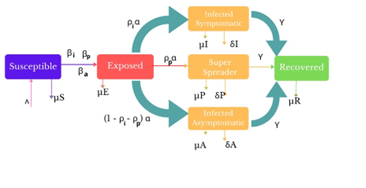
This paper explores the dynamics of COVID-19 transmission, particularly focusing on super-spreaders, through the lens of the SIR model. The model comprises six compartments representing susceptible, exposed, symptomatic infected, super-spreader, asymptomatic infected, and recovered individuals. Utilizing a set of non-linear, interdependent differential equations, we numerically solve for model parameters to examine the influence of super-spreaders on infection spread within the population. We calculate the basic reproduction number (R0) and discuss the stability of disease-free equilibrium. Our findings underscore the significant role played by super-spreaders and asymptomatic individuals in disease dissemination. Drawing on the epidemiological concept of the iceberg phenomenon, we offer insights into super-spreader events (SSEs) in India and their ramifications.
Published
How to Cite
Issue
Section
Copyright (c) 2024 Gurpreet Singh Tuteja, Tapshi Lal

This work is licensed under a Creative Commons Attribution 4.0 International License.
How to Cite
Similar Articles
- S. A. Agunbiade, J. U. Abubakar, T. L. Oyekunle, M. T. Akolade, Stagnation point flow of viscous nanofluid towards a shrinking sheet with quadratic buoyancy and thermophoresis influence: convection through porous media , Journal of the Nigerian Society of Physical Sciences: Volume 6, Issue 3, August 2024
- A. B. Disu, S. O. Salawu, Thermal distribution of magneto-tangent hyperbolic flowing fluid over a porous moving sheet: A Lie group analysis , Journal of the Nigerian Society of Physical Sciences: Volume 5, Issue 1, February 2023
- Monika Saini, Ashish Kumar, Fuzzy semi-Markovian stochastic model for single-unit system with repairman arrival delay under Lindley lifetime distribution using bell-shaped membership function , Journal of the Nigerian Society of Physical Sciences: Volume 8, Issue 3, August 2026
- Akila Dabara Kayit, Mohd Tahir Ismail, Novel way to predict stock movements using multiple models and comprehensive analysis: leveraging voting meta-ensemble techniques , Journal of the Nigerian Society of Physical Sciences: Volume 6, Issue 3, August 2024
- Ebere Uzoka Chidi, Edward Anoliefo, Collins Udanor, Asogwa Tochukwu Chijindu, Lois Onyejere Nwobodo, A blind navigation guide model for obstacle avoidance using distance vision estimation based YOLO-V8n , Journal of the Nigerian Society of Physical Sciences: Volume 7, Issue 1, February 2025
- Sunday Samuel Bako, Norhaslinda Ali, Jayanthi Arasan, Assessing model selection techniques for distributions use in hydrological extremes in the presence of trimming and subsampling , Journal of the Nigerian Society of Physical Sciences: Volume 6, Issue 4, November 2024
- W. A. Yahya, Alpha decay half-lives of 171-189Hg isotopes using Modified Gamow-like model and temperature dependent proximity potential , Journal of the Nigerian Society of Physical Sciences: Volume 2, Issue 4, November 2020
- S. I. Ele, U. R. Alo, H. F. Nweke, A. H. Okemiri, E. O. Uche-Nwachi, Deep convolutional neural network (DCNN)-based model for pneumonia detection using chest x-ray images , Journal of the Nigerian Society of Physical Sciences: Volume 7, Issue 2, May 2025
- Samy A. Khalil, Performance Evaluation and Statistical Analysis of Solar Energy Modeling: A Review and Case Study , Journal of the Nigerian Society of Physical Sciences: Volume 4, Issue 4, November 2022
- Umaru Hassan, Mohd Tahir Ismail, Improving forecasting accuracy using quantile regression neural network combined with unrestricted mixed data sampling , Journal of the Nigerian Society of Physical Sciences: Volume 5, Issue 4, November 2023
You may also start an advanced similarity search for this article.







