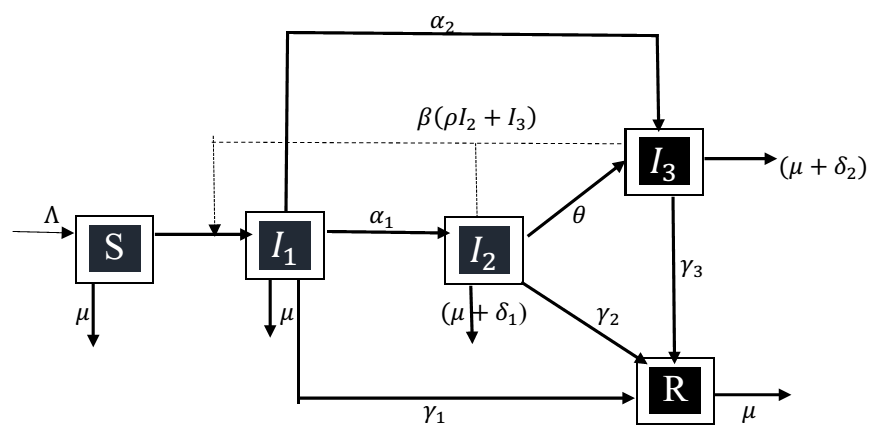
A tuberculosis model with three infected classes
Keywords:
Optimal Control, Lyapunov function, Equilibrium, Basic , JacobianAbstract
The dynamics of tuberculosis within a population cannot be adequately represented by a single infectious class. Therefore, this study develops a compartmental model encompassing latent, active, and drug-resistant populations to better capture tuberculosis dynamics in a community. Model analysis reveals that the disease-free equilibrium point is locally asymptotically stable when the basic reproduction number is below one. Moreover, the use of a suitable Lyapunov function demonstrates global asymptotic stability of the disease-free equilibrium point. An endemic equilibrium emerges when the basic reproduction number exceeds one. Sensitivity analysis is conducted for each parameter associated with the basic reproduction number, and optimal control analysis is employed to assess the impact of various control strategies on disease containment. Numerical simulations are conducted to supplement theoretical findings, illustrating the practical implications of the proposed control strategies.
Published
How to Cite
Issue
Section
Copyright (c) 2023 A. O. Sangotola, S. B. Adeyemo, O. A. Nuga, A. E. Adeniji, A. J. Adigun

This work is licensed under a Creative Commons Attribution 4.0 International License.
How to Cite
Similar Articles
- O. J. Olusesi, K. J. Oyewumi, W. A. Yahya, The statistical ensemble of q-deformed hyperbolic modified P\"oschl-Teller potential for certain diatomic molecules through Euler-Maclaurin approach , Journal of the Nigerian Society of Physical Sciences: Volume 7, Issue 2, May 2025
- Friday Obarhua, Oluwasemire John Adegboro, An Order Four Continuous Numerical Method for Solving General Second Order Ordinary Differential Equations , Journal of the Nigerian Society of Physical Sciences: Volume 3, Issue 1, February 2021
- A. A. Willoughby, A. A. Soge, O. F. Dairo, O. D. Olukanni, E. U. Durugbo, W. S. Michael, T. A. Adebayo, Fabrication and Characterization of a Dye-Sensitized Solar Cell using Natural Dye Extract of Rosella (Hibiscus sabdariffa L.) as Photosensitizer , Journal of the Nigerian Society of Physical Sciences: Volume 3, Issue 4, November 2021
- E. I. Akinola, R. A. Oderinu, S. Alao, O. E. Opaleye, An Integral Transform-Weighted Residual Method for Solving Second Order Linear Boundary Value Differential Equations with Semi-Infinite Domain , Journal of the Nigerian Society of Physical Sciences: Volume 4, Issue 4, November 2022
- Raja Aqib Shamim, Majid Khan Majahar Ali, Optimizing discrete dutch auctions with time considerations: a strategic approach for lognormal valuation distributions , Journal of the Nigerian Society of Physical Sciences: Volume 7, Issue 1, February 2025
- F. L. Kherfane, A. BOUKRAA, B. Beladel, A. Douara, I. E. Tibermacine, A. Rabehi, M. Benghanem, Structural, electronic and optical properties of theFeAs(1-x)La(x) ternary alloys: a first principles calculations , Journal of the Nigerian Society of Physical Sciences: Volume 8, Issue 1, February 2026
- Chinedu L. Udeze, Idongesit E. Eteng, Ayei E. Ibor, Application of Machine Learning and Resampling Techniques to Credit Card Fraud Detection , Journal of the Nigerian Society of Physical Sciences: Volume 4, Issue 3, August 2022
- Elsayed Elshoubary, Effect of reduction method on the performance a software defined network system using Gumbel Hougaard family copula distribution , Journal of the Nigerian Society of Physical Sciences: Volume 5, Issue 4, November 2023
- O. M. Ogunlaran, M. A. Kehinde, M. A. Akanbi, E. I. AKINOLA, A Chebyshev polynomial based block integrator for the direct numerical solution of fourth order ordinary differential equations , Journal of the Nigerian Society of Physical Sciences: Volume 6, Issue 2, May 2024
- Shaymaa Mohammed Ahmed, Majid Khan Majahar Ali, Arshad Hameed Hasan, Evaluating feature selection methods in a hybrid Weibull Freund-Cox proportional hazards model for renal cell carcinoma , Journal of the Nigerian Society of Physical Sciences: Volume 7, Issue 3, August 2025
You may also start an advanced similarity search for this article.