A tuberculosis model with three infected classes
Keywords:
Optimal Control, Lyapunov function, Equilibrium, Basic , JacobianAbstract
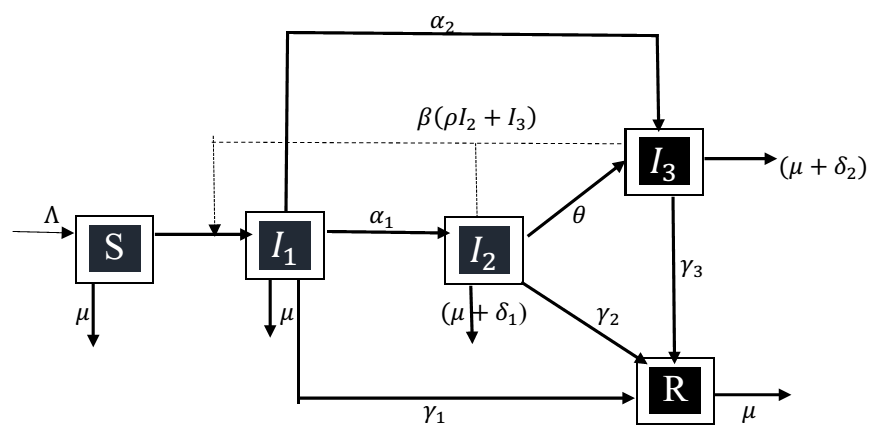
The dynamics of tuberculosis within a population cannot be adequately represented by a single infectious class. Therefore, this study develops a compartmental model encompassing latent, active, and drug-resistant populations to better capture tuberculosis dynamics in a community. Model analysis reveals that the disease-free equilibrium point is locally asymptotically stable when the basic reproduction number is below one. Moreover, the use of a suitable Lyapunov function demonstrates global asymptotic stability of the disease-free equilibrium point. An endemic equilibrium emerges when the basic reproduction number exceeds one. Sensitivity analysis is conducted for each parameter associated with the basic reproduction number, and optimal control analysis is employed to assess the impact of various control strategies on disease containment. Numerical simulations are conducted to supplement theoretical findings, illustrating the practical implications of the proposed control strategies.
Published
How to Cite
Issue
Section
Copyright (c) 2023 A. O. Sangotola, S. B. Adeyemo, O. A. Nuga, A. E. Adeniji, A. J. Adigun

This work is licensed under a Creative Commons Attribution 4.0 International License.
How to Cite
Similar Articles
- Adebola Samuel Adeoye, Ezekiel Olaoluwa Omole, Sule Adekunle Jimoh, Victoria Iyadunni Ayodele, Taiwo Aanu Ogunlusi, A comprehensive investigation of dual-damped Euler-Bernoulli beam under moving mass on Pasternak foundation via spectral and central difference methods , Journal of the Nigerian Society of Physical Sciences: Volume 8, Issue 2, May 2026
- Victor Oboni Atabo, Solomon Ortwer Adee, A New Special 15-Step Block Method for Solving General Fourth Order Ordinary Differential Equations , Journal of the Nigerian Society of Physical Sciences: Volume 3, Issue 4, November 2021
- Muteeu A. Olopade, Anthony B. Adegboyega, Kayode I. Ogungbemi, Adeyinka D. Adewoyin, Investigation of the behaviour of tunable chalcogenide-Bismuth based perovskite BiTl (SxSe1-x)3(X = 0, 0.33, 0.67, 1): first principles calculations , Journal of the Nigerian Society of Physical Sciences: Volume 7, Issue 1, February 2025
- Pragati, Rajneesh Kumar, Sachin Kaushal, Effect of a moving thermal load in a modified couple stress medium with double porosity and hyperbolic two-temperature theory , Journal of the Nigerian Society of Physical Sciences: Volume 8, Issue 1, February 2026
- E. Udensi, R. B. Salau, S. O. Salihu, M. M. Ndamitso, M. T. Bisiriyu, Chemometric authentication of branded and crude spices using integrated GC–MS fingerprints and elemental profiling , Journal of the Nigerian Society of Physical Sciences: Volume 8, Issue 3, August 2026
- T. S. Fagbemigun, M. O. Olorunfemi, S. A. Wahab, Modeling of Self Potential (SP) Anomalies over a Polarized Rod with Finite Depth Extents , Journal of the Nigerian Society of Physical Sciences: Volume 1, Issue 2, May 2019
- B. I. Akinnukawe, K. O. Muka, L-Stable Block Hybrid Numerical Algorithm for First-Order Ordinary Differential Equations , Journal of the Nigerian Society of Physical Sciences: Volume 2, Issue 3, August 2020
- Umaru Hassan, Mohd Tahir Ismail, Improving forecasting accuracy using quantile regression neural network combined with unrestricted mixed data sampling , Journal of the Nigerian Society of Physical Sciences: Volume 5, Issue 4, November 2023
- P. K. Alimo, G. Lartey-Young, S. Agyeman, T. Y. Akintunde, E. Kyere-Gyeabour, F. Krampah, A. Awomuti, O. Oderinde, A. O. Agbeja, O. G. Afolabi, Spatial distribution and policy implications of the exhaust emissions of two-stroke motorcycle taxis: a case study of southwestern state in Nigeria , Journal of the Nigerian Society of Physical Sciences: Volume 6, Issue 2, May 2024
- K. T. Shivaram, A. M. Yogitha, S. M. Rajesh, N. Mahesh Kumar, Numerical computation of cut off wave number in polygonal wave guide by eight node finite element mesh generation approach , Journal of the Nigerian Society of Physical Sciences: Volume 6, Issue 4, November 2024
You may also start an advanced similarity search for this article.