A new Maxwell-Log logistic distribution and its applications for mortality rate data
Keywords:
Log-Logistic distribution, Maxwell generalized family, Maxwell-Log Logistic distribution, Order statistics, COVID-19Abstract
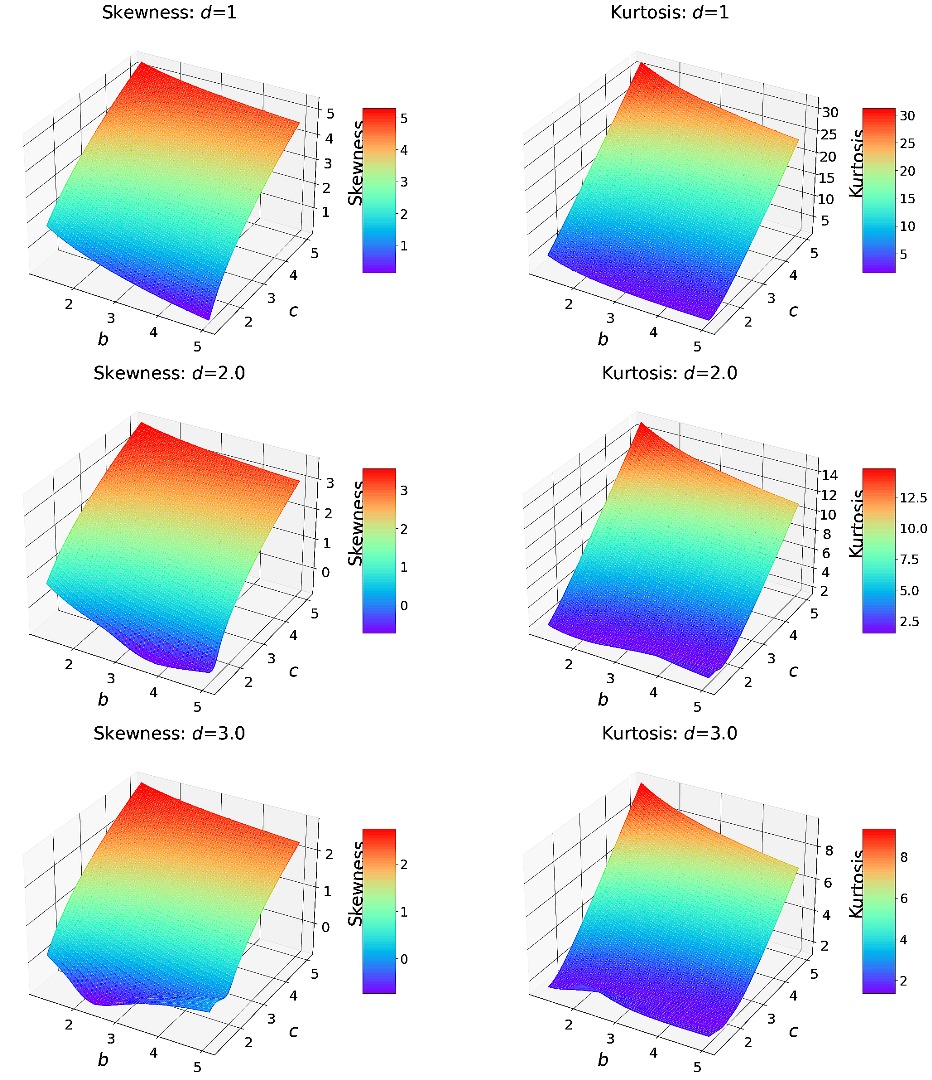
In this research, we extended the Log-Logistic distribution by incorporating it into the Maxwell generalized class, resulting in the Maxwell-Log Logistic (Max-LL ) distribution. The probability density function and cumulative distribution function of the proposed distribution have been defined. The proposed distribution’s density shapes can be left or right-skewed and symmetric. The failure function of this distribution might be increasing, decreasing, or inverted bathtub forms. We discussed some essential properties of the Max-LL distribution, including moments, moment generating function, probability weighted moments, stress-strength, and order statistics. The efficiency of the model parameters has been evaluated through a simulation study utilizing a quantile function. To assess the proposed distribution’s adaptability, we applied it to two lifetime datasets: global COVID-19 mortality rates (for nations with more than 100,000 cases) and Canadian COVID-19 mortality rates. The Maxwell-Log Logistic distribution outperformed other distributions on both datasets, as evidenced by several accuracy measures. This shows that the proposed distribution is the best fit for COVID-19 mortality rate data in Canada and around the world.
References
[1] A. I. Ishaq, A. A. Suleiman, A. Usman, H. Daud & R. Sokkalingam, “Transformed Log-Burr III distribution: Structural features and appli cation to milk production”, Engineering Proceedings 56 (2023) 322. https://doi.org/10.3390/ASEC2023-15289.
[2] A. I. Ishaq, A. A. Suleiman, H. Daud, N. S. Sawaran Singh, M. Othman, R. Sokkalingam, P. Wiratchotisatian, A. G. Usman & S. I. Abba, “LogKumaraswamy distribution: its features and applications”, Frontiers in Applied Mathematics and Statistics 9 (2023) 1258961. https://doi.org/10.3389/fams.2023.1258961.
[3] H. Daud, A. A. Suleiman, A. I. Ishaq, N. Alsadat, M. Elgarhy, A. Usman, P. Wiratchotisatian, A. U. Ubale & Y. Liping, “A new extension of the Gumbel distribution with biomedical data analysis”, Journal of Radiation Research and Applied Sciences 17 (2024) 101055. https://doi.org/10.1016/j.jrras.2024.101055.
[4] I. E. Ragab, H. Daud, A. A. Suleiman, N. Alsadat, V. B. Nagarjuna & M. Elgarhy, “Type II Topp-Leone exponentiated gamma distribution with application to breaking stress data”, Journal of Radiation Research and Applied Sciences 17 (2024) 101045. https://doi.org/10.1016/j.jrras.2024.101045.
[5] P. F. Verhulst, “Notice sur la loi que la population suit dans son accroissement”, Correspondence mathematique et physique 10 (1838) 113. https://cir.nii.ac.jp/crid/1570009749935841536.
[6] P. R. Fisk, “The graduation of income distributions,” Econometrica: journal of the econometric society,” 29 (1961) 171. https://www.econometricsociety.org/publications/econometrica/1961/04/01/graduation-income-distributions.
[7] S. Bennett, “Log-logistic regression models for survival data”, Journal of the Royal Statistical Society Series C: Applied Statistics 32 (1983) 165. https://doi.org/10.2307/2347295.
[8] Y. Yu, Y. Jia, M. A. Alshahrani, O. A. Alamri, H. Daud, J. G. Dar & A. A. Suleiman, “Adopting a new sine-induced statistical model and deep learning methods for the empirical exploration of the music and reliability data”, Alexandria Engineering Journal 104 (2024) 396. https://doi.org/10.1016/j.aej.2024.07.104.
[9] P. R. Tadikamalla, “A look at the Burr and related distributions”, International Statistical Review/Revue Internationale de Statistique 48 (1980) 337. https://doi.org/10.2307/1402945.
[10] C. Kleiber & S. Kotz, Statistical size distributions in economics and actuarial sciences, John Wiley & Sons, 2003. https://doi.org/10.1002/0471457175.
[11] J. F. Lawless, Statistical models and methods for lifetime data, John Wiley & Sons, 2011. https://doi.org/10.1002/9781118033005.
[12] R. B. D’Agostino, “Modelling survival data in medical research”, Journal of the American Statistical Association 90 (1995) 1125. https://doi.org/10.1093/jrsssa/qnae038.
[13] M. Ahmad, C. Sinclair & A. Werritty, “Log-logistic flood frequency analysis”, Journal of Hydrology 98 (1988) 205. https://doi.org/10.1016/0022-1694.
[14] N. Balakrishnan and H. Malik, “Best linear unbiased estimation of location and scale parameters of the log-logistic distribution”, Communications in Statistics-Theory and Methods 16 (1987) 3477. https://doi.org/10.1080/03610928708829586.
[15] F. Ashkar & S. Mahdi, “Fitting the log-logistic distribution by generalized moments”, Journal of Hydrology 328 (2006) 694. https://doi.org/10.1016/j.jhydrol.2006.01.014/
[16] T. V. F. De Santana, E. M. Ortega, G. M. Cordeiro & G. O. Silva, “The Kumaraswamy-log-logistic distribution”, Journal of Statistical Theory and Applications 11 (2012) 265. https://www.researchgate.net/publication/316154940_The_Kumaraswamy-Log-Logistic_Distribution.
[17] G. M. Cordeiro & M. De Castro, “A new family of generalized distributions”, Journal of statistical computation and simulation 81 (2011) 883. https://doi.org/https://doi.org/10.1080/00949650903530745.
[18] R. C. Gupta, P. L. Gupta & R. D. Gupta, “Modeling failure time data by Lehman alternatives”, Communications in Statistics-Theory and methods 27 (1988) 887. https://www.tandfonline.com/doi/abs/10.1080/03610929808832134
[19] W. Gui, “Marshall-Olkin extended log-logistic distribution and its application in minification processes”, Applied Mathematical Sciences 7 (2013) 77. http://dx.doi.org/10.12988/ams.2013.35268.
[20] M. H. Tahir, M. Mansoor, M. Zubair & G. Hamedani, “McDonald loglogistic distribution with an application to breast cancer data”, Journal of Statistical Theory and Applications 13 (2014) 65. https://doi.org/10.2991/jsta.2014.13.1.6.
[21] V. Kariuki, A. Wanjoya & O. Ngesa, “Properties, estimation, and applications of the extended log-logistic distribution”, Scientific Reports 14 (2024) 20967. https://doi.org/10.1038/s41598-024-68843-4.
[22] D. C. T. Granzotto & F. Louzada, “The transmuted log-logistic distribution: modeling, inference, and an application to a polled tabapua race time up to first calving data”, Communications in Statistics-Theory and Methods 44 (2015) 3387. http://dx.doi.org/10.1080/03610926.2013.775307.
[23] W. T. Shaw & I. R. Buckley, “The alchemy of probability distributions: beyond Gram-Charlier expansions, and a skew-kurtotic-normal distribution from a rank transmutation map”, arXiv preprint arXiv:0901.0434 (2009). https://doi.org/10.48550/arXiv.0901.0434.
[24] L. D. Ribeiro-Reis, “Unit log-logistic distribution and unit log-logistic regression model”, Journal of the Indian Society for Probability and Statis tics 22 (2021) 375. https://doi.org/10.1007/s41096-021-00109-y.
[25] A. K. Fulment, S. R. Gadde & J. K. Peter, “The odd log-logistic generalized exponential distribution: Application on survival times of chemotherapy patients data”, F1000research 11 (2022). http://dx.doi.org/10.12688/f1000research.127363.1.
[26] R. Hosana, N. W. W. S. Sari & A. Kurniawan, “Survival analysis and hazard of log logistic distribution on type I censored data parametrically”, Contemporary Mathematics and Applications 5 (2023) 79. https://e-journal.unair.ac.id/CONMATHA/article/view/47040.
[27] M. K. Shakhatreh & M. A. Aljarrah, “Bayesian analysis of unit log logistic distribution using non-informative priors”, Mathematics 11 (2023) 4947. https://doi.org/10.3390/math11244947.
[28] V. Ranjbar, A. Eftekharian, O. Kharazmi, and M. Alizadeh, “Odd log logistic generalised Lindley distribution with properties and applications”, Statistics in Transition new series 24 (2023) 71. http://dx.doi.org/10.59170/stattrans-2023-052.
[29] M. C. Santos & R. R. Pescim, “A new extension of the Burr XII distribution generated by odd log-logistic random variables”, Communications in Statistics-Theory and Methods 53 (2024) 5003. https://doi.org/10.1080/03610926.2023.2200560.
[30] Z. Ma, M. Wang & C. Park, “Robust explicit estimation of the log-logistic distribution with applications”, Journal of Statistical Theory and Practice 17 (2023) 21. https://doi.org/10.1007/s42519-023-00322-x.
[31] A. F. Fagbamigbe, G. K. Basele, B. Makubate & B. O. Oluyede, “Application of the exponentiated Log-logistic weibull distribution to censored data”, Journal of the Nigerian Society of Physical Sciences 1 (2019) 12. http://dx.doi.org/10.46481/jnsps.2019.4.
[32] I. E. Okorie, A. C. Akpanta, J. Ohakwe, D. C. Chikezie, C. U. Onyemachi & M. K. Rastogi, “Zero-truncated Poisson-power function distribution”, Annals of Data Science 8 (2021) 107. https://doi.org/10.1007/s40745-019-00201-y.
[33] A. Fayomi, S. Khan, M. H. Tahir, A. Algarni, F. Jamal & R. Abu-Shanab, “A new extended gumbel distribution: Properties and application”, Plos one 17 (2022) e0267142. https://doi.org/10.1371/journal.pone.0267142.
[34] M. Arif, D. M. Khan, M. Aamir, M. El-Morshedy, Z. Ahmad & Z. Khan, “A new flexible exponentiated-x family of distributions: characterizations and applications to lifetime data”, IETE Journal of Research 69 (2022) 1. https://www.tandfonline.com/doi/abs/10.1080/03772063.2022.2034537.
[35] A. Ishaq, A. Usman, M. Tasi’u, A. Suleiman & A. Ahmad, “A new odd f-weibull distribution: properties and application of the monthly Nigerian naira to british pound exchange rate data”, International Conference on Data Analytics for Business and Industry (ICDABI) (2022) 326. https://doi.org/10.1109/ICDABI56818.2022.10041527.
[36] A. A. Suleiman, M. Othman, A. I. Ishaq, M. L. Abdullah, R. Indawati, H. Daud & R. Sokkalingam, “A new statistical model based on the novel generalized odd beta prime family of continuous probability distributions with applications to cancer disease data sets”, (2022). https://doi.org/10.20944/preprints202212.0072.v.
[37] M. Muhammad et al., “A new extension of the topp–leone-family of models with applications to real data”, Annals of Data Science 10 (2023) 225. https://link.springer.com/article/10.1007/s40745-022-00456-y.
[38] G. P. Dhungana & V. Kumar, “Exponentiated Odd Lomax Exponential distribution with application to COVID-19 death cases of Nepal,” PloS one 17 (2022) e0269450. https://doi.org/10.1371/journal.pone.0269450.
[39] A. A. Suleiman, H. Daud, N. S. S. Singh, M. Othman, A. I. Ishaq & R. Sokkalingam, “A novel odd beta prime-logistic distribution: desirable mathematical properties and applications to engineering and environmental data”, Sustainability 15 (2023) 10239. https://doi.org/10.3390/su151310239.
[40] A. I. Ishaq, U. Panitanarak, A. A. Abiodun, A. A Suleiman, & H. Daud, “The generalized odd maxwell-kumaraswamy distribution: its properties and applications”, Contemporary Mathematics, 5 (2024) 711–742. https://doi.org/10.37256/cm.5120242888.
[41] F. Vilca, C. Borelli Zeller & N. Balakrishnan, “Multivariate Birnbaum–Saunders distribution based on a skewed distribution and associated EM-estimation”, Brazilian Journal of Probability and Statistics 37 (2023) 26. https://doi.org/10.1214/22-BJPS559.
[42] M. Kamal et al., “A new improved form of the Lomax model: Its bivariate extension and an application in the financial sector”, Alexandria Engineering Journal 75 (2023) 127. https://doi.org/10.1016/j.aej.2023.05.027.
[43] F. Willayat, N. Saud, M. Ijaz, A. Silvianita & M. El-Morshedy, “Marshall–Olkin Extended Gumbel Type-II distribution: properties and applications”, Complexity 2022 (2022) 2219570. https://onlinelibrary.wiley.com/doi/full/10.1155/2022/2219570.
[44] S. M. Aljeddani & M. Mohammed, “An extensive mathematical approach for wind speed evaluation using inverse Weibull distribution”, Alexandria Engineering Journal 76 (2023) 775. https://doi.org/10.1016/j.aej.2023.06.076.
[45] S. B. Sayibu, A. Luguterah & S. Nasiru, “McDonald Generalized power weibull distribution: properties, and applications”, J. Stat. Appl. Pro. 13 (2024) 297. https://dx.doi.org/10.18576/jsap/130121.
[46] A. A. Suleiman, H. Daud, N. S. S. Singh, A. I. Ishaq & M. Othman, “A new odd beta prime-burr x distribution with applications to petroleum rock sample data and covid-19 mortality rate”, Data 8 (2023) 143. https://doi.org/10.3390/data8090143.
[47] M. Kamal, H. E. Sadig, A. Al Mutairi, I. Alkhairy, F. M. A. Zaghdoun, M. Yusuf, E. Hussam, M. Abotaleb, M. S. Mustafa & A. F. Alsaedy, “A new updated version of the Weibull model with an application to re-injury rate data”, Alexandria Engineering Journal 83 (2023) 92. http://dx.doi.org/10.1016/j.aej.2023.10.018.
[48] A. Usman, A. I. Ishaq, A. A. Suleiman, M. Othman, H. Daud & Y. Aliyu, “Univariate and bivariate log-topp-leone distribution using censored and uncensored datasets”, in Computer Sciences & Mathematics Forum 7 (2023) 32. https://doi.org/10.3390/IOCMA2023-14421.
[49] A. I. Ishaq & A. A. Abiodun, “The Maxwell–Weibull distribution in modeling lifetime datasets”, Annals of Data Science 7 (2020) 639. https://doi.org/10.1007/s40745-020-00288-8
[50] A. Alzaatreh, C. Lee & F. Famoye, “A new method for generating families of continuous distributions”, Metron 71 (2013) 63. https://link.springer.com/article/10.1007/s40300-013-0007-y.
[51] U. A. Abdullahi, A. A. Suleiman, A. I. Ishaq, A. Usman & A. Suleiman,“The Maxwell–exponential distribution: theory and application to life time data”, Journal of Statistical Modeling & Analytics (JOSMA) 3(2021). http://dx.doi.org/10.22452/josma.vol3no2.4.
[52] A. I. Ishaq, A. A. Abiodun & J. Y. Falgore, “Bayesian estimation of the parameter of Maxwell-Mukherjee Islam distribution using assumptions of the Extended Jeffrey’s, Inverse-Rayleigh and Inverse-Nakagami priors under the three loss functions”, Heliyon 7 (2021). https://doi.org/10.1016/j.heliyon.2021.e08200.
[53] A. I. Ishaq & A. A. Abiodun, “On the developments of Maxwell-Dagum distribution”, Journal of Statistical Modelling: Theory and Applications 2 (2021) 1. https://www.researchgate.net/publication/357312489_On_thedevelopments_of_Maxwell-Dagum_distribution.
[54] K. Koobubpha, T. Panitanarak, P. Domthong & U. Panitanarak, “The maxwell-burr X distribution: its properties and applications to the COVID-19 mortality rate in Thailand”, Thailand Statistician 21 (2023) 421. https://ph02.tci-thaijo.org/index.php/thaistat/article/view/249011.
[55] A. A. Suleiman, A. Suleiman, U. A. Abdullahi & A. Suleiman, “Estimation of the case fatality rate of COVID-19 epidemiological data in Nigeria using statistical regression analysis”, Biosafety and Health 3 (2021) 4. https://doi.org/10.1016/j.bsheal.2020.09.003.
[56] A. A. Osi, M. Abdu, U. Muhammad, A. Ibrahim, L.A. Isma’il, A. A. Suleiman, H. S. Abdulkadir, S. S. Sada, H. G. Dikko & M. Z. Ringim, “A classification approach for predicting COVID-19 Patient’s survival outcome with machine learning techniques”, MedRxiv (2020). http://dx.doi.org/10.5455/sf.aaosi2.
[57] P. Samui, J. Mondal & S. Khajanchi, “A mathematical model for COVID 19 transmission dynamics with a case study of India”, Chaos, Solitons & Fractals 140 (2020) 110173. https://doi.org/10.1016/j.chaos.2020.110173.
[58] T. Rocha Filho et al., “A data-driven model for COVID-19 pandemic–Evolution of the attack rate and prognosis for Brazil”, Chaos, Solitons & Fractals 152 (2021) 111359. https://doi.org/10.1016/j.chaos.2021.111359.
[59] B. H. Foy, B. Wahl, K. Mehta, A. Shet, G. I. Menon & C. Britto, “Comparing COVID-19 vaccine allocation strategies in India: A mathematical modelling study”, International Journal of Infectious Diseases 103 (2021) 431. https://doi.org/10.1016/j.ijid.2020.12.075
[60] A. A. Suleiman, H. Daud, A. I. Ishaq, M. Othman, H. M. Alshanbari & S. N. Alaziz, “A novel extended Kumaraswamy distribution and its application to COVID-19 data”, Engineering Reports 6 (2024) e12967. https://doi.org/10.1002/eng2.12967.
[61] I. S. Gradshteyn & I. M. Ryzhik, Table of integrals, series, and products”, Academic press, 2014. https://doi.org/10.1016/C2010-0-64839-5.
[62] J. A. Greenwood, J. M. Landwehr, N. C. Matalas & J. R. Wallis, “Probability weighted moments: definition and relation to parameters of several distributions expressable in inverse form”, Water resources research 15 (1979) 1049. https://doi.org/10.1029/WR015i005p01049.
[63] S. Dey, T. Dey, S. Ali & M. S. Mulekar, “Two-parameter Maxwell distribution: Properties and different methods of estimation”, Journal ofStatistical Theory and Practice 10 (2026) 291. https://doi.org/10.1080/15598608.2015.1135090.
[64] S. Ali, S. Dey, M. Tahir & M. Mansoor, “A comparison of different methods of estimation for the flexible Weibull distribution”, Communications Faculty of Sciences University of Ankara Series A1 Mathematics and Statistics 69 (2020) 794. https://doi.org/10.1214/22-BJPS546.
[65] S. Ali, J. Ara & I. Shah, “A comparison of different parameter estimation methods for exponentially modified Gaussian distribution”, Afrika Matematika 33 (2022) 58. https://doi.org/10.1007/s13370-022-00995-w.
[66] M. Alizadeh, A. Z. Afify, M. S. Eliwa & S. Ali, “The odd log-logistic Lindley-G family of distributions: properties, Bayesian and non-Bayesian estimation with applications”, Computational statistics 35 (2020) 281. https://doi.org/10.1007/s00180-019-00932-9.
[67] S. Ali, S. Dey, M. H. Tahir & M. Mansoor, “Two-parameter logistic exponential distribution: Some new properties and estimation methods”, American Journal of Mathematical and Management Sciences 39 (9) (20202). https://doi.org/10.1080/01966324.2020.1728453.
[68] E. M. Almetwally, R. Alharbi, D. Alnagar & E. H. Hafez, “A new inverted topp-leone distribution: applications to the COVID-19 mortality rate in two different countries”, Axioms 10 (2021) 25. https://doi.org/10.3390/axioms10010025.
[69] K. Rosaiah, R. Kantam & S. Kumar, “Reliability test plans for exponentiated log-logistic distribution”, Stochastics and Quality Control 21 (2006) 279. https://doi.org/10.1515/EQC.2006.2792006.
Published
How to Cite
Issue
Section
Copyright (c) 2025 Aliyu Ishaq, Uthumporn Panitanarak, Alfred Abiodun, Ahmad Suleiman, Hanita Daud

This work is licensed under a Creative Commons Attribution 4.0 International License.