Optimal control with the effects of ivermectin and live stock availability on malaria transmission
Keywords:
Mathematical modeling, Malaria, Ivermectin, LivestockAbstract
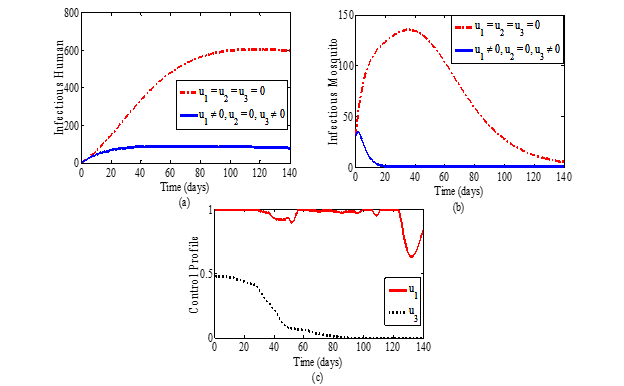
Malaria remains a global threat and the conventional methods used for combating the disease leave out mosquitoes that feed outdoors. This study addresses the challenge posed by such mosquitoes based on a tool called ivermectin drug which is lethal to mosquitoes that ingest bloodmeal containing a concentration of it. We formulated a mathematical model with three control tools (insecticide treated nets, treatment of infective individuals and ivermectin drug on livestock and humans) for the transmission and control of malaria under optimal condition. The model’s basic reproduction number, R0 was estimated and the local and global stability analyses of the disease-free and endemic equilibrium points of the model were carried out. Sensitivity analysis carried out showed that R0 is most sensitive to the mosquito biting rate and to the proportion of blood meal on human with cattle availability in such a way that any percent increase in the value of any of these parameters will lead to an equal percent increase in the value of R0. The result of an optimal control analysis based on three time dependent controls suggests that the combination of all three controls gives the best result followed by the strategy that combines the use of ivermectin drug and the treatment of infective human. Depending on available resources, any of these is recommended to be adopted in malaria intervention programmes because of their effectiveness on both the infective human and mosquito populations with the potential of contributing significantly to the disease elimination within a minimal time frame.
Published
How to Cite
Issue
Section
Copyright (c) 2024 Josephine E. Ochigbo, Joel N. Ndam, Wipuni U. Sirisena

This work is licensed under a Creative Commons Attribution 4.0 International License.
How to Cite
Similar Articles
- Umaru C. Obini, Chukwu Jeremiah, Sylvester A. Igwe, Development of a machine learning based fileless malware filter system for cyber-security , Journal of the Nigerian Society of Physical Sciences: Volume 6, Issue 4, November 2024
- Folake Lois Joseph, Adeyemi Sunday Olagunju, Emmanuel Oluseye Adeyefa, Adewale Adeyemi James, Hybrid Block Methods with Constructed Orthogonal Basis for Solution of Third-Order Ordinary Differential Equations , Journal of the Nigerian Society of Physical Sciences: Volume 5, Issue 1, February 2023
- O. G. Obadina, Adedayo Funmi Adedotuun, O. A. Odusanya, Ridge Estimation's Effectiveness for Multiple Linear Regression with Multicollinearity: An Investigation Using Monte-Carlo Simulations , Journal of the Nigerian Society of Physical Sciences: Volume 3, Issue 4, November 2021
- Kanak Saini, Monika Saini, Ashish Kumar, Dinesh Kumar Saini, Availability predictions of solar power plants using multiple regression and neural networks: an analytical study , Journal of the Nigerian Society of Physical Sciences: Volume 7, Issue 2, May 2025
- Jinta Jose, Rajesh K. Thumbakara, J. D. Thenge Mashale, Bobin George, Sijo P. George, Homomorphic and restricted homomorphic products of soft graphs , Journal of the Nigerian Society of Physical Sciences: Volume 7, Issue 1, February 2025
- O. J. Olusesi, K. J. Oyewumi, W. A. Yahya, The statistical ensemble of q-deformed hyperbolic modified P\"oschl-Teller potential for certain diatomic molecules through Euler-Maclaurin approach , Journal of the Nigerian Society of Physical Sciences: Volume 7, Issue 2, May 2025
- Segun L. Jegede, Adewale F. Lukman, Kayode Ayinde, Kehinde A. Odeniyi, Jackknife Kibria-Lukman M-Estimator: Simulation and Application , Journal of the Nigerian Society of Physical Sciences: Volume 4, Issue 2, May 2022
- G. A. Shewa, F. I. Ugwuowo, Combating the Multicollinearity in Bell Regression Model: Simulation and Application , Journal of the Nigerian Society of Physical Sciences: Volume 4, Issue 3, August 2022
- S. N. Enemuo, O. N. Akande, M. O. Lawrence, I. C. Saidu, Optimized aspect level sentiment analysis of tweet data using deep learning and rule-based techniques , Journal of the Nigerian Society of Physical Sciences: Volume 7, Issue 2, May 2025
- F. O. Aweda, J. A. Akinpelu, T. K. Samson, M. Sanni, B. S. Olatinwo, Modeling and Forecasting Selected Meteorological Parameters for the Environmental Awareness in Sub-Sahel West Africa Stations , Journal of the Nigerian Society of Physical Sciences: Volume 4, Issue 3, August 2022
You may also start an advanced similarity search for this article.