Optimal control with the effects of ivermectin and live stock availability on malaria transmission
Keywords:
Mathematical modeling, Malaria, Ivermectin, LivestockAbstract
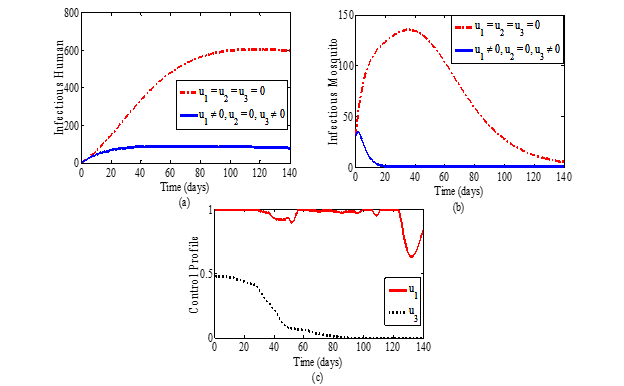
Malaria remains a global threat and the conventional methods used for combating the disease leave out mosquitoes that feed outdoors. This study addresses the challenge posed by such mosquitoes based on a tool called ivermectin drug which is lethal to mosquitoes that ingest bloodmeal containing a concentration of it. We formulated a mathematical model with three control tools (insecticide treated nets, treatment of infective individuals and ivermectin drug on livestock and humans) for the transmission and control of malaria under optimal condition. The model’s basic reproduction number, R0 was estimated and the local and global stability analyses of the disease-free and endemic equilibrium points of the model were carried out. Sensitivity analysis carried out showed that R0 is most sensitive to the mosquito biting rate and to the proportion of blood meal on human with cattle availability in such a way that any percent increase in the value of any of these parameters will lead to an equal percent increase in the value of R0. The result of an optimal control analysis based on three time dependent controls suggests that the combination of all three controls gives the best result followed by the strategy that combines the use of ivermectin drug and the treatment of infective human. Depending on available resources, any of these is recommended to be adopted in malaria intervention programmes because of their effectiveness on both the infective human and mosquito populations with the potential of contributing significantly to the disease elimination within a minimal time frame.
References
World Health Organization [WHO] (2022). World Malaria Report 2022 (Issue Brief No. 978-92-4-006489-8). Geneva, Switzerland. [Online]. Retrieved January 12, 2023 from https://www.who.int/teams/global-malaria-programme/reports/world-malaria-report-2022.
S. S. Kiware, N. Chitnis, S. J. Moore, G. J. Devine, S. Majambere & G. F. Killeen, “Simplified models of vector control impact upon malaria transmission by zoophagic mosquitoes”, PLoS One 7 (2012) 5. https://doi.org/10.1371/journal.pone.0037661.
World Health Organization (WHO), “Manual on environmental management for mosquito control with special emphasis on mosquito vectors”, 1982. https://iris.who.int/bitstream/handle/10665/37329/9241700661_eng.pdf.
C. J. Chaccour, N. R. Rabinovich, H. Slater, S. E. Canavati, T. Bousema, M. Lacerda, F. Kuile, C. Drakeley, Q. Bassat, B. D. Foy & K. Kobylinski, “Establishment of the ivermectin research for malaria elimination network: Updating the research agenda”, Malaria Journal 14 (2015) 243. https://doi.org/10.1186/s12936-015-0691-6.
M. L. Fritz, P. Y. Siegert, E. D. Walker, M. N. Bayoh, J. R. Vulule & J. R. Miller, “Toxicity of bloodmeals from ivermectin-treated cattle to Anopheles gambiaes.l”, Ann. Trop. Med. Para. 103 (2009) 6. https://doi.org/10.1179/000349809X12459740922138.
World Health Organization [WHO] (2016). World Malaria Report 2016. Geneva, Switzerland. (9789241511711-eng.pdf pp. 1–186). [Online]. Retrieved January 16, 2023 from https://apps.who.int/iris/rest/bitstreams/1069305/retrieve.
H. C. Slater, B. D. Foy, K. Kobylinski, C. Chaccour, O. J. Watson, J. Hellewell, G. Aljayyoussi, T. Bousema, J. Burrows, U. D’Alessandro, H. Alout, F. O. Ter Kuile, P. G. T. Walker, A. C. Ghani, M. R. Smit, “Ivermectin as a novel complementary malaria control tool to reduce incidence and prevalence: a modelling study”, Lancet Infect Dis. 20 (2020) 4. https://doi.org/10.1016/s1473-3099(19)30633-4.
H. C. Slater, P. G. Walker, T. Bousema, L. C. Okell & A. C.Ghani, “The potential impact of adding ivermectin to a mass treatment intervention to reduce malaria transmission: A modelling study”, J. Infect Dis. 210 (2014) 12. https://doi.org/10.1016/S1473-3099(19)30633-4.
A. O. Franco, M. G. M. Gomes, M. Rowland, P. G. Coleman & C. R. Davies, “Controlling malaria using livestock-based interventions: A one health approach”, PLoS ONE 9 (2014) 7. https://doi.org/10.1371/journal.pone.0101699.
L. Yakob, “Endectocide-treated cattle for malaria control: a coupled entomological epidemiological model”, Parasite Epidemiology and Control 1 (2016) 1. https://doi.org/10.1016/j.parepi.2015.12.001.
L. Yakob, M. Cameron & J. Lines, “Combining indoor and outdoor methods for controlling malaria vectors: an ecological model of endectocide-treated livestock and insecticidal bednets”, Malar. J. 16 (2017) 114. https://doi.org/10.1186/s12936-017-1748-5.
J. L. Waite, S. Swain, P. A. Lynch, S. K. Sharma, M. A. Haque, J. Montgomery & M. B. Thomas, “Increasing the potential for malaria elimination by targeting zoophilic vectors”, Sci. Rep. 7 (2017) 40551. https://doi.org/10.1038/srep40551.
J. E. Ochigbo, M. I. Ali, O. E. Oche, C. E. Okorie & K. A. Adamu, “Mathematical model with relapse and the effect of ivermectin on malaria transmission dynamics”, International Journal of Research and Innovation in Applied Science IV (2019) 1. https://www.academia.edu/85907846/Mathematical_Model_with_Relapse_and_the_Effect_of_Ivermectin_on_Malaria_Transmission_Dynamics.
L. S. Pontryagin, V. G. Boltyanskii, R. V. Gamkrelidze & E. F. Mishchenko, The mathematical theory of optimal processes, Wiley, New York, Sydney, 1962, pp. 1–360. https://doi.org/10.1002/zamm.19630431023.
K. O. Okosun, R. Ouifki & N. Marcus, “Optimal control analysis of a malaria disease transmission model that includes treatment and vaccination with waning immunity”, Biosystems 106 (2011) 2. https://doi.org/10.1016/j.biosystems.2011.07.006.
B. M. Adams, H. T. Banks, H. Kwon & H. T. Tran, “Dynamic multidrug therapy for HIV: Optimal and STI control approaches”, Mathematical Biosciences and Engineering 1 (2004) 2. https://doi.org/10.3934/mbe.2004.1.223.
K. O. Okosun, O. Rachid & N. Marcus, “Optimal control strategies and cost-effectiveness analysis of a malaria model”, Biosystems 111 (2013) 2. https://doi.org/10.1016/j.biosystems.2012.09.008.
O. G. Otieno, Optimal control strategies for minimizing malaria transmission in Kenya, Ph.D dissertation, Department of Biostatistics, Moi University, Eldoret, Kenya, 2016, pp. 1–197. http://ir.mu.ac.ke:8080/xmlui/bitstream/handle/123456789/1058/Okello$%$20Gabriel$%$20Otieno$%$202016.pdf?sequence=1$&$isAllowed=y.
S. Olaniyi, K. O. Okosun, S. O. Adesanya & R. S. Lebeloe, “Modelling malaria dynamics with partial immunity and protected travelers: Optimal control and cost-effectiveness analysis”, Journal of Biological Dynamics 14 (2020) 1. https://doi.org/10.1080/17513758.2020.1722265.
J. L. Willems, Stability theory of dynamical systems, Wiley Interscience Division, Nelson, New York, 1970, pp. 1–201. https://books.google.com.ng/books/about/Stability_Theory_of_Dynamical_Systems.html?id=dlivAAAAIAAJ&redir_esc=y.
J. P. LaSalle, The Stability of Dynamical Systems, SIAM, Philadelphia, Philadelphia, Pennsylvania, 1976, pp. 1–76. https://epubs.siam.org/doi/pdf/10.1137/1.9781611970432.fm.
C. Castillo-Chavez & B. Song, “Dynamical models of tuberculosis and their applications”, Mathematical Biosciences and Engineering 1 (2004) 2. https://doi.org/10.3934/mbe.2004.1.361.
N. Chitnis, J. M. Hyman & J. M. Cushing, “Determining important parameters in the spread of malaria through the sensitivity analysis of a mathematical model”, Bulletin of Mathematical Biology 70 (2008) 5. https://doi.org/10.1007/s11538-008-9299-0.
B. Kbenesh, C. Yanzhao & K. Hee-Dae, “Optimal control of vector-borne diseases: treatment and prevention”, Discrete Continuous Dynamical System series B. 11 (2009) 3. https://doi.org/10.3934/dcdsb.2009.11.587.
O. D. Makinde & K. O. Okosun, “Impact of chemo-therapy on optimal control of malaria disease with infected immigrants”, BioSystems 104 (2011) 1. https://doi.org/10.1016/j.biosystems.2010.12.010.
R. J. Smith & S. D. Hove-Musekwa, “Determining e?ective spraying periods to control malaria via indoor residual spraying in sub-saharan Africa”, Journal of Applied Mathematics and Decision Sciences 2008 (2008) 745463. https://doi.org/10.1155/2008/745463.
G. G. Mwanga, H. Haario & B. K.Nannyonga, “Optimal control of malaria model with drug resistance in presence of parameter uncertainty”, Applied Mathematical Sciences 8 (2014) 55. http://dx.doi.org/10.12988/ams.2014.43197.
J. A. M. Felippe de Souza, A. L. C. Marco & Y. Takashi, ”Optimal control theory applied to the Anti-viral treatment of AIDS”, Proceedings of the IEEE Conference on Decision and Control, Sydney, 2000, pp. 4839–4844. https://doi.org/10.1109/CDC.2001.914696.
D. Kirschner, S. Lenhart & S. Serbin, “Optimal control of the chemotherapy of HIV”, J. Math. Biol. 35 (1997) 775. https://doi.org/10.1007/s002850050076.
F. B. Agusto, N. Marcus & K. O. Okosun, “Application of optimal control to the epidemiology of malaria”, Electronic Journal of Di?erential Equations 81 (2012) 1. http://ejde.math.txstate.edu.
K. O. Okosun & O. D. Makinde, “A co-infection model of malaria and cholera diseases with optimal control”, Mathematical Biosciences 258 (2014) 19. https://doi.org/10.1016/j.mbs.2014.09.008.
W. H. Fleming & R. W. Rishel, Deterministic and stochastic optimal control, Springer Verlag, New York, 1975, pp. 1–222. https://doi.org/10.1007/978-1-4612-6380-7.
S. Lenhart & J. T. Workman, ”Optimal control applied to biological models”, Chapman & Hall/CRC Mathematical and Computational Biology Series, Chapman & Hall/CRC, Boca Raton, Florida, 2007, pp. 1–261. https://doi.org/10.1201/9781420011418.
H. S. F. Rodrigues, Optimal control and numerical optimization applied to epidemiological models, Ph.D dissertation, Departamento de Matemática, Universidade de Aveiro, Aveiro, Portugal, 2012, pp. 1–162. https://core.ac.uk/download/pdf/15569819.pdf.
Published
How to Cite
Issue
Section
Copyright (c) 2024 Josephine E. Ochigbo, Joel N. Ndam, Wipuni U. Sirisena

This work is licensed under a Creative Commons Attribution 4.0 International License.