Data safety prediction using YOLOv7+G3HN for traffic roads
Keywords:
Vehicle detection, Near miss detection, YOLOv7+G3HN, Machine LearningAbstract
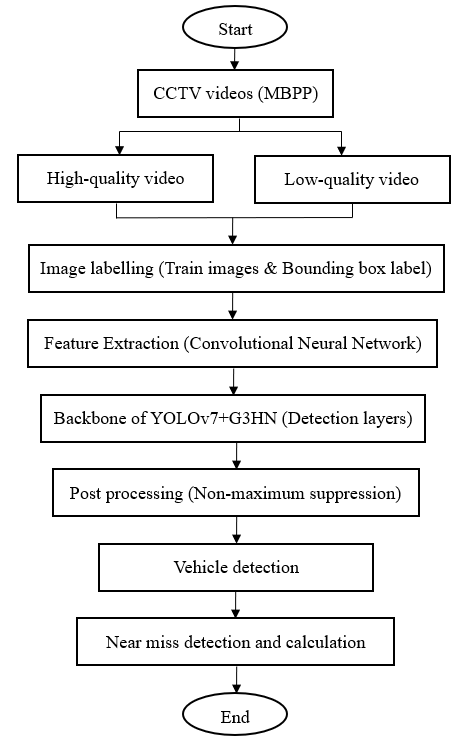
Pulau Pinang has introduced several measures to enhance traffic safety and promote sustainability, including the installation of CCTV systems and the implementation of smart solutions and green technology as part of the Penang 2030 vision, aligning with the Sustainable Development Goals (SDGs). However, despite these efforts, road accidents persist due to non-optimised detection models, incomplete data from manual reporting, and technological constraints in real-time video analysis and predictive modelling. This study evaluates the effectiveness of the YOLOv7+G3HN framework for vehicle detection and near-miss analysis, with a focus on the influence of video quality on detection performance. The research aims to understand how high- and low-quality video inputs affect the accuracy and computational efficiency of detection algorithms. High[1]quality videos resulted in significantly faster computation times for vehicle detection than low-quality videos, highlighting the importance of video resolution in optimising detection processes. Despite the robustness of the algorithm, with no errors detected in both video qualities, higher miss detection rates in low-quality videos suggest that lower resolution may compromise detection accuracy and the effectiveness of monitoring systems. Near-miss analysis revealed that high-quality videos had a lower probability of near-miss occurrences than low-quality videos, highlighting the importance of video resolution for detection efficacy. These findings emphasise the critical role of high-resolution video inputs in enhancing detection accuracy and reliability, advocating for their implementation to optimise vehicle detection and improve road safety. Additionally, YOLOv7+G3HN outperforms YOLOv7 in both accuracy and speed. The study concludes that the YOLOv7+G3HN framework is effective for vehicle detection and near-miss analysis, provided that video quality is considered in system design and implementation.
Published
How to Cite
Issue
Section
Copyright (c) 2024 Lek Ming Lim, Yang Lu, Ahmad Sufril Azlan Mohamed, Majid Khan Majahar Ali

This work is licensed under a Creative Commons Attribution 4.0 International License.
How to Cite
Similar Articles
- Gabriel James, Anietie Ekong, Etimbuk Abraham, Enobong Oduobuk, Peace Okafor, Analysis of support vector machine and random forest models for predicting the scalability of a broadband network , Journal of the Nigerian Society of Physical Sciences: Volume 6, Issue 3, August 2024
- Gabriel James, Ime Umoren, Anietie Ekong, Saviour Inyang, Oscar Aloysius, Analysis of support vector machine and random forest models for classification of the impact of technostress in covid and post-covid era , Journal of the Nigerian Society of Physical Sciences: Volume 6, Issue 3, August 2024
- David Opeoluwa Oyewola, Emmanuel Gbenga Dada, Juliana Ngozi ndunagu, Terrang Abubakar Umar, Akinwunmi S.A, COVID-19 Risk Factors, Economic Factors, and Epidemiological Factors nexus on Economic Impact: Machine Learning and Structural Equation Modelling Approaches , Journal of the Nigerian Society of Physical Sciences: Volume 3, Issue 4, November 2021
- O. E. Ojo, A. Gelbukh, H. Calvo, O. O. Adebanji, Performance Study of N-grams in the Analysis of Sentiments , Journal of the Nigerian Society of Physical Sciences: Volume 3, Issue 4, November 2021
- Silifat Adaramaja Abdulraheem, Salisu Aliyu, Fatima Binta Abdullahi, Hyper-parameter tuning for support vector machine using an improved cat swarm optimization algorithm , Journal of the Nigerian Society of Physical Sciences: Volume 5, Issue 4, November 2023
- Ogochukwu C. Okeke, Ike J. Mgbeafulike, Anthony I. Adigwe, Chidiogo C. Nwokedi, Nwadiogo E. G. Mmaduakonam, Calista U. Okpala, Chinonso J. Okonkwo, Nnamdi C. Ezenwegbu, SAE-IF: A hybrid sparse autoencoder–isolation forest framework for real-time credit-card fraud detection and sustainable digital-economy protection , Journal of the Nigerian Society of Physical Sciences: Volume 8, Issue 3, August 2026
- Muhammad Dahiru Liman, Salamatu Ibrahim Osanga, Esther Samuel Alu, Sa'adu Zakariya, Regularization Effects in Deep Learning Architecture , Journal of the Nigerian Society of Physical Sciences: Volume 6, Issue 2, May 2024
- A. E. Ibor, D. O. Egete, A. O. Otiko, D. U. Ashishie, Detecting network intrusions in cyber-physical systems using deep autoencoder-based dimensionality reduction approach anddeep neural networks , Journal of the Nigerian Society of Physical Sciences: Volume 7, Issue 3, August 2025
- O. J. Ibidoja, F. P. Shan, Mukhtar, J. Sulaiman, M. K. M. Ali, Robust M-estimators and Machine Learning Algorithms for Improving the Predictive Accuracy of Seaweed Contaminated Big Data , Journal of the Nigerian Society of Physical Sciences: Volume 5, Issue 1, February 2023
- P. O. Odion, M. N. Musa, S. U. Shuaibu, Age Prediction from Sclera Images using Deep Learning , Journal of the Nigerian Society of Physical Sciences: Volume 4, Issue 3, August 2022
You may also start an advanced similarity search for this article.
Most read articles by the same author(s)
- Nour Hamad Abu Afouna, Majid Khan Majahar Ali, Optimizing precision farming: enhancing machine learning efficiency with robust regression techniques in high-dimensional data , Journal of the Nigerian Society of Physical Sciences: Volume 7, Issue 1, February 2025