Data safety prediction using YOLOv7+G3HN for traffic roads
Keywords:
Vehicle detection, Near miss detection, YOLOv7+G3HN, Machine LearningAbstract
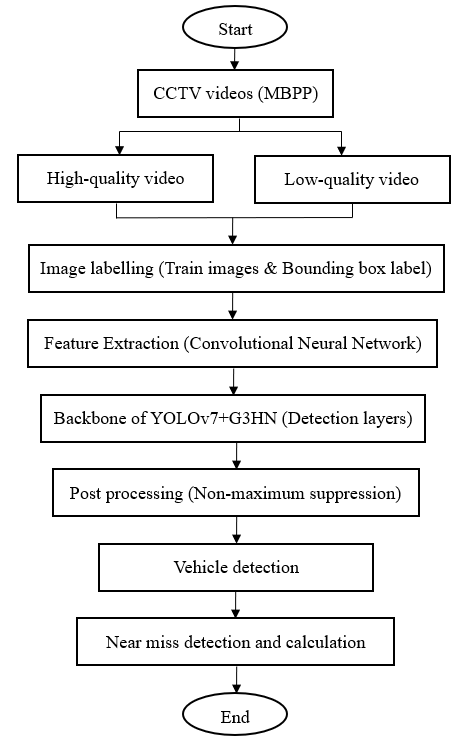
Pulau Pinang has introduced several measures to enhance traffic safety and promote sustainability, including the installation of CCTV systems and the implementation of smart solutions and green technology as part of the Penang 2030 vision, aligning with the Sustainable Development Goals (SDGs). However, despite these efforts, road accidents persist due to non-optimised detection models, incomplete data from manual reporting, and technological constraints in real-time video analysis and predictive modelling. This study evaluates the effectiveness of the YOLOv7+G3HN framework for vehicle detection and near-miss analysis, with a focus on the influence of video quality on detection performance. The research aims to understand how high- and low-quality video inputs affect the accuracy and computational efficiency of detection algorithms. High[1]quality videos resulted in significantly faster computation times for vehicle detection than low-quality videos, highlighting the importance of video resolution in optimising detection processes. Despite the robustness of the algorithm, with no errors detected in both video qualities, higher miss detection rates in low-quality videos suggest that lower resolution may compromise detection accuracy and the effectiveness of monitoring systems. Near-miss analysis revealed that high-quality videos had a lower probability of near-miss occurrences than low-quality videos, highlighting the importance of video resolution for detection efficacy. These findings emphasise the critical role of high-resolution video inputs in enhancing detection accuracy and reliability, advocating for their implementation to optimise vehicle detection and improve road safety. Additionally, YOLOv7+G3HN outperforms YOLOv7 in both accuracy and speed. The study concludes that the YOLOv7+G3HN framework is effective for vehicle detection and near-miss analysis, provided that video quality is considered in system design and implementation.
Published
How to Cite
Issue
Section
Copyright (c) 2024 Lek Ming Lim, Yang Lu, Ahmad Sufril Azlan Mohamed, Majid Khan Majahar Ali

This work is licensed under a Creative Commons Attribution 4.0 International License.
How to Cite
Similar Articles
- V Umarani, A Julian, J Deepa, Sentiment Analysis using various Machine Learning and Deep Learning Techniques , Journal of the Nigerian Society of Physical Sciences: Volume 3, Issue 4, November 2021
- Paavithashnee Ravi Kumar, Majid Khan Majahar Ali, Olayemi Joshua Ibidoja, Identifying heterogeneity for increasing the prediction accuracy of machine learning models , Journal of the Nigerian Society of Physical Sciences: Volume 6, Issue 3, August 2024
- Akila Dabara Kayit, Mohd Tahir Ismail, Novel way to predict stock movements using multiple models and comprehensive analysis: leveraging voting meta-ensemble techniques , Journal of the Nigerian Society of Physical Sciences: Volume 6, Issue 3, August 2024
- George Muddu, Shefiu Olusegun Ganiyu, Adekunle Olugbenga Ejidokun, Yusuf Abass Aleshinloye, Integrated data-driven credit default prediction in Uganda using machine learning models , Journal of the Nigerian Society of Physical Sciences: Volume 8, Issue 1, February 2026
- Raphael Ozighor Enihe, Rajesh Prasad, Francisca Nonyelum Ogwueleka, Fatimah Binta Abdullahi, The effect of imbalance data mitigation techniques on cardiovascular disease prediction , Journal of the Nigerian Society of Physical Sciences: Volume 7, Issue 2, May 2025
- Mahesh Kumar Singh, Arun Kumar Singh, Pushpa Choudhary, Akhilesh Kumar Singh, Lalit Kumar Tyagi, A practical deep learning framework for multi-class skin cancer detection using U-Net segmentation and ResNet50 transfer learning , Journal of the Nigerian Society of Physical Sciences: Volume 8, Issue 3, August 2026
- O. Oderinde, C. L. Mgbechidinma, A. O. Agbeja, A. A. Ajayi, A. O. Ogundiran, O. O. Olaide, O. A. Orelaja, C. A. Mgbechidimma, C. O. Ajanaku, K. D. Oyeyemi, Appraising raw exhaust pollutant gases emissions from industrial generators using statistics and machine learning approaches , Journal of the Nigerian Society of Physical Sciences: Volume 7, Issue 4, November 2025
- Timothy Kayode Samson, Francis Olatunbosun Aweda, Wind speed prediction in some major cities in Africa using Linear Regression and Random Forest algorithms , Journal of the Nigerian Society of Physical Sciences: Volume 6, Issue 4, November 2024
- Gabriel James, Ifeoma Ohaeri, David Egete, John Odey, Samuel Oyong, Enefiok Etuk, Imeh Umoren, Ubong Etuk, Aloysius Akpanobong, Anietie Ekong, Saviour Inyang, Chikodili Orazulume, A fuzzy-optimized multi-level random forest (FOMRF) model for the classification of the impact of technostress , Journal of the Nigerian Society of Physical Sciences: Volume 7, Issue 3, August 2025
- David Opeoluwa Oyewola, Emmanuel Gbenga Dada, Juliana Ngozi ndunagu, Terrang Abubakar Umar, Akinwunmi S.A, COVID-19 Risk Factors, Economic Factors, and Epidemiological Factors nexus on Economic Impact: Machine Learning and Structural Equation Modelling Approaches , Journal of the Nigerian Society of Physical Sciences: Volume 3, Issue 4, November 2021
You may also start an advanced similarity search for this article.
Most read articles by the same author(s)
- Nour Hamad Abu Afouna, Majid Khan Majahar Ali, Optimizing precision farming: enhancing machine learning efficiency with robust regression techniques in high-dimensional data , Journal of the Nigerian Society of Physical Sciences: Volume 7, Issue 1, February 2025