Non-monochromatic laser assist scattering in thermal environment
Keywords:
Non-monochromatic laser fields, Differential cross section, Thermal environment, Electron-atom interactions, Quantum controlAbstract
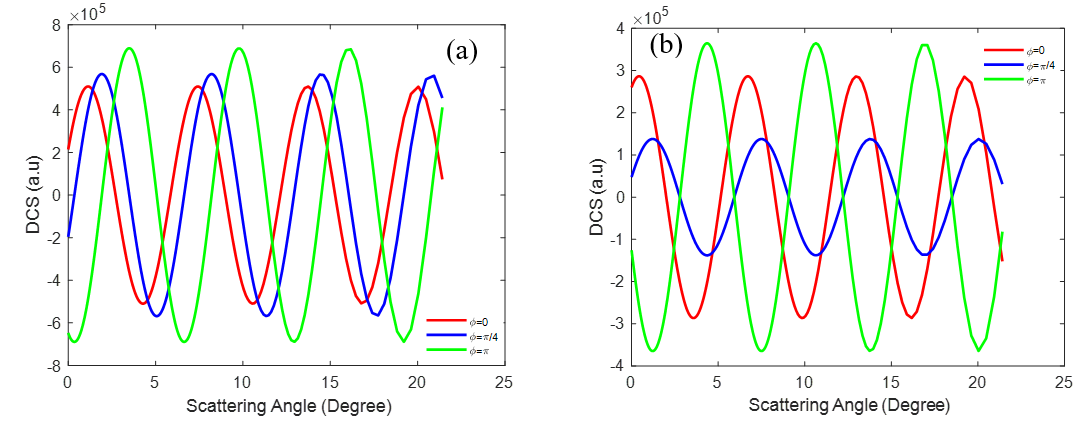
This study aims to investigate the differential cross-section (DCS) in a non-monochromatic laser-assisted thermal environment. Building on existing research, which primarily explores electron dynamics and ionization processes without considering thermal effects, this work seeks to bridge this research gap by examining the DCS under non-monochromatic laser fields in a thermal environment. The methodology involves utilizing a vector potential derived by Milosvic to represent non-monochromatic laser fields and applying a semi-classical approximation with the help of Volkov solutions. The S-matrix is then obtained to study the DCS. The developed model was computed to analyze the nature of the DCS. The results indicate that the DCS for photon absorption is higher than for emission due to atomic oscillation/excitation. This causes atom expansion upon absorption and a decrease in field strength during emission. Furthermore, the DCS behavior varies with the phase of the non-monochromatic wave and polarization, with distinct patterns observed for absorption and emission scenarios. The DCS with energy at different rates of absorption and emission exhibits a damping nature. Additionally, the DCS shows oscillatory behavior with separation distance, displaying higher values for absorption and varying with laser phase. The findings provide valuable insights into electron-atom interactions under laser fields in thermal conditions, with implications for quantum thermal machines, photochemistry, proton exchange membrane fuel cells (PEMFC), and more.
Published
How to Cite
Issue
Section
Copyright (c) 2024 Saddam Husain Dhobi, Kishori Yadav, ]{Suresh Prasad Gupta, Jeevan Joyti Nakarmi, Ajay Kumar Jha

This work is licensed under a Creative Commons Attribution 4.0 International License.
How to Cite
Similar Articles
- F. U. Salifu, O. A. Oladipo, E. O. Ebock, B. Nava, Deep neural network model for vertical total electron content prediction at a single low latitude station , Journal of the Nigerian Society of Physical Sciences: Volume 7, Issue 4, November 2025
- O. A. Uwaheren, A. F. Adebisi, O. A. Taiwo, Perturbed Collocation Method For Solving Singular Multi-order Fractional Differential Equations of Lane-Emden Type , Journal of the Nigerian Society of Physical Sciences: Volume 2, Issue 3, August 2020
- S. O. Salawu, R. A. Kareem, J. O. Ajilore, Eyring-Powell MHD nanoliquid and entropy generation in a porous device with thermal radiation and convective cooling , Journal of the Nigerian Society of Physical Sciences: Volume 4, Issue 4, November 2022
- Olumide O. Olaiya, Rasaq A. Azeez, Mark I. Modebei, Efficient Hybrid Block Method For The Numerical Solution Of Second-order Partial Differential Problems via the Method of Lines , Journal of the Nigerian Society of Physical Sciences: Volume 3, Issue 1, February 2021
- Adefunke Bosede Familua, Ezekiel Olaoluwa Omole, Luke Azeta Ukpebor, A Higher-order Block Method for Numerical Approximation of Third-order Boundary Value Problems in ODEs , Journal of the Nigerian Society of Physical Sciences: Volume 4, Issue 3, August 2022
- J. O. Kuboye, O. R. Elusakin, O. F. Quadri, Numerical Algorithms for Direct Solution of Fourth Order Ordinary Differential Equations , Journal of the Nigerian Society of Physical Sciences: Volume 2, Issue 4, November 2020
- Solomon A. Ayuba, I. Akeyede, A. S. Olagunju, Stability and Sensitivity Analysis of Dengue-Malaria Co-Infection Model in Endemic Stage , Journal of the Nigerian Society of Physical Sciences: Volume 3, Issue 2, May 2021
- Victor Oboni Atabo, Solomon Ortwer Adee, A New Special 15-Step Block Method for Solving General Fourth Order Ordinary Differential Equations , Journal of the Nigerian Society of Physical Sciences: Volume 3, Issue 4, November 2021
- Oluwole Adigun, Lasisi Egibunu Umoru, Temidayo Nancy Iwatan, Effects of different electrolytes on the structure and yield ofgraphene oxide produced via electrochemical exfoliation , Journal of the Nigerian Society of Physical Sciences: Volume 5, Issue 4, November 2023
- Saheed Ajao, Isaac Olopade, Titilayo Akinwumi, Sunday Adewale, Adelani Adesanya, Understanding the Transmission Dynamics and Control of HIV Infection: A Mathematical Model Approach , Journal of the Nigerian Society of Physical Sciences: Volume 5, Issue 2, May 2023
You may also start an advanced similarity search for this article.