Software Process Ontology: A case study of software organisations software process sub domains
Keywords:
Software Process, Software Process Ontology, Ontology, Knowledge, Formal Representation, Knowledge RepresentationAbstract
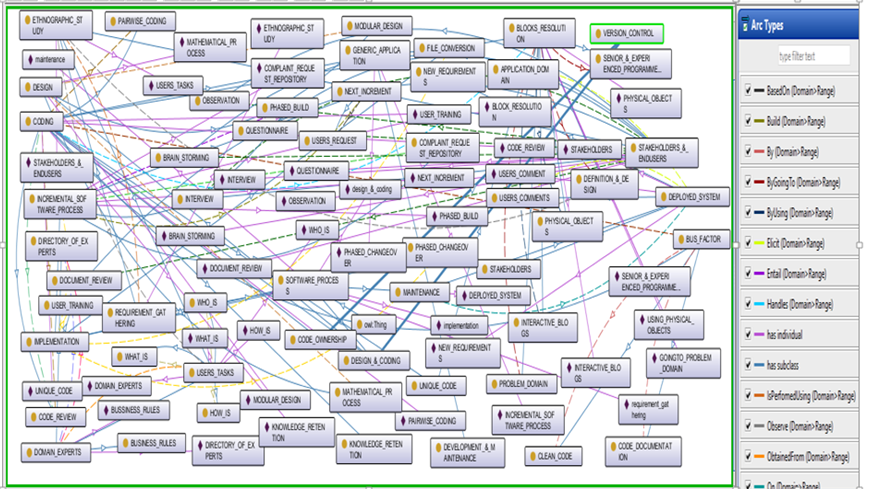
In a domain like software process that is intensively knowledge driven, transforming intellectual knowledge by formal representation is an invaluable requirement. An improved use of this knowledge could lead to maximum payoff in software organisations which is key. The purpose of formal representation is to help organisations achieve success by modelling successful organisations. In this paper, Software process knowledge from successful organisations was harvested and formally modeled using ontology. Domain specific knowledge base ontology was produced for core software process subdomain, with its resulting software process ontology produced.
References
I. Rus and M. Lindvall, “Knowledge Management in Software Engineering” IEEE Software 19 (2002) 26.
D. O'Leary, “Using AI in knowledge management: knowledge bases and ontologies” IEEE Intelligent Systems, 13 (1998) 34
T. H. Davenport and L. Prusak, “Working Knowledge – How Organizations Manage What They Know. Harvard Business School Press, Boston, Massachusetts”. (1998)
O. Mendes and A. Abran, “Issues in the Development of an Ontology for an Emerging Engineering Discipline. First Workshop on Ontology, Conceptualizations and Epistemology for Software and Systems Eng. (ONTOSE)”. Alcalá Henares, Spain (2005)
M. A., Sicilia, J. J. Cuadrado, E. García, D. Rodríguez and J.R. Hilera J.R., ”The Evaluation of Ontological Representation of the SWEBOK as a Revision Tool. In: 29th Int. Computer Software and Application Conference (COMPSAC)”, Edinburgh, UK. (2005) 26
P. Wongthongtham, E. Chang, T. Dillon, and I. Sommerville, “Development of a Software Engineering Ontology for Multisite Software Development. IEEE Transactions on Knowledge and Data Engineering” 21 (8) (2009) 1205
C. Calero, F. Ruiz and M. Piattini, “Ontologies for Software Engineering and Software Technology. Springer Science & Business Media.”. (2006)
E. F. Souza, R.A.Falbo and N.L.Vijaykumar, “Using Ontology Patterns for Building a Reference Software Testing Ontology. In: 17th IEEE Int. Enterprise Distributed Object Computing Conference Workshops (EDOCW)” Vancouver (2013) 21
C. González-Pérez and B. Henderson-Sellers, “An Ontology for Software Development Methodologies and Endeavour” (2006). In: [7] A.C.Bringuente, R.A. Falbo and G. Guizzardi, “Using a Foundational Ontology for Reengineering a Software Process Ontology. Journal of Information and Data Management” 2 (3) (2011) 511.
R. F. Calhau and R.A. Falbo, “An Ontology-based Approach for Semantic Integration. In: 14th IEEE International Enterprise Distributed Object Computing Conference, Vitória, Brazil. Los Alamitos: IEEE Computer Society” (2010) 111-120
F. Borges Ruy, R. de Almeida Falbo, M. Perini Barcellos, S. Dornelas Costa and G. Guizzardi “SEON: A Software Engineering Ontology Network” (2016). In: E. Blomqvist , P. Ciancarini, F. Poggi and F. Vitali (eds) “Knowledge Engineering and Knowledge Management. EKAW 2016. Lecture Notes in Computer Science” Springer, Cham (2016) 10024
A. Zouaq and R. Nkambou, “Evaluating the generation of domain ontologies in the knowledge puzzle project. IEEE Transactions on Knowledge and Data Engineering”, 21(2009) 1559–1572. http://dx.doi.org/10.1109/TKDE.2009.25
M. D. Kickmeier-Rust and D. Albert, “The ELEKTRA ontology model: A learner-centered approach to resource description. Advances in Web Based Learning – ICWL 2007”. Lecture Notes in Computer Science. Berlin: Springer. 4823 (2008) 78
T. R. Gruber, “Toward principles for the design of ontologies used for knowledge sharing?”. International Journal of Human-Computer Studies, 43, (1995) 907–928. http://dx.doi.org/10.1006/ijhc.1995.1081
A. Zouaq and R. Nkambou, Building domain ontologies from text for educational purposes. IEEE Transactions on Learning Technologies, 1 (2008) 49–62. http://dx.doi.org/10.1109/TLT.2008.12
M. Alavi, and D. E. Leidner, ’Knowledge management and knowledge management systems: Conceptual foundations and research issues”. MIS Quarterly, 25 (2001) 107.
R. K Taluja, C.K. Tewari and A. Kaur, “Concept of Knowledge Management and Its Usage in Higher Learning Institutions”. VSRD-TNTJ. I (4) (2010) 255
E. Perez, “Knowledge Management in the Library—Not. Database Magazine” 22(2) (1999) 75.
K. M. Kidwell, L. Vander and S.L. Johnson, “Applying corporate knowledge management practices in higher education”, Journal of Educause Quarterly 4, (2000) 28.
Firestone “ Key Issues in Knowledge Management, Knowledge and Innovation”. Journal of the KMCI; 1(3) (2001) 8.
A.P.J. Abdul-Kalam, “Digital Library and its multidimensions”. President of India’s speech at the “Inauguration of International Conference on Digital Libraries (ICDL) retrieved 16/9/18 from: http://www.presidentofindia.nic.in/scripts/sllatest1.jsp?id=282 (2004)
R. O. Oveh and F.A. Egbokhare, “Harvesting and Informal Representation of Software Process Domain Knowledge”. Intelligent Computing Conference, 2 (2019)936–947. Springer Nature Switzerland
J. Ward and A. Aurum, “Knowledge Management in Software Engineering - Describing the Process”. Proceedings of the 2004 Australian Software Engineering Conference (ASWEC’04) (2004)
P., Wongthongtham, N. Kasisopha, E. Chang and T. Dillon, “A Software Engineering Ontology as Software Engineering Knowledge Representation”. International Conference on Convergence and Hybrid Information Technology. IEEE. (2008) 668
R. A. Falbo and G. Bertollo, “A software process ontology as a common vocabulary about software processes”. International Journal of Business Process Integration and Management. 4 (2009) 239
M. Gruninger and M. S. Fox, “Methodology for the design and evaluation of ontologies”. In IJCAI95 Workshop on Basic Ontological Issues in Knowledge Sharing, Montreal. (1995)
N. F. Noy and D. L. McGuiness, “Ontology Development 101: A Guide to Creating Your First Ontology”, Stanford Knowledge Systems Laboratory Technical Report KSL-01-05 and Stanford Medical Informatics Technical Report SMI-2001-0880 (2001).
B. Kapoor and S. Sharma, “A Comparative Study Ontology Building Tools for Semantic Web Applications”. International Journal of Web and Semantic Technology, 1 (2010) 1.
A. F. Sawsaa, “Ontological Engineering Approach of Developing Ontology of Information Science”. Anchor Academic Publishing. https://books.google.com.ng/books?isbn=3954894483 (2015)
O. Corcho and A. Gomez-Perez, “A Roadmap to Ontology Specification Languages”, in Rose Dieng and Olivier Corby (eds.), Knowledge Engineering and Knowledge Management. Methods, Models and Tools, Springer, Berlin, (2000) 80.
Published
How to Cite
Issue
Section
Copyright (c) 2019 Journal of the Nigerian Society of Physical Sciences

This work is licensed under a Creative Commons Attribution 4.0 International License.