Synergistic intelligence: a novel hybrid model for precision agriculture using k-means, naive Bayes, and knowledge graphs
Keywords:
Hybrid knowledge discovery, Precision agriculture, K-means clustering, Knowledge graphsAbstract
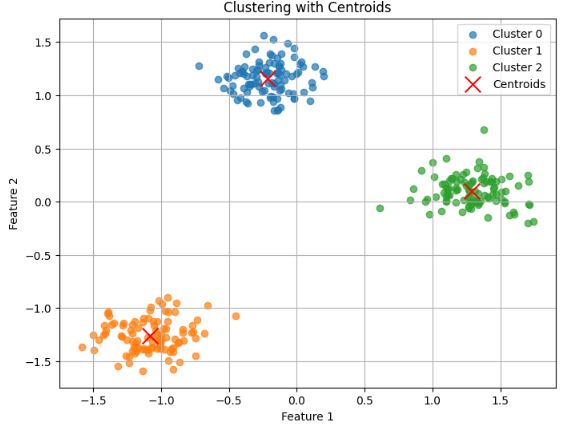
This study presents a novel hybrid knowledge discovery model integrating K-Means clustering, Naive Bayes classification, and Knowledge Graph technology to address interpretability and data heterogeneity challenges in precision agriculture. The proposed framework first applies K-Means to segment agro-ecological zones using multi-source data (soil, climate, satellite imagery), then employs Naive Bayes to classify crop productivity tiers, achieving 89% accuracy—surpassing standalone benchmarks (Naive Bayes: 86%, Random Forest: 87.5%). A Neo4j-based Knowledge Graph contextualizes these outputs, demonstrating 95% schema completeness and efficient querying (0.1559s latency), while enabling dynamic analysis of soil-climate-crop relationships. Pilot trials confirmed actionable impacts, including 22% reduced water use and 18% less fertilizer waste in targeted farms. By unifying unsupervised/supervised learning with semantic reasoning, this work advances scalable, interpretable decision support systems for sustainable agriculture, offering a replicable template for global food security initiatives.
References
[1] FAO, IFAD, UNICEF, WFP & WHO, “The state of food security and nutrition in the world 2020. Transforming food systems for affordable healthy diets”, Rome, FAO, 2020. https://doi.org/10.4060/ca9692en.
[2] S. O. Araújo, R. S. Peres, J. C. Ramalho, F. Lidon & J. Barata, “Machine learning applications in agriculture: Current trends, challenges, and future perspectives”, Agronomy 13 (2023) 2976. https://doi.org/10.3390/agronomy13122976.
[3] S. A. Bhat, N. Huang, I. B. Sofi & F. Khan, “Data-driven agriculture: Applications, challenges, and opportunities”, Journal of King Saud University - Computer and Information Sciences 33 (2021) 100913. https://doi.org/10.1016/j.jksuci.2021.09.006.
[4] Z. Li, G. Chen, T. Zhang, et al., “Integration of remote sensing and machine learning for precision agriculture: A comprehensive perspective on applications”, Agronomy 14 (2024) 1975. https://doi.org/10.3390/agronomy14091975.
[5] R. P. Khan, S. Gupta, T. Daum, R. Birner & C. Ringler, “Levelling the field: A review of the ICT revolution and agricultural extension in the global south”, Journal of International Development 37 (2024) 1. https://doi.org/10.1002/jid.3949.
[6] R. K. Raghuwanshi & R. K. Tiwari, “A comprehensive review of data mining in the agricultural sector in India”, Journal of Advances in Science and Technology 21 (2024) 441. https://doi.org/10.29070/g2syer82.
[7] U. Fayyad, G. Piatetsky-Shapiro & P. Smyth, “From data mining to knowledge discovery in databases”, AI Magazine 17 (1996) 37. https://doi.org/10.1609/aimag.v17i3.1230.
[8] R. Srivaramangai, R. Patil & V. Mahajan, “Applications of various data mining techniques used in agriculture sector to increase productivity”, International Journal of Research and Analytical Reviews 5 (2018) 1100. https://www.ijrar.org/papers/IJRAR1944356.pdf.
[9] K. G. Liakos, P. Busato, D. Moshou, S. Pearson & D. Bochtis, “Machine learning in agriculture: A review”, Sensors 18 (2018) 2674. https://doi.org/10.3390/s18082674.
[10] J. Sheng, J. Amankwah-Amoah, Z. Khan & X. Wang, “Big data analytics and machine learning: A retrospective overview and bibliometric analysis”, Expert Systems with Applications 184 (2021) 115561. https://doi.org/10.1016/j.eswa.2021.115561.
[11] K. Rendall, A. Nisioti & A. Mylonas, “Towards a multi-layered phishing detection”, Sensors 20 (2020) 4540. https://doi.org/10.3390/s20164540.
[12] Y. Zhao, C. C. Zhou & J. K. Bellonio, “Multilayer value metrics using lexical link analysis and game theory for discovering innovation from big data and crowd-sourcing”, in 2016 IEEE/ACM International Conference on Advances in Social Networks Analysis and Mining (ASONAM), San Francisco, CA, USA: IEEE, 2018, p. 1145. https://doi.org/10.1109/asonam.2018.8508498.
[13] I. A. Ayinde, O. A. Otekunrin, S. O. Akinbode, O. A. Otekunrin, “Food security in Nigeria: Impetus for growth and development”, Journal of Agricultural Economics and Human Development 6 (2020) 800. https://doi.org/10.6084/m9.figshare.12949352.v1.
[14] D. Odunze, “A review of the Nigerian agricultural promotion policy (2016-2020): Implications for entrepreneurship in the agribusiness sector”, International Journal of Agricultural Policy and Research 7 (2019) 1. https://doi.org/10.15739/ijapr.19.008.
[15] A. Kamilaris & F. X. Prenafeta-Boldú, “Machine learning in agriculture: A comprehensive updated review”, Sensors 21 (2021) 3758. https://doi.org/10.3390/s21113758.
[16] P. Monnin, M. Carlsson, V. Court, “Development of a knowledge graph framework to ease and empower translational approaches in plant research: a use-case on grain legumes”, Frontiers in Artificial Intelligence 6 (2023) 1191122. https://doi.org/10.3389/frai.2023.1191122.
[17] H. Chi, J. Liu, J. Wu, K. Lin, J. Gong, Z. Chen, “A review of research on multimodal knowledge graphs in agriculture”, Proceedings Volume 12937, International Conference on Internet of Things and Machine Learning (IoTML 2023), p. 16, 2023. https://doi.org/10.1117/12.3013264.
[18] X. Liu, Y. Wang, H. Zhang, “Knowledge graph for integration and quality traceability of agricultural product information”, Frontiers in Sustainable Food Systems 8 (2024) 1389945. https://doi.org/10.3389/fsufs.2024.1389945.
[19] J. H. Holmes, “Knowledge discovery in biomedical data: theory and methods”, in Knowledge Discovery in Biomedical Data, Amsterdam, Netherlands: Elsevier, 2013, p. 179. https://doi.org/10.1016/b978-0-12-401678-1.00007-5.
[20] A. Rotondo & F. Quilligan, “Evolution paths for knowledge discovery and data mining process models”, SN Computer Science 1 (2020) 117. https://doi.org/10.1007/s42979-020-0117-6.
[21] C. Nwagu, “Knowledge discovery in databases (KDD): an overview”, International Journal of Computer Science and Information Security 15 (2017) 13. https://pdfcoffee.com/knowledge-discovery-in-databases-kdd-an-overview-pdf-free.html.
[22] COMSOC, “IEEE GLOBECOM 2014 hosts 57th annual international conference in thriving entrepreneurial and technological center known as ’the silicon hills’ [Conference Report]”, IEEE Communications Magazine 53 (2015) 12. https://doi.org/10.1109/mcom.2015.7010508.
[23] M. Alnoukari & A. E. Sheikh, “Knowledge discovery process models”, in Advances in Business Information Systems and Analytics, Hershey, PA, USA: IGI Global, 2012, p. 72. https://doi.org/10.4018/978-1-61350-050-7.ch004.
[24] B. Mahesh, “Machine learning algorithms - a review”, International Journal of Scientific Research 9 (2020) 381. https://doi.org/10.21275/ART20203995.
[25] M. Awad & R. Khanna, “Machine learning and knowledge discovery”, in Efficient Learning Machines, Berkeley, CA, USA: Apress, 2015, p. 19. https://doi.org/10.1007/978-1-4302-5990-9_2.
[26] A. M. Ikotun, A. E. Ezugwu, L. Abualigah, B. Abuhaija & J. Heming, “K-means clustering algorithms: a comprehensive review, variants analysis, and advances in the era of big data”, Information Sciences 622 (2023) 1459. https://doi.org/10.1016/j.ins.2022.11.139.
[27] Y. Li & H. Wu, “A clustering method based on K-means algorithm”, Physics Procedia 25 (2012) 1104. https://doi.org/10.1016/j.phpro.2012.03.206.
[28] J. VanderPlas, “Frequentism and Bayesianism: a Python-driven primer”, arXiv preprint arXiv:1411.5018, 2014. https://doi.org/10.48550/arxiv.1411.5018.
[29] T. N. Viet, H. L. Minh, L. C. Hieu & T. H. Anh, “The Naı̈ve Bayes algorithm for learning data analytics”, Indian Journal of Computer Science and Engineering 12 (2021) 1038. https://doi.org/10.21817/indjcse/2021/v12i4/211204191.
[30] P. S. Maya Gopal & B. R. Chintala, “Big data challenges and opportunities in agriculture”, International Journal of Agricultural and Environmental Information Systems 11 (2020) 48. https://doi.org/10.4018/ijaeis.2020010103.
[31] B. Fatih & F. Kayaalp, “Review of machine learning and deep learning models in agriculture”, International Advanced Researches and Engineering Journal 5 (2021) 309. https://doi.org/10.35860/iarej.848458.
[32] N. Chergui & M. T. Kechadi, “Data analytics for crop management: a big data view”, Journal of Big Data 9 (2022) 106. https://doi.org/10.1186/s40537-022-00668-2.
[33] V. M. Ngo & M. T. Kechadi, “Crop knowledge discovery based on agricultural big data integration”, arXiv preprint, 2020. https://doi.org/10.48550/arxiv.2003.05043.
[34] A. L’heureux, K. Grolinger, H. F. Elyamany & M. A. Capretz, “A survey of machine learning for big data processing”, EURASIP Journal on Advances in Signal Processing 2016 (2016) 67. https://doi.org/10.1186/s13634-016-0355-x.
[35] D. Zhang, L. Qian, B. Mao, C. Huang & Y. Liu, “A data-driven approach to precision agriculture: challenges and opportunities”, Precision Agriculture 22 (2021) 1. https://doi.org/10.1007/s11119-020-09764-w.
[36] Y. Vivek, V. Ravi, A. A. Mane & L. R. Naidu, “Explainable artificial intelligence and causal inference based ATM fraud detection”, arXiv preprint arXiv:2211.10595, 2022. https://doi.org/10.48550/arxiv.2211.10595.
[37] A. John-Otumu, M. Rahman, O. Nwokonkwo & M. Onuoha, “AI-based techniques for online social media network sentiment analysis-a methodical review”, International Journal of Computer Science, Engineering and Information Technology 16 (2023) 555. https://www.researchgate.net/publication/372242567_AI-based_Techniques_for_Online_Social_Media_Network_Sentiment_Analysis-a_Methodical_Review.
[38] P. M. Alamdari, N. J. Navimipour, M. Hosseinzadeh, A. A. Safaei & A. Darwesh, “A systematic study on the recommender systems in the e-commerce”, IEEE Access 8 (2020) 115694. https://doi.org/10.1109/access.2020.3002803.
[39] I. H. Sarker, “Data science and analytics: an overview from data-driven smart computing, decision-making and applications perspective”, SN Computer Science 2 (2021) 440. https://doi.org/10.1007/s42979-021-00765-8.
[40] S. Krishnan & S. Geetha, “Prediction of heart disease using machine learning algorithms”, in 2019 International Conference on Intelligent Computing and Control Systems (ICCS), Madurai, India: IEEE, 2019, p. 835. https://doi.org/10.1109/ICIICT1.2019.8741465.
[41] C. A. Palacios, J. A. Reyes-Suárez, L. A. Bearzotti, V. Leiva & C. Marchant, “Knowledge discovery for higher education student retention based on data mining: machine learning algorithms and case study in Chile”, Entropy 23 (2021) 485. https://doi.org/10.3390/e23040485.
[42] E. A. Amrieh, T. Hamtini & I. Aljarah, “Mining educational data to predict student’s academic performance using ensemble methods”, International Journal of Database Theory and Application 9 (2016) 119. https://doi.org/10.14257/ijdta.2016.9.8.13.
[43] M. B. Anley & T. B. Tesema, “A collaborative approach to build a KBS for crop selection: Combining experts knowledge and machine learning knowledge discovery”, in Communications in Computer and Information Science, Cham, Switzerland: Springer, 2019, p. 80. https://doi.org/10.1007/978-3-030-26630-1_8.
[44] F. Soares, T. Silveira & H. Freitas, “Hybrid approach based on SARIMA and artificial neural networks for knowledge discovery applied to crime rates prediction”, in Proceedings of the 22nd International Conference on Enterprise Information Systems (ICEIS 2020), Setúbal, Portugal: SciTePress, 2020, p. 407. https://doi.org/10.5220/0009412704070415.
[45] A. T. Athanasios, A. Nikolaos & B. Dimitrios, “Editorial: Recent advances in big data, machine, and deep learning for precision agriculture”, Frontiers in Plant Science 15 (2024) 1367538. https://doi.org/10.3389/fpls.2024.1367538.
Published
How to Cite
Issue
Section
Copyright (c) 2025 Catherine N. Ogbizi-Ugbe, Osowomuabe Njama-Abang, Samuel Oladimeji, Idongetsit E. Eteng, Edim A. Emanuel (Author)

This work is licensed under a Creative Commons Attribution 4.0 International License.