Hybrid deep belief network and fuzzy clustering approach for geothermal prospectivity mapping in northeastern Nigeria using magnetic and landsat data
Keywords:
Geothermal mapping, DBN, FCM, Unsupervised learningAbstract
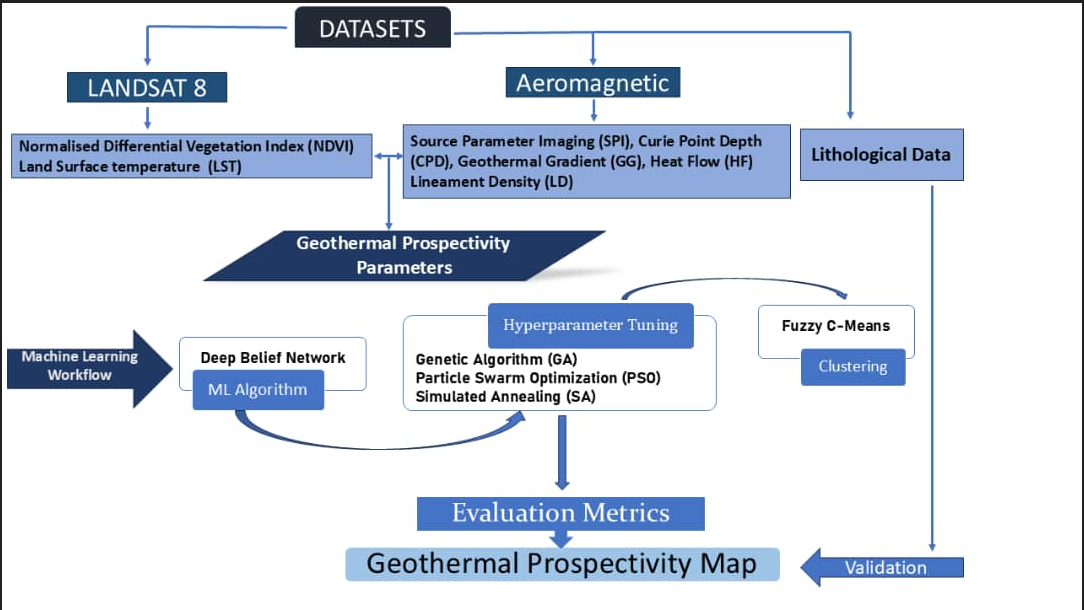
Nigeria faces persistent energy supply challenges, particularly in its northeastern region, where grid access is limited and dependence on fossil fuels undermines sustainability goals. Although the National Renewable Energy Action Plan (NREAP 2015–2030) outlines ambitious targets for renewable energy integration, it notably lacks specific strategies for geothermal development—leaving a critical gap in policy and resource utilization. This study addresses that gap by developing a scalable, cost-effective geothermal prospectivity mapping framework using remote sensing and aeromagnetic data integrated through a hybrid machine learning model. A novel combination of Deep Belief Networks (DBN) for feature extraction and Fuzzy C-Means (FCM) clustering for spatial classification was employed, with optimization achieved using three metaheuristic algorithms: Genetic Algorithm (GA), Particle Swarm Optimization (PSO), and Simulated Annealing (SA). Among these, the DBN-SA model achieved the best internal validity, with superior Silhouette Score, Davies–Bouldin Index, and cluster compactness, ensuring robust and interpretable prospectivity results. Key geothermal indicators—including land surface temperature, vegetation stress, Curie depth, heat flow, and magnetic source depth—were derived from Landsat and airborne magnetic datasets. The resulting map classifies the study area into low, moderate, and high geothermal potential zones, with validation supported by geological correlation and the presence of known thermal features like the Wikki Warm Spring. Approximately one-third of the area was identified as high-potential, particularly over basement terrains with high heat production and structural permeability. This approach offers both scientific insight and practical direction for decentralized, low-carbon energy deployment in northeastern Nigeria, aligning with broader national renewable energy goals and filling a crucial gap in geothermal resource planning.
References
[1] S. O. Oyedepo, “Energy and sustainable development in Nigeria: the way forward”, Energy, Sustainability and Society 2 (2012) 15. https://doi.org/10.1186/2192-0567-2-15.
[2] E. M. Abraham & E. E. Nkitnam, “Review of geothermal energy research in Nigeria: the geoscience front”, International Journal of Earth Sciences and Geophysics 3 (2017) 15. https://vibgyorpublishers.org/content/ijesg/fulltext.php?aid=ijesg-3-015.
[3] S. Lo Russo, G. Taddia & V. Verda, “Development of the thermally affected zone (TAZ) around a groundwater heat pump (GWHP) system: a sensitivity analysis”, Geothermics 43 (2012) 66. https://doi.org/10.1016/j.geothermics.2012.02.001.
[4] A. I. Osman, L. Chen, M. Yang, G. Msigwa, M. Farghali, S. Fawzy, D. W. Rooney & P. S. Yap, “Cost, environmental impact, and resilience of renewable energy under a changing climate: a review”, Environmental Chemistry Letters 21 (2023) 741. https://doi.org/10.1007/s10311-022-01532-8.
[5] K. A. Mogaji, O. T. Adeniyi & A. A. Komolafe, “Geothermal energy potentiality modeling using GIS-based machine learning algorithm concept in southwestern Nigeria: insights from geophysical and remote sensing data sets”, Research Square (2023). https://doi.org/10.21203/rs.3.rs-3089187/v1.
[6] J. A. Mono, T. Ndougsa Mbarga, Y. Tarek, J. D. Ngoh & I. O. Amougou, “Estimation of Curie-point depths, geothermal gradients and near-surface heat flow from spectral analysis of aeromagnetic data in the Loum–Minta area (centre-east Cameroon)”, Egyptian Journal of Petroleum 27 (2018) 1291. https://doi.org/10.1016/j.ejpe.2018.07.002.
[7] S. T. A. Okolie, O. Ozuor, O. Fakehinde, S. O. Ongbali, O. S. I. Fayomi & F. A. Agu, “Study of Nigeria geothermal energy resources viability, brief production techniques and transportation”, Energy Procedia 157 (2019) 1475. https://doi.org/10.1016/j.egypro.2018.11.312.
[8] M. F. Coolbaugh, C. Kratt, A. Fallacaro, W. M. Calvin & J. V. Taranik, “Detection of geothermal anomalies using advanced spaceborne thermal emission and reflection radiometer (ASTER) thermal infrared images at Bradys Hot Springs, Nevada, USA”, Remote Sensing of Environment 106 (2007) 350. https://doi.org/10.1016/j.rse.2006.09.001.
[9] E. M. Abraham, K. M. Lawal, A. C. Ekwe, O. Alile, K. A. Murana & A. A. Lawal, “Reply to discussion on spectral analysis of aeromagnetic data for geothermal energy investigation of Ikogosi Warm Spring, Ekiti State, southwestern Nigeria”, Geothermal Energy 2 (2014) 18. https://doi.org/10.1186/s40517-014-0018-9.
[10] Q. Lv, Y. Dou, X. Niu, J. Xu & B. Li, Classification of land cover based on deep belief networks using polarimetric RADARSAT-2 data, Proceedings of the IEEE Geoscience and Remote Sensing Symposium (IGARSS) Quebec City, QC, Canada, 2014, pp. 4679–4682. https://doi.org/10.1109/IGARSS.2014.6947537.
[11] S. Li, B. Jiang, S. Liang, J. Peng, H. Liang, J. Han & K. Jia, “Evaluation of nine machine learning methods for estimating daily land surface radiation budget from MODIS satellite data”, International Journal of Digital Earth 15 (2022) 1784. https://doi.org/10.1080/17538947.2022.2130460.
[12] Y. Wei, H. Zhang, J. Dai, R. Zhu, L. Qiu, Y. Dong & S. Fang, “Deep belief network with swarm spider optimization method for renewable energy power forecasting”, Processes 11 (2023) 1001. https://doi.org/10.3390/pr11041001.
[13] K.-T. T. Bui, D. T. Bui, J. Zou, C. Van Doan & I. Revhaug, “A novel hybrid artificial intelligent approach based on neural fuzzy inference model and particle swarm optimization for horizontal displacement modeling of hydropower dam”, Neural Computing and Applications 29 (2018) 1495. https://doi.org/10.1007/s00521-016-2666-0.
[14] K. Sörensen & F. W. Glover, “Metaheuristics”, in Encyclopedia of operations research and management science, S. I. Gass & M. C. Fu (Eds.), Springer, Boston, MA, (2013) 960. https://doi.org/10.1007/978-1-4419-1153-7_1167.
[15] S. Shamshirband, M. Hadipoor, A. Baghban, A. Mosavi, J. Bukor & A. R. Várkonyi-Kóczy, “Developing an ANFIS–PSO model to predict mercury emissions in combustion flue gases”, Mathematics 7 (2019) 965. https://doi.org/10.3390/math7100965.
[16] L. I. Nwankwo, “Estimation of depths to the bottom of magnetic sources and ensuing geothermal parameters from aeromagnetic data of Upper Sokoto Basin, Nigeria”, Geothermics 54 (2015) 76. https://doi.org/10.1016/j.geothermics.2014.12.001.
[17] L. I. Nwankwo & A. T. Shehu, “Evaluation of Curie point depths, geothermal gradients and near-surface heat flow from high-resolution aeromagnetic (HRAM) data of the entire Sokoto Basin, Nigeria”, Journal of Volcanology and Geothermal Research 305 (2015) 45. https://doi.org/10.1016/j.jvolgeores.2015.09.017.
[18] T. O. Lawal & L. I. Nwankwo, “Evaluation of the depth to the bottom of magnetic sources and heat flow from high-resolution aeromagnetic (HRAM) data of part of Nigeria’s sector of the Chad Basin", Arabian Journal of Geosciences 10 (2017) 378. https://doi.org/10.1007/s12517-017-3154-2.
[19] J. O. Adedapo, E. Kurowska, K. Schoeneich & A. E. Ikpokonte, “Geothermal gradient of the Niger Delta from recent studies”, International Journal of Scientific and Engineering Research 4 (2013) 39. https://docslib.org/doc/2212118/geothermal-gradient-of-niger-delta-from-recent-studies.
[20] G. O. Emujakporue & A. S. Ekine, “Determination of geothermal gradient in the Eastern Niger Delta sedimentary basin from bottom hole temperatures”, Journal of Earth Sciences and Geotechnical Engineering 4 (2014) 109. https://www.researchgate.net/publication/315678417.
[21] G. E. Obande, K. M. Lawal & L. A. Ahmed, “Spectral analysis of aeromagnetic data for geothermal investigation of Wikki Warm Spring, north-east Nigeria”, Geothermics 50 (2014) 85. https://doi.org/10.1016/j.geothermics.2013.08.002.
[22] S. Kasidi & A. Nur, “Estimation of Curie point depth, heat flow and geothermal gradient inferred from aeromagnetic data over Jalingo and environs, north-eastern Nigeria”, International Journal of Scientific Engineering and Technology 6 (2013) 294. https://www.researchgate.net/publication/288016929.
[23] M.Y.Kwaya,E.Kurowska&A.S.Arabi, “Geothermal gradient and heat flow in the Nigeria sector of the Chad Basin, Nigeria”, Computer Water, Energy and Environmental Engineering 5 (2016) 70. https://doi.org/10.4236/cweee.2016.52007.
[24] C. G. Chukwu, E. E. Udensi, E. M. Abraham, A. C. Ekwe & A. O. Selemo, “Geothermal energy potential from analysis of aeromagnetic data of part of the Niger-Delta Basin, southern Nigeria”, Energy 143 (2018) 846. https://doi.org/10.1016/j.energy.2017.11.040.
[25] O. Sunday, A. A. Elijah, B. O. Samuel & C. O. Daramola, “Investigation of geothermal potential of the Dahomey basin, Nigeria, through analysis of geomagnetic and geo-resistivity dataset”, NRIAG Journal of Astronomy and Geophysics 11 (2022) 373. https://doi.org/10.1080/20909977.2022.2141022.
[26] A. K. Usman, J. Osumeje, Y. A. Bello, Y. A. Hassan & E. Onuh, “Evaluation of geothermal energy resource potential in northeastern Nigeria using spectral analysis of aeromagnetic data”, Scientific World Journal 20 (2025) 122. https://doi.org/10.4314/swj.v20i1.16.
[27] A. K. Usman, J. Osumeje, K. Lawal, Y. A. Hassan & M. Umar,“ A preliminary assessment of north-eastern Nigeria’s geothermal potential zones using land surface temperature”, Scientific World Journal 20 (2025) 445. https://doi.org/10.4314/swj.v20i1.60.
[28] N. G. Obaje, Geology and mineral resources of Nigeria, Springer, 2009. https://doi.org/10.1007/978-3-540-92685-6.
[29] M. H. Dickson & M. Fanelli, Geothermal energy: utilization and technology, Routledge, 2003. https://doi.org/10.4324/9781315065786.
[30] E. R. Okoroafor, C. M. Smith, K. I. Ochie, C. J. Nwosu, H. Gudmundsdottir & M. Aljubran, “Machine learning in subsurface geothermal energy: two decades in review”, Geothermics 102 (2022) 102401. https://doi.org/10.1016/j.geothermics.2022.102401.
[31] M. Boumehdi, Y. Hahou, K. Amrouch, N. E. Berkat, J. Carneiro, A. Correia & O. Sadki, “New assessment of geothermal resources in Morocco: evaluation of the Curie point depth method using magnetic data for geothermal gradient and heat flow estimation”, Scientific African 28 (2025) e02726. https://doi.org/10.1016/j.sciaf.2025.e02726.
[32] Z. Naseer, M. Ehsan, M. Ali, M. R. Amjad, M. A. U. Latif & K. Abdelrahman, “Lithofacies and sandstone reservoir characterization for geothermal assessment through artificial intelligence”, Results in Engineering 26 (2025) 105173. https://doi.org/10.1016/j.rineng.2025.105173.
[33] H. Guo, C. Li, B. Peng, X. Shan, J. Xu, Z. Zhang & J. Chang, “Geothermal regime and its implication on hydrocarbon accumulation in the north ernJunggar Basin”, Geological Journal (2025). https://doi.org/10.1002/gj.5194.
[34] F. Khan, M. Mahmoud, A. Raza, M. Murtaza, B. N. Tackie-Otoo, S. Patil, T. Al Shafloot & M. S. Kamal, “Laboratory demonstration of geothermal rock cooling to reduce breakdown pressure in hydraulic fracturing”, presented at GOTECH Conference, Dubai, UAE, 2025. https://doi.org/10.2118/224657-MS.
[35] G. E. Hinton, S. Osindero & Y. W. Teh, “A fast-learning algorithm for deep belief nets”, Neural Computation 18 (2006) 1527. https://doi.org/10.1162/neco.2006.18.7.1527.
[36] Y. Bengio, “Learning deep architectures for AI”, Foundations and Trends in Machine Learning 2 (2009) 1. https://doi.org/10.1561/2200000006.
[37] J. C. Bezdek, R. Ehrlich & W. Full, “FCM: The fuzzy c-means clustering algorithm”, Computers & Geosciences 10 (1984) 191. https://doi.org/10.1016/0098-3004(84)90020-7.
[38] M. N. Tijani, “Geology of Nigeria”, in Landscapes and landforms of Nigeria, A. Faniran, L. K. Jeje, O. A. Fashae & A. O. Olusola (Eds.) Springer, Cham, 2023. https://doi.org/10.1007/978-3-031-17972-3_1.
[39] J. B. Wright, “The Benue Trough and coastal basins”, in Geology and mineral resources of West Africa, J. B. Wright (Ed.) Springer, Dordrecht, 1985. https://doi.org/10.1007/978-94-015-3932-6_11.
[40] A. Mamudua, E. S. Akanbia & S. C. Odewumi, “Hydrothermal alteration and mineral potential zones of Bauchi area northeastern Nigeria using interpretation of aeroradiometric data”, Journal of the Nigerian Society of Physical Sciences 7 (2025) 2193. https://doi.org/10.46481/jnsps.2025.2193.
[41] J. G. Fitton, “The Cameroon Line, West Africa: A comparison between oceanic and continental alkaline volcanism”, in Alkaline igneous rocks, J. G. Fitton & B. G. J. Upton (eds.), Geological Society, London, Special Publications 30 (1987) 273. https://doi.org/1144/GSL.SP.1987.030.01.13.
[42] T. Schl¨uter, “Review of countries and territories”, in Geological atlas of Africa, Springer, Berlin and Heidelberg, 2008, p. 31. https://doi.org/10.1007/978-3-540-76373-4_4.
[43] A. Oyebamiji, O. Akinola, O. Olaolorun, Y. Abdu-Raheem, A. Adeoye & M. Oguntuase, “Geochemistry, petrogenesis and geological implication of granitic rocks in Igarra area, southwestern Nigeria”, Applied earth science 133 (2024) 174. https://doi.org/10.1177/25726838241273519.
[44] A. B. Yusuf, H. S. Lim & I. Ahmad Abir, “Radiogenic heat production estimation towards sustainable energy drive in northeastern Nigeria”, Heliyon 9 (2023) e16310. https://doi.org/10.1016/j.heliyon.2023.e16310.
[45] K. Salako, A. Abbass, A. Rafiu, U. Alhassan, A. Aliyu & A. Taiwo, “Assessment of geothermal potential of parts of Middle Benue Trough, north-east Nigeria”, Journal of environmental soil physics 45 (2020) 27. https://doi.org/10.22059/jesphys.2019.260257.1007017.
[46] O. M. Adedokun, O. P. Oladejo, K. N. Alao, E. O. Adeniyi, H. Otobrise, K. O. Suleman, T. A. Adagunodo, O. Adedokun & L. A. Sunmonu, “Delineation of structural lineaments of Shaki West southwestern Nigeria using high resolution aeromagnetic data”, Journal of the Nigerian Society of Physical Sciences 7 (2025) 2493. https://doi.org/10.46481/jnsps.2025.2493.
[47] A. Yusuf, L. H. San & I. A. Abir, “A preliminary geothermal prospectivity mapping based on integrated GIS, remote-sensing, and geophysical techniques around northeastern Nigeria”, Sustainability 13 (2021) 8525. https://doi.org/10.3390/su13158525.
[48] V. Caselles, E. Valor, C. Coll & E. Rubio, “Thermal band selection for the PRISM instrument: Analysis of emissivity–temperature separation algorithms”, Journal of Geophysical Research: Atmospheres 102 (1997) 11145. https://doi.org/10.1029/97JD00344.
[49] P. S. Kealy & S. J. Hook, “Separating temperature and emissivity in thermal infrared multispectral scanner data: implications for recovering land surface temperatures”, IEEE Transactions on Geoscience and Remote Sensing 31 (1993) 1155. https://doi.org/10.1109/36.317447.
[50] S. J. Alhadithi & A. S. Al-Banna, “Using source parameter imaging technique to the aeromagnetic data to estimate the basement depth of Tharthar Lake and surrounding area in Central Iraq”, Iraqi Geological Journal 55 (2022) 151. https://doi.org/10.46717/igj.55.1F.12Ms-2022-06-27.
[51] J. B. Thurston & R. S. Smith, “Automatic conversion of magnetic data to depth, dip, and susceptibility contrast using the SPI method”, Geophysics 62 (1997) 807. https://doi.org/10.1190/1.1444190.
[52] Y. Okubo, R. J. Graf, R. O. Hansen, K. Ogawa & H. Tsu, “Curie point depths of the Island of Kyushu andsurrounding areas, Japan”, Geophysics 50 (1985) 481. https://doi.org/10.1190/1.1441926.
[53] A. Tanaka, Y. Okubo & O. Matsubayashi, “Curie point depth based on spectrum analysis of the magnetic anomaly data in East and South east Asia”, Tectonophysics 306 (1999) 461. https://doi.org/10.1016/S0040-1951(99)00072-4.
[54] G. E. Hinton, “A practical guide to training restricted Boltzmann machines”, in Neural Networks: Tricks of the Trade, Lecture Notes in Computer Science 7700, Springer, Berlin and Heidelberg, 2012, p. 599. https://doi.org/10.1007/978-3-642-35289-8_32.
[55] A.Fischer&C.Igel, “Anintroduction to restricted Boltzmann machines”, in Progress in Pattern Recognition, Image Analysis, Computer Vision, and Applications, L. Alvarez, M. Mejail, L. Gomez & J. Jacobo (Eds.) Lecture Notes in Computer Science 7441, Springer, Berlin and Heidelberg, 2012, p. 14. https://doi.org/10.1007/978-3-642-33275-3_2.
[56] J. H. Holland, “Genetic algorithms and adaptation”, in Adaptive Control of Ill-Defined Systems, O. G. Selfridge, E. L. Rissland & M. A. Arbib (Eds.) NATO Conference Series 16, Springer, Boston, MA, 1984, p. 317. https://doi.org/10.1007/978-1-4684-8941-5_21.
[57] J. Kennedy, “Particle swarm optimization”, in Encyclopedia of Machine Learning, C. Sammut & G. I. Webb (Eds.) Springer, Boston, MA, 2011, p. 760. https://doi.org/10.1007/978-0-387-30164-8_630.
[58] A. Mehrabian & C. Lucas, “A novel numerical optimization algorithm inspired from weed colonization”, Ecological Informatics 1 (2006) 355. https://doi.org/10.1016/j.ecoinf.2006.07.003.
[59] K. Su, L. Ma, X. Guo & Y. Sun, “An efficient discrete invasive weed optimization algorithm for web services selection”, Journal of Software 9 (2014) 709. https://doi.org/10.4304/jsw.9.3.709-715.
[60] J. C. Dunn, “A fuzzy relative of the ISODATA process and its use in detecting compact well-separated clusters”, Journal of Cybernetics 3 (1973) 32. https://doi.org/10.1080/01969727308546046.
[61] J. C. Bezdek, Pattern recognition with fuzzy objective function algorithms, Springer, Boston, MA, 1981. https://doi.org/10.1007/978-1-4757-0450-1.
[62] V. Schwämmle & O. N. Jensen, “A simple and fast method to determine the parameters for fuzzy c–means cluster analysis”, Bioinformatics 26 (2010) 841. https://doi.org/10.1093/bioinformatics/btq534.
[63] F. Pedregosa, G. Varoquaux, A. Gramfort, V. Michel, B. Thirion, O. Grisel, M. Blondel, A. M¨uller, J. Nothman, G. Louppe, P. Pretten hofer, R. Weiss, V. Dubourg, J. Vanderplas, A. Passos, D. Cournapeau, M. Brucher, M. Perrot & ´ E. Duchesnay, “Scikit-learn: machine learn ing in Python”, Journal of Machine Learning Research 12 (2011) 2825. https://jmlr.csail.mit.edu/papers/v12/pedregosa11a.html.
[64] N. Zaini, M. Yanis, F. Abdullah, F. van der Meer & M. Aufaristama, “Exploring the geothermal potential of Peut Sagoe volcano using Landsat 8 OLI/TIRS images”, Geothermics 105 (2022) 102499. https://doi.org/10.1016/j.geothermics.2022.102499.
[65] E. Rahimi, P. Dong & C. Jung, “Global NDVI–LST correlation: temporal and spatial patterns from 2000 to 2024”, Environments 12 (2025) 67. https://doi.org/10.3390/environments12020067.
[66] S. Guha & H. Govil, “Land surface temperature and normalized difference vegetation index relationship: a seasonal study on a tropical city”, SN Applied Sciences 2 (2020) 1661. https://doi.org/11007/s42452-020-03458-8.
[67] N. Kikon, D. Kumar & S. A. Ahmed, “Quantitative assessment of land surface temperature and vegetation indices on a kilometer grid scale”, Environmental Science and Pollution Research 30 (2023) 107236. https://doi.org/10.1007/s11356-023-27418-y.
[68] V. M. Sayão, N. V. dos Santos & W. de Sousa Mendes, “Land use/land cover changes and bare soil surface temperature monitoring in southeast Brazil”, Geoderma Regional 22 (2020) e00313. https://doi.org/10.1016/j.geodrs.2020.e00313.
[69] S. E. Ekwok, O.-I. M. Achadu, A. E. Akpan, A. M. Eldosouky, C. H. Ufuafuonye, K. Abdelrahman & D. G´omez-Ortiz, “Depth estimation of sedimentary sections and basement rocks in the Bornu Basin, north east Nigeria using high-resolution airborne magnetic data”, Minerals 12 (2022) 285. https://doi.org/10.3390/min12030285.
[70] K. N. Alao, O. P. Oladejo, K. O. Suleman, O. Mary, E. O. Adeniyi, H. Otobrise & L. A. Sunmonu, “Determination of depth to magnetic sources using source parameter imaging of high-resolution aeromagnetic data ofEsie, north central Nigeria”, International Journal of Advanced Multidisciplinary Research and Studies 4 (2024) 1091. https://doi.org/10.62225/2583049X.2024.4.6.3559.
[71] E. Júlíusson & G. Axelsson, “Stock models for geothermal resources”, Geothermics 72 (2018) 249. https://doi.org/10.1016/j.geothermics.2017.11.006.
[72] A. W. Tende, M. D. Aminu & J. N. Gajere, “A spatial analysis for geothermal energy exploration using bivariate predictive modelling”, Scientific Reports 11 (2021) 19755. https://doi.org/10.1038/s41598-021-99244-6.
[73] J. Rafiq, I. S. Abu-Mahfouz, K. Chavanidis, D. Arrofi & P. Soupios, “Spatial distribution of structural lineaments in the Al-Lith geothermal field, western Saudi Arabia: remote sensing and aeromagnetic data analysis”, Journal of Asian Earth Sciences: X 13 (2025) 100191. https://doi.org/10.1016/j.jaesx.2025.100191.
[74] P. J. Rousseeuw, “Silhouettes: a graphical aid to the interpretation and validation of cluster analysis”, Journal of Computational and Applied Mathematics 20 (1987) 53. https://doi.org/10.1016/0377-0427(87)90125-7.
[75] J. C. Bezdek, R. Ehrlich & W. Full, “FCM: the fuzzy c-means clustering algorithm”, Computers & Geosciences 10 (1983) 191. https://doi.org/10.1016/0098-3004(84)90020-7.
[76] A. Starczewski, “A new validity index for crisp clusters”, Pattern Analysis and Applications 20 (2017) 687. https://doi.org/10.1007/s10044-015-0525-8.
[77] H. Wang, J. Wang & G. Wang, “A survey of fuzzy clustering validity evaluation methods”, Information Sciences 618 (2022) 270. https://doi.org/10.1016/j.ins.2022.11.010.
[78] K. Wu & J. Liu, “Learning large-scale fuzzy cognitive maps under limited resources”, Engineering Applications of Artificial Intelligence 116 (2022) 105376. https://doi.org/10.1016/j.engappai.2022.105376.
[79] X. Wu, Y. Yu, L. Chen, W. Ding & Y. Wang, “Robust deep fuzzy K-means clustering for image data”, Pattern Recognition 153 (2024) 110504. https://doi.org/10.1016/j.patcog.2024.110504.
[80] M. Halder, D. Paul & S. Sensarma, “Rhyolites in continental mafic large igneous provinces: petrology, geochemistry and petrogenesis”, Geoscience Frontiers 12 (2021) 53. https://doi.org/10.1016/j.gsf.2020.06.011.
[81] S. Burchardt, M. Bazargan, E. Bessi Gestsson, C. Hieronymus, E. Ronchin, H. Tuffen, M. J. Heap, J. Davidson, B. Kennedy, A. Hobé & E. Saubin, “Geothermal potential of small sub-volcanic intrusions in a typical Icelandic caldera setting”, Volcanica 5 (2022) 477. https://doi.org/10.30909/vol.05.02.477507.
[82] I. M. Artemieva, H. Thybo, K. Jakobsen, N. K. Sørensen & L. S. Nielsen, “Heat production in granitic rocks: global analysis based on a new data compilation GRANITE2017”, Earth-Science Reviews 172 (2017) 1. https://doi.org/10.1016/j.earscirev.2017.07.003.
[83] H. Abul Khair, D. Cooke & M. Hand, “Seismic mapping and geome chanical analyses of faults within deep hot granites, a workflow for enhanced geothermal system projects”, Geothermics 53 (2015) 46. https://doi.org/10.1016/j.geothermics.2014.04.007.
[84] A. Comerford, A. Fraser-Harris, G. Johnson & C. McDermott, “Controls on geothermal heat recovery from a hot sedimentary aquifer in Guardbridge, Scotland: field measurements, modelling and long term sustainability”, Geothermics 76 (2018) 125. https://doi.org/10.1016/j.geothermics.2018.07.004.
Published
How to Cite
Issue
Section
Copyright (c) 2025 A. K. Usman, Y. A. Hassan, A. A. Bery, A. A. Sunny, M. D. Dick, A. B. Mohammed, R. O. Aderoju (Author)

This work is licensed under a Creative Commons Attribution 4.0 International License.