Food and environmental degradation as causative agents of honey bee colonies decline: Mathematical model approach
Keywords:
Honey Bees, Colony Collapse Disorder, degradation, EnvironmentAbstract
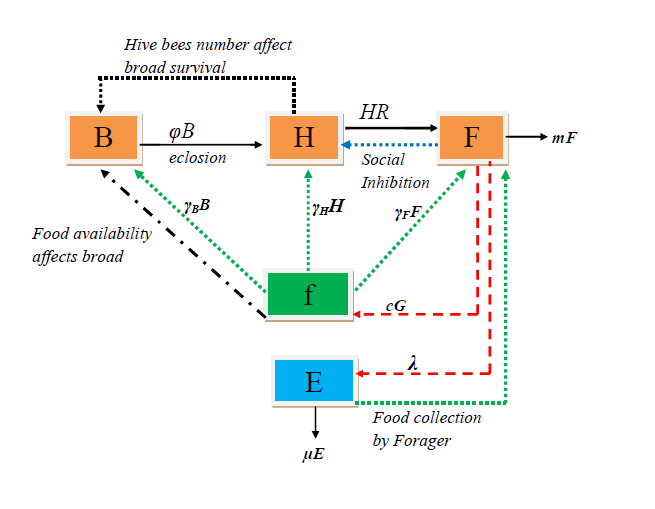
In this research, a new compartment model of honey bee population is developed to study the effects of gradual change of food availability and environmental degradation on bee population growth and development. The model is proved to be mathematical well posed and a non-trivial equilibrium point is shown to exist and asymptotically stable under certain conditions. The model predicts a critical threshold environmental degradation rate above which the population size of bees decline and subsequently collapse. Low environmental degradation and high food availability leads to stable bee population. Global sensitivity analysis is conducted to determine the most sensitive parameters of the model that can lead to colony collapse disorder. Numerical simulations are conducted to illustrate all the results.
Published
How to Cite
Issue
Section
Copyright (c) 2021 Journal of the Nigerian Society of Physical Sciences

This work is licensed under a Creative Commons Attribution 4.0 International License.
How to Cite
Similar Articles
- Misbaudeen Abdul-Hammed, Ibrahim Olaide Adedotun, Tolulope Irapada Afolabi Afolabi, Ubeydat Temitope Ismail, Praise Toluwalase Akande, Balqees Funmilayo Issa, Analysis of the Bioactive Compounds from Carica papaya in the Management of Psoriasis using Computational Techniques , Journal of the Nigerian Society of Physical Sciences: Volume 5, Issue 1, February 2023
- K. A Haruna, J. K. Raji, A. Y. Jimoh, J. A. Adeoye, O. O. Alu, A. A. Badmus, B. Garba, Biostratigraphy and paleoenvironment studies of shales from Owan-1 Well, Niger Delta Basin, Nigeria , Journal of the Nigerian Society of Physical Sciences: Volume 7, Issue 3, August 2025
- Oboti Nwamaka Peace, Osita Miracle Nwakeze, Sunday Stephen Okika, Okafor Chinedu Martin, Agubosim Chuka Charles, Privacy-preserving federated learning with MobileViT for chest X-ray classification in Nigerian hospitals , Journal of the Nigerian Society of Physical Sciences: Volume 8, Issue 4, November 2026 (in progress)
- K. O. Sodeinde, S. A. Animashaun, H. O. Adubiaro, Methods for the Detection and Remediation of Ammonia from Aquaculture Effluent: A Review , Journal of the Nigerian Society of Physical Sciences: Volume 5, Issue 1, February 2023
- B. O. Eyenubo, V. O. Peretomode, F. Egharevba, S. A. Osakwe, O. G. Avwioro, Polychlorinated biphenyls (PCBs) in sediments and fish from dredged tributaries and creeks of river Ethiope, South-South, Nigeria: sources, risk assessment and bioaccumulation , Journal of the Nigerian Society of Physical Sciences: Volume 6, Issue 2, May 2024
- Emmanuel Agboeze, Henry Okechukwu Agboeze, Theresa Orieji Uchechukwu, Anayo Vitus Ofordile, Chukwuebuka Gabriel Eze, Environmental and health risk assessment of cadmium, zinc,iron, copper in crops and soil at Enugu State dumpsite , Journal of the Nigerian Society of Physical Sciences: Volume 8, Issue 1, February 2026
- E. O. Echeweozo, C. I. Nworie, A. O. Ojobeagu, P. B. Otah, I. J. Okoro, Health risk assessment due to environmental radioactivity and heavy metal contamination at the central solid waste dumpsite in Ebonyi State, Nigeria , Journal of the Nigerian Society of Physical Sciences: Volume 7, Issue 2, May 2025
- Muhammad Farman, Noreen Asghar, Muhammad Umer Saleem, Nezihal Gokbulut, Evren Hincal, Aseel Smerat, Mohamed Hafez, Optimal control of smoking-induced asthma and cardiovascular disorders with medical and public health interventions , Journal of the Nigerian Society of Physical Sciences: Volume 8, Issue 3, August 2026
You may also start an advanced similarity search for this article.
Most read articles by the same author(s)
- Adamu Shitu Hassan, Nafiu Hussaini, Analysis of an HIV - HCV simultaneous infection model with time delay , Journal of the Nigerian Society of Physical Sciences: Volume 3, Issue 1, February 2021