Bridging context gaps in low-resource language chatbots through multilevel attention and hybrid embedding approaches
Keywords:
Low-resource languages, Igbo conversational agent, Multilevel attention, Hybrid embeddings, Context-aware dialogue systemsAbstract
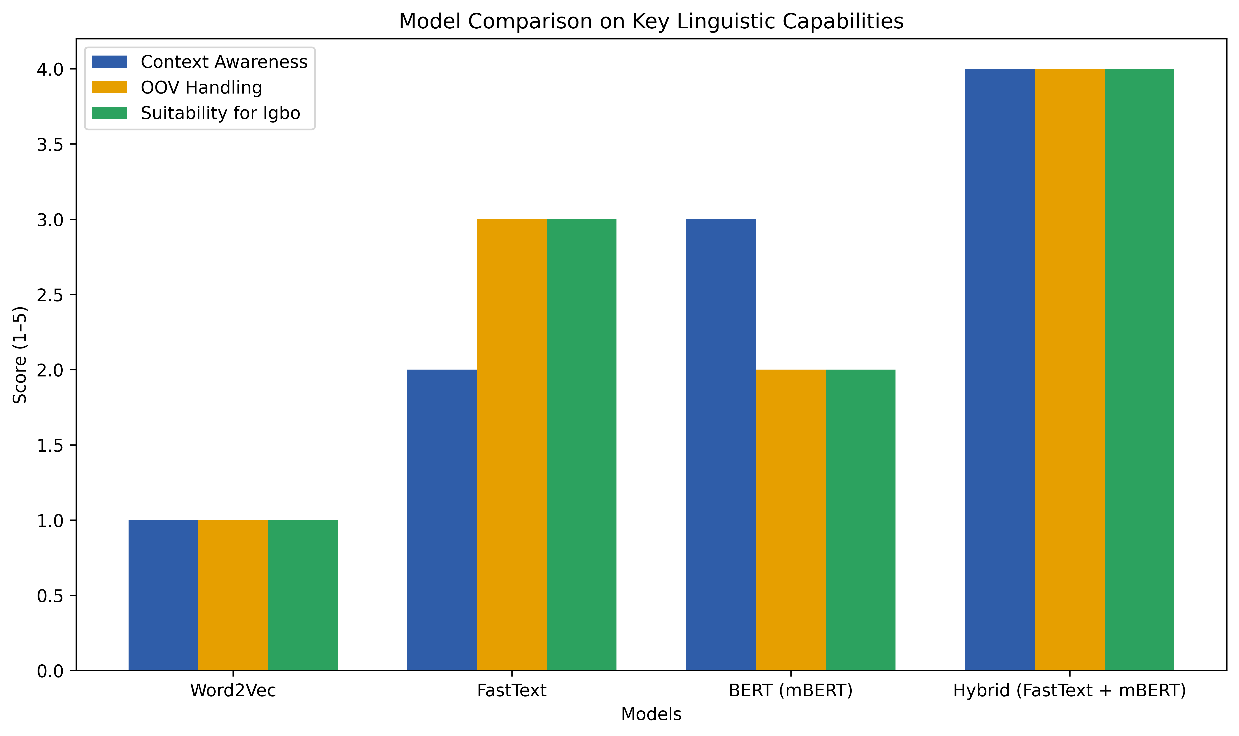
Conversational agents for low-resource languages (LRLs), such as Igbo, face major challenges, including limited annotated data, code-switching, and weak contextual coherence in multi-turn dialogue. This study proposes a multilevel-attention and hybrid-embedding framework that integrates FastText subword representations with multilingual BERT (mBERT) to improve semantic understanding and context retention. The architecture applies hierarchical attention at the word, utterance, and dialogue levels, enabling effective modeling of conversational dependencies and reducing context drift. The model was evaluated on a curated Igbo--English conversational dataset and benchmarked against long short-term memory (LSTM), Transformer, FastText, mBERT, and XLM-R baselines. For response generation, the proposed framework achieved a bilingual evaluation understudy (BLEU) score of 44.1%, a longest-common-subsequence recall-oriented understudy for gisting evaluation (ROUGE-L) score of 60.3%, and a context-retention accuracy (CRA) of 81.5%. For intent classification, it attained an F1-score of 87.3% and an area under the receiver operating characteristic curve (ROC-AUC) of 0.91; for context-dependency detection, it achieved an F1-score of 84.3%. The framework also reduced inference latency and was robust to code-switching and noisy conversational input. Human evaluation confirmed improvements in response clarity, cultural relevance, and multi-turn coherence. The findings show that hybrid embeddings combined with multilevel attention provide an effective and scalable approach to conversational AI for LRLs, with potential applicability to other African languages.
References
[1] M. R. Varzaneh, S. A. Alibrahim, O. Dakkak & K. M. Karaoğlan, ``Conversational agent chatbot classification and design techniques: A survey on conversational agents chatbots'', in Using AI Tools in Text Analysis, Simplification, Classification, and Synthesis, IGI Global Scientific Publishing, Hershey, PA, USA, 2025, pp. 257--292. https://www.researchgate.net/publication/388646758_Conversational_Agent_Chatbot_Classification_and_Design_Techniques_A_Survey_on_Conversational_Agents_Chatbots.
[2] N. Shrivastava, P. Tewari, S. Sujatha, S. R. Bogireddy, N. Varshney & V. Sharma, ``Natural language processing for conversational AI: Chatbots and virtual assistants'', 2025 IEEE International Conference on Interdisciplinary Approaches in Technology and Management for Social Innovation (IATMSI), 2025, pp. 1--6. https://doi.org/10.1109/IATMSI64286.2025.10984818.
[3] M. K. Saravana, A. Mohammed, S. Pattanayak, D. Paswan & Y. Dadhich, ``Multilingual chatbot development using pre-trained language models: A survey'', Indian Journal of Computer Science and Technology 4 (2025) 152. https://doi.org/10.59256/indjcst.20250401023.
[4] M. A. Aisha & R. B. Jamei, ``Conversational AI revolution: A comparative review of machine learning algorithms in chatbot evolution'', East Journal of Engineering 1 (2025) 1. https://doi.org/10.63496/eje.Vol1.Iss1.30.
[5] G. M. Biancofiore, D. Di Palma, C. Pomo, F. Narducci & T. Di Noia, ``Conversational user interfaces and agents'', in Human-Centered AI: An Illustrated Scientific Quest, Springer Nature Switzerland, Cham, Switzerland, 2025, pp. 399--438. https://doi.org/10.1007/978-3-031-61375-3_4.
[6] G. C. Uzoaru, I. I. Ayogu, A. C. Onyeka & J. N. Odii, ``Attention-based chatbots for low-resource language processing: A comprehensive review'', SSR Journal of Engineering and Technology 2 (2025) 8. https://doi.org/10.5281/zenodo.15857587.
[7] J. O. Alabi, M. A. Hedderich, D. I. Adelani & D. Klakow, ``Charting the landscape of African NLP: Mapping progress and shaping the road ahead'', Proceedings of the 2025 Conference on Empirical Methods in Natural Language Processing, 2025, pp. 27807--27841. https://doi.org/10.18653/v1/2025.emnlp-main.1414.
[8] I. Inuwa-Dutse, ``NaijaNLP: A survey of Nigerian low-resource languages'', arXiv (2025) 2502.19784. https://doi.org/10.48550/arXiv.2502.19784.
[9] P. Okewunmi, F. James & O. Fajemila, ``Evaluating robustness of LLMs to typographical noise in Yorùbá QA'', Proceedings of the Sixth Workshop on African Natural Language Processing (AfricaNLP 2025), 2025, pp. 195--202. https://doi.org/10.18653/v1/2025.africanlp-1.29.
[10] D. Hennekeuser, D. Vaziri, D. Golchinfar & G. Stevens, ``What I don't like about you? A systematic review of impeding aspects for the usage of conversational agents'', Interacting with Computers 36 (2024) 293. https://doi.org/10.1093/iwc/iwae018.
[11] A. Rasool, M. I. Shahzad, H. Aslam, V. Chan & M. A. Arshad, ``Emotion-aware embedding fusion in large language models (Flan-T5, Llama 2, DeepSeek-R1, and ChatGPT 4) for intelligent response generation'', AI 6 (2025) 56. https://doi.org/10.3390/ai6030056.
[12] T. Wu, Y. Wang & N. Quach, ``Advancements in natural language processing: Exploring transformer-based architectures for text understanding'', 2025 5th International Conference on Artificial Intelligence and Industrial Technology Applications (AIITA), 2025, pp. 1384--1388. https://doi.org/10.48550/arXiv.2503.20227.
[13] N. Raychawdhary, S. Bhattacharya, C. Seals, & G. Dozier, ``Empowering sentiment analysis in African low-resource languages through transformer models and strategic language selection'', (2025) IEEE Access. https://doi.org/10.1109/ACCESS.2025.3599480
[14] A. Asemi, R. K. Shahvandy & M. Houshangi, ``A comparative empirical evaluation of semantic clustering algorithms on static word embeddings'', International Journal of Information Management Data Insights 6 (2026) 100396. https://doi.org/10.1016/j.jjimei.2026.100396.
[15] J. O. Abimbola, G. S. Kuaban & S. A. Ajayi, ``Open-source embedding models: A comprehensive survey of techniques, benchmarks, and applications'', IEEE Access 14 (2026) 41284. https://doi.org/10.1109/ACCESS.2026.3670100.
[16] A. K. Jadon & S. Kumar, ``Deciphering emotions from text: A comparative analysis of word embeddings'', Journal of The Institution of Engineers (India) 107 (2026) 111. https://doi.org/10.1007/s40031-026-01301-z.
[17] A. Saxena & A. Santhanavijayan, ``A layer-wise survey on internal modifications in BERT and its variants: Techniques, applications, and performance trade-offs'', International Journal of Data Science and Analytics 22 (2026) 1. https://doi.org/10.1007/s41060-025-00986-7.
[18] D. Mbaye, T. D. P. Mbengue, M. R. Seye, M. Diallo, M. L. Ndiaye, D. S. Adjanohoun, C. S. Wade, D. Sow, J.-C. B. Munyaka & J. Chenal, ``Opportunities and challenges of natural language processing for low-resource Senegalese languages in social science research'', arXiv preprint arXiv: 2601.09716 (2025). https://doi.org/10.48550/arXiv.2601.09716.
[19] A. Jiang & A. Zubiaga, ``Cross-lingual offensive language detection: A systematic review of datasets, approaches, and challenges'', ACM Computing Surveys 58 (2026) 269. https://doi.org/10.1145/3801736.
[20] U. Tukeyev, A. Shormakova, A. Karibayeva, D. Rakhimova, B. Abduali, D. Amirova, N. Rakhmanberdi & R. Aliyev, ``An integrated approach to adapting open-source AI models for machine translation of low-resource Turkic languages'', Computers 15 (2026) 73. https://doi.org/10.3390/computers15020073.
[21] L. Ouchene & S. Bessou, ``AlgVec: A word embedding model for the Algerian dialect in Arabic and Arabizi'', Journal of King Saud University Computer and Information Sciences 38 (2026) 20. https://doi.org/10.1007/s44443-025-00407-6.
[22] X. Wang, W. Liu, Y. Yang, Y. Gao, Q. Du & L. Bao, ``Docsentinet: a adaptive architecture for efficient document-level sentiment analysis'', International Journal of Data Science and Analytics 21 (2026) 34. https://doi.org/10.1007/s41060-025-00943-4.
[23] M. S. Z. Pattankudi, A. R. Attar, N. Abhishek, S. Uppin, U. Kulkarni, & N. D. G, MT5-Based Multimodal Framework for Kannada-to-English Translation, In 2025 IEEE Conference on Engineering Informatics (ICEI) (2025), pp. 1-7. https://doi.org/10.1109/ICEI68356.2025.11603704
[24] M. K. Nazir, M. Bilal & S. C. Shongwe, ``Sentiment analysis for code-mixed low-resource languages: A systematic review of approaches, techniques, applications, challenges, and future directions'', Social Network Analysis and Mining 16 (2026) 47. https://doi.org/10.1007/s13278-026-01588-2.
[25] K. Mitra, A. V. Kolasani, P. S. Shruthi, K. Chelliah, A. Malapati & M. Lee, ``MDMIC: An augmented Indic corpus and joint multitask attention-based fusion framework for cross-domain, multi-intent NLU in LoRes languages'', IEEE Access 14 (2026) 28631. https://doi.org/10.1109/ACCESS.2026.3664703.
[26] J. Lee, & I. Joe, ``A dialogue response generation model with latent variable modeling and LWE attention based on the VW-BLEU evaluation metric''. IEEE Access 13 (2025), 49710.
[27] N. S. Mullah & W. M. N. W. Zainon, AI and low-resource languages: Bridging the linguistic divide, in Reshaping Language and Cognition in Education Through AI, IGI Global Scientific Publishing, Hershey, PA, USA, 2026, pp. 77--128. https://www.researchgate.net/publication/401236705_AI_and_Low-Resource_Languages_Bridging_the_Linguistic_Divide.
[28] J. Wang, B. Ma, Y. Nan, Y. He, H. Sun, C. Liu, S. Tao, Q. Qi & J. Liao, ``Improving matching models with contextual attention for multi-turn response selection in retrieval-based chatbots'', IEEE Transactions on Network Science and Engineering 12 (2025) 1497. https://doi.org/10.1109/TNSE.2025.3532663.
[29] B. M. Deeb, A. V. Savchenko & I. Makarov, ``Enhancing emotion recognition in speech based on self-supervised learning: Cross-attention fusion of acoustic and semantic features'', IEEE Access 13 (2025) 56283. https://doi.org/10.1109/ACCESS.2025.3554454.
[30] Y. Wang, X. Li, H. Yu, F. Hu, G. Wang & D. Lei, ``Continuous entity reasoning for multi-turn medical dialogue generation'', IEEE Transactions on Consumer Electronics 71 (2025) 10681. https://doi.org/10.1109/TCE.2025.3598217.
[31] P. Bojanowski, E. Grave, A. Joulin, & T. Mikolov, ``Enriching word vectors with subword information. Transactions of the association for computational linguistics'', 5 (2017) 135.
[32] A. Ba Alawi & F. Bozkurt, ``Performance analysis of embedding methods for deep learning-based Turkish sentiment analysis models'', Arabian Journal for Science and Engineering 50 (2025) 7299. https://doi.org/10.1007/s13369-024-09360-4.
[33] A. Somani, S. R. M. Kumar & A. Malapati, ``Where does mBERT understand code-mixing? Layer-dependent performance on semantic tasks'', IEEE Access 13 (2025) 135950. https://doi.org/10.1109/ACCESS.2025.3594135.
[34] S. Phani, A. Abdul, M. K. S. Prasad & V. D. Reddy, ``MATSFT: User query-based multilingual abstractive text summarization for low-resource Indian languages by fine-tuning mT5'', Alexandria Engineering Journal 127 (2025) 129. https://doi.org/10.1016/j.aej.2025.04.031.
[35] X. Li & K. Zhang, ``Contrastive learning pre-training and quantum theory for cross-lingual aspect-based sentiment analysis'', Entropy 27 (2025) 713. https://doi.org/10.3390/e27070713.
[36] L. B. Marques, S. Isotani, B. Pimentel, J. V. L. B. do Nascimento, M. Isotani, I. I. Bittencourt & C. E. Snow, ``Structural and semantic analysis techniques for translation evaluation of educational materials'', International Conference on Artificial Intelligence in Education, Cham, Switzerland, (2025), pp. 230. https://doi.org/10.1007/978-3-031-99261-2_21.
[37] I. Ezeani, M. Hepple, I. Onyenwe, & E. Chioma, Igbo diacritic restoration using embedding models. In Proceedings of the 2018 Conference of the North American Chapter of the Association for Computational Linguistics: Student Research Workshop, (2018) pp. 54.
[38] BBC News Igbo. https://www.bbc.com/igbo.
[39] Common Crawl Foundation, Common Crawl. https://commoncrawl.org.
[40] Teta!, ``Jehovah's Witnesses (Awake!) Igbo Edition and Ulo Nche (Watchtower)''. https://www.jw.org/ig.
Published
How to Cite
Issue
Section
Copyright (c) 2026 Godson Chetachi Uzoaru, Ikechukwu Ignatius Ayogu, Juliet Nnenna Odii, Aloysius Chijioke Onyeka (Author)

This work is licensed under a Creative Commons Attribution 4.0 International License.