Strategic interventions in schistosomiasis control: leveraging mass drug administration, public engagement, and intermediate host control to disrupt transmission dynamics

Authors

  • Agatha Abokwara
    Department of Mathematics, Joseph Sarwuan Tarka University, Makurdi, Benue State, Nigeria
  • Chinwendu E. Madubueze
    Department of Mathematics, Joseph Sarwuan Tarka University, Makurdi, Benue State, Nigeria
  • Reuben I. Gweryina
    Department of Mathematics, Joseph Sarwuan Tarka University, Makurdi, Benue State, Nigeria
  • Terhemen Aboiyar
    Department of Mathematics, Joseph Sarwuan Tarka University, Makurdi, Benue State, Nigeria

Keywords:

Bifurcation, Control reproduction number, Stability analysis, Sensitivity analysis, Schistosomiasis

Abstract

Schistosomiasis is caused by parasitic flatworms known as schistosomes. Humans become infected when they come into contact with freshwater containing these parasites. Many communities have only a limited understanding of how schistosomiasis spreads or how mass drug administration (MDA) can help to manage it. Furthermore, some regions neglect snail control efforts, despite snails are key intermediate hosts in disease transmission. In this study, we employ mathematical equations to illustrate how schistosomiasis spreads when public enlightenment campaigns, mass drug administration, and snail control measures are implemented. We calculate the control reproduction number, $R_c,$ and examine the existence and stability of both the disease-free and endemic equilibrium states. Our results indicate that when people are aware of the disease, participate in mass drug administration, and intensify snail control efforts, the spread of the disease slows. Sensitivity analysis reveals that mass drug administration and increasing snail mortality rates are the most effective strategies for reducing $R_c.$ Simulations suggest that improved sanitation and educating people about the benefits of taking medicine can reduce the number of infected individuals. Furthermore, treating water or introducing predatory fish can help to lower the population of disease carrying snails. These findings provide valuable insights that can assist public health stakeholders in making informed decisions to control schistosomiasis.
Dimensions

[1] E. Bottieau, M. Mbow, I. Brosius, C. Roucher, C. T. Gueye, O. T. Mbodj, B. T. Faye, A. De Hondt, B. Smekens, D. Arango, C. Burm, A. Tsoumanis, L. Paredis, Y. Van Herrewege, I. Potters, J. Richter, A. Rosanas-Urgell, B. Cisse, S. Mboup & K. Polman, ``Antimalarial artesunate--mefloquine versus praziquantel in African children with schistosomiasis: an open-label, randomized controlled trial'', Nature Medicine 30 (2024) 130. https://doi.org/10.1038/s41591-023-02719-4.

[2] I. Bada, I. I. Ako, R. U. Akhaze & O. O. Olowu, ``Mathematical analysis of schistosomiasis with case detection'', Journal of the Nigerian Association of Mathematical Physics 59 (2021) 1. https://www.researchgate.net/publication/371811583_MATHEMATICAL_ANALYSIS_OF_SCHISTOSOMIASIS_WITH_CASE_DETECTION.

[3] A. Idan & H. A. M. Al-Saady, ``Schistosomiasis in Iraq: a mini-review of literature'', The Medical Journal of Basrah University 42 (2024) 28. https://doi.org/10.33762/mjbu.2024.145555.1181.

[4] World Health Organization, Schistosomiasis. [Online]. https://www.who.int/news-room/fact-sheets/detail/schistosomiasis. [Accessed: Sep. 28, 2024].

[5] P. A. Mawa, J. Kincaid-Smith, E. M. Tukahebwa, J. P. Webster & S. Wilson, ``Schistosomiasis morbidity hotspots: roles of the human host, the parasite and their interface in the development of severe morbidity'', Frontiers in Immunology 12 (2021) 635869. https://doi.org/10.3389/fimmu.2021.635869.

[6] Y. Qi, M. Huang, H. Sun, X. Wu, Z. Liu & D. Lu, ``Prevalence of depressive symptoms in patients with advanced schistosomiasis in China'', PLoS Neglected Tropical Diseases 18 (2024) e0012003. https://doi.org/10.1371/journal.pntd.0012003.

[7] P. Ogongo, R. K. Nyakundi, G. K. Chege & L. Ochola, ``The road to elimination: current state of schistosomiasis research and progress towards the end game'', Frontiers in Immunology 13 (2022) 846108. https://doi.org/10.3389/fimmu.2022.846108.

[8] D. Gurarie & C. H. King, ``Population biology of Schistosoma mating, aggregation, and transmission breakpoints: more reliable model analysis for the end-game in communities at risk'', PLoS ONE 9 (2014) e115875. https://doi.org/10.1371/journal.pone.0115875.

[9] M. T. Inobaya, R. M. Olveda, T. N. P. Chau, D. U. Olveda & A. G. P. Ross, ``Prevention and control of schistosomiasis: a current perspective'', Research and Reports in Tropical Medicine 5 (2015) 65. https://doi.org/10.2147/RRTM.S44274.

[10] T. Chiyaka & W. Garira, ``Mathematical analysis of the transmission dynamics of schistosomiasis in the human-snail hosts'', Journal of Biological Systems 17 (2009) 397. https://doi.org/10.1142/S0218339009002910.

[11] S. Kadaleka, S. Abelman, P. M. Mwamtobe & J. M. Tchuenche, ``Optimal control analysis of a human-bovine schistosomiasis model'', Journal of Biological Systems 29 (2021) 1. https://doi.org/10.1142/S0218339021500017.

[12] E. Kanyi, A. S. Afolabi & N. O. Onyango, ``Mathematical modelling and analysis of transmission dynamics and control of schistosomiasis'', Journal of Applied Mathematics 2021 (2021) 6653796. https://doi.org/10.1155/2021/6653796.

[13] O. Koutou, B. Traore & B. Sangare, ``Analysis of schistosomiasis global dynamics with general incidence functions and two delays'', International Journal of Applied and Computational Mathematics 7 (2021) 1. https://doi.org/10.1007/s40819-021-01188-y.

[14] S. Lopez, S. Majid, R. Syed, J. Rychtar & D. Taylor, ``Mathematical model of voluntary vaccination against schistosomiasis'', PeerJ 12 (2024) e16869. https://doi.org/10.7717/peerj.16869.

[15] W. Nur, S. Trisilowati, A. Suryanto & W. M. Kusumawinahyu, ``Mathematical modelling of schistosomiasis transmission dynamics in traditional cattle farmer communities'', Advances in Social Science, Education and Humanities Research 550 (2020) 123. https://doi.org/10.2991/assehr.k.210508.105.

[16] W. Nur, S. Trisilowati, A. Suryanto & W. M. Kusumawinahyu, ``Model incorporating snail predator as biological control agent'', Mathematics 9 (2021) 1858. https://doi.org/10.3390/math9161858.

[17] M. Ronoh, F. Chirove, S. A. Pedro, M. S. S. Tchamga, C. E. Madubueze, S. C. Madubueze, J. Addawe, P. M. Mwamtobe & K. R. Mbra, ``Modelling the spread of schistosomiasis in humans with environmental transmission'', Applied Mathematical Modelling 95 (2021) 1. https://doi.org/10.1016/j.apm.2021.01.046.

[18] Z. Tabo, C. Kalinda, L. Breuer & C. Albrecht, ``Adapting strategies for effective schistosomiasis prevention'', Mathematics 11 (2023) 2609. https://doi.org/10.3390/math11122609.

[19] A. Abokwara & C. E. Madubueze, ``The role of non-pharmacological interventions on the dynamics of schistosomiasis'', Journal of Mathematical and Fundamental Sciences 53 (2021) 243. https://doi.org/10.5614/j.math.fund.sci.2021.53.2.6.

[20] E. Madubueze, R. I. Gweryina & A. Abokwara, ``Mathematical analysis and optimal control of schistosomiasis transmission model'', Biomath Communications 9 (2022) 071. https://doi.org/10.11145/bmc.2022.03.071.

[21] D. Temfack, ``Mathematical modelling of schistosomiasis transmission using reaction-diffusion equations'', Fundamental Journal of Mathematics and Applications 7 (2024) 45. https://doi.org/10.33401/fujma.1412958.

[22] P. Wu, Y. Salmaniw & X. Wang, ``Threshold dynamics of a reaction--advection--diffusion schistosomiasis epidemic model'', Journal of Mathematical Biology 88 (2024) 1. https://doi.org/10.1007/s00285-024-02097-6.

[23] Z. Tabo, L. Luboobi, P. Kraft & C. Albrecht, ``Control of schistosomiasis by intermediate hosts'', Mathematical Biosciences 376 (2024) 109263. https://doi.org/10.1016/j.mbs.2024.109263.

[24] H. C. Turner, J. E. Truscott, A. A. Bettis, S. H. Farrell, A. K. Deol, J. M. Whitton, F. M. Fleming, & R. M. Anderson, ``Evaluating the variation in the projected benefit of community-wide mass treatment for schistosomiasis: implications for future economic evaluations'', Parasites & Vectors 10 (2017) 213. https://doi.org/10.1186/s13071-017-2141-5.

[25] World Health Organization, Field use of molluscicides in schistosomiasis control programmes: An operational manual for programme managers, World Health Organization, Geneva, Switzerland, 2017. ISBN: 978-92-4-151199-5.

[26] H. King & D. Bertsch, ``Historical perspective: Snail control to prevent schistosomiasis'', PLoS Neglected Tropical Diseases 9 (2015) e0003657. https://doi.org/10.1371/journal.pntd.0003657.

[27] E. Madubueze, Z. Chazuka, I. O. Onwubuya, F. Fatimawati & C. W. Chukwu, ``On the mathematical modelling of schistosomiasis transmission dynamics with heterogeneous intermediate host'', Frontiers in Applied Mathematics and Statistics 8 (2022) 1020161. https://doi.org/10.3389/fams.2022.1020161.

[28] N. McCreesh, G. Nikulin & M. Booth, ``Predicting the effects of climate change on Schistosoma mansoni transmission in eastern Africa'', Parasites & Vectors 8 (2015) 4. https://doi.org/10.1186/s13071-014-0617-0.

[29] C. Appleton, ``The influence of temperature on the life-cycle and distribution of Biomphalaria pfeifferi (Krauss, 1948) in south-eastern Africa'', International Journal for Parasitology 7 (1977) 335. https://doi.org/10.1016/0020-7519(77)90057-1.

[30] M. Kheir, I. A. Eltoum, A. M. Saad, M. M. Ali, O. Z. Baraka & M. Homeida, ``Mortality due to Schistosoma mansoni: A field study in Sudan'', The American Journal of Tropical Medicine and Hygiene 60 (1999) 307. https://doi.org/10.4269/ajtmh.1999.60.307.

[31] G. Birkhoff & C. Rota, Ordinary Differential Equations, 4th ed., John Wiley & Sons, Hoboken, NJ, USA, 1998. ISBN: 9780471860037.

[32] P. Van den Driessche & J. Watmough, ``Reproduction numbers and sub-threshold endemic equilibria'', Mathematical Biosciences 180 (2002) 29. https://doi.org/10.1016/S0025-5564(02)00108-6.

[33] M. Heffernan, R. J. Smith & L. M. Wahl, ``Perspectives on the basic reproductive ratio'', Journal of the Royal Society Interface 2 (2005) 281. https://doi.org/10.1098/rsif.2005.0042.

[34] A. Abokwara & C. E. Madubueze, ``Optimizing the control of lymphatic filariasis: A mathematical modelling and cost-effectiveness analysis'', Discover Public Health 22 (2025) 703. https://doi.org/10.1186/s12982-025-01058-8.

[35] C. Castillo-Chavez & B. Song, ``Dynamical models of tuberculosis and their applications'', Mathematical Biosciences and Engineering 1 (2004) 361. https://doi.org/10.3934/mbe.2004.1.361.

[36] World Health Organization, Ending the Neglect to Attain the Sustainable Development Goals: A Road Map for Neglected Tropical Diseases 2021--2030, World Health Organization, Geneva, Switzerland, 2021. https://www.who.int/publications/i/item/9789240010352.

[37] G. Colley, A. L. Bustinduy, W. E. Secor & C. H. King, ``Human schistosomiasis'', The Lancet 383 (2014) 2253. https://doi.org/10.1016/S0140-6736(13)61949-2.

[38] H. King, ``Parasites and poverty: The case of schistosomiasis'', Acta Tropica 113 (2010) 95. https://doi.org/10.1016/j.actatropica.2009.11.012.

[39] C. Castillo-Chavez, Z. Feng & W. Huang, ``On the computation of $R_0$ and its role on global stability'', in Mathematical Approaches for Emerging and Reemerging Infectious Diseases, Springer, New York, USA, 2002, pp. 229--250. https://www.researchgate.net/publication/228915276.

[40] J. LaSalle & S. Lefschetz, The Stability of Dynamical Systems, SIAM, Philadelphia, PA, USA, 1976. ISBN: 9780898710158.

[41] World Development Indicators, Life expectancy at birth, total (years) -- Nigeria. [Online]. https://data.worldbank.org/indicator/SP.DYN.LE00.IN?locations=NG. [Accessed: Jun. 20, 2025].

[42] F. Maldonado & J. Acosta-Matienzo, ``Biological studies on the miracidium of Schistosoma mansoni'', American Journal of Tropical Medicine 28 (1948) 645. https://doi.org/10.4269/ajtmh.1948.s1-28.645.

[43] P. Whitfield, A. Bartlett, N. Khammo & R. Clothier, ``Age-dependent survival and infectivity of Schistosoma mansoni cercariae'', Parasitology 127 (2003) 29. https://doi.org/10.1017/S0031182003003263.

[44] N. Marsudi, Hidayat & R. B. E. Wibowo, ``Optimal control and sensitivity analysis of HIV model with public health education campaign and antiretroviral therapy'', AIP Conference Proceedings 2021 (2018) 060033. https://doi.org/10.1063/1.5062797.

[45] R. Bandekar & M. Ghosh, ``A coinfection model on TB--COVID-19 with optimal control and sensitivity analysis'', Mathematics and Computers in Simulation 200 (2022) 1. https://doi.org/10.1016/j.matcom.2022.04.001.

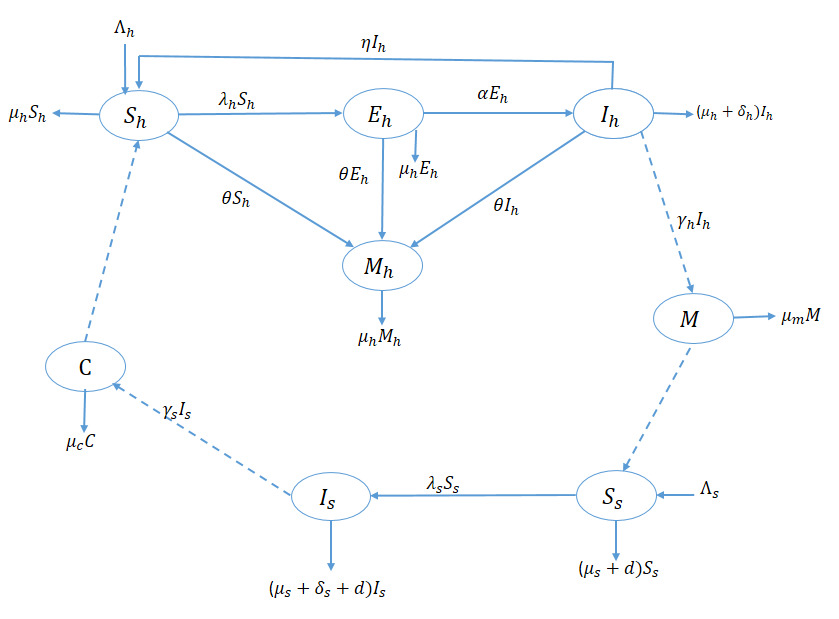
Schematic diagram of the schistosomiasis model.

Published

2026-05-14

How to Cite

Strategic interventions in schistosomiasis control: leveraging mass drug administration, public engagement, and intermediate host control to disrupt transmission dynamics. (2026). Journal of the Nigerian Society of Physical Sciences, 8(2), 3122. https://doi.org/10.46481/jnsps.2026.3122

Issue

Section

Mathematics & Statistics

How to Cite

Strategic interventions in schistosomiasis control: leveraging mass drug administration, public engagement, and intermediate host control to disrupt transmission dynamics. (2026). Journal of the Nigerian Society of Physical Sciences, 8(2), 3122. https://doi.org/10.46481/jnsps.2026.3122

Similar Articles

1-10 of 277

You may also start an advanced similarity search for this article.

Most read articles by the same author(s)