A novel mathematical model for transmission dynamics of HPV and cervical cancer progression with cancer-reliant awareness

Authors

  • Ogechi Regina Amanso
    Pan African University Institute for Basic Sciences, Technology and Innovation (PAUSTI), Nairobi, Kenya
    Kingsley Ozumba Mbadiwe University, Ideato South, Imo State
  • Jeconia Okelo Abonyo
    Department of Mathematics, Jomo Kenyatta University of Agriculture and Technology, Nairobi, Kenya
  • Phineas Roy Kiogora
    Department of Mathematics, Jomo Kenyatta University of Agriculture and Technology, Nairobi, Kenya
  • Obiora Cornelius Collins
    Institute of Systems Science, Durban University of Technology, Durban 4000, South Africa

Keywords:

Human Papillomavirus, Cervical Cancer, Mathematical Modelling, Awareness, Numerical Simulation

Abstract

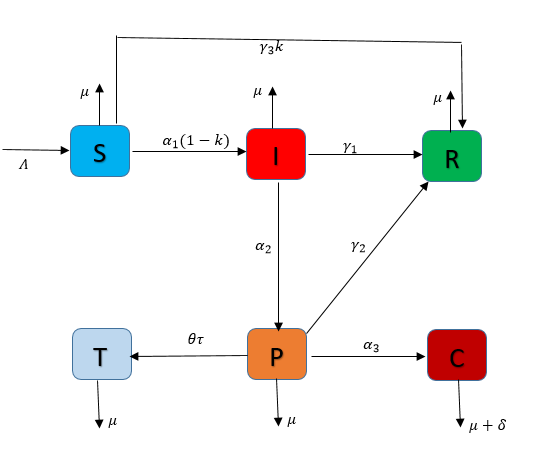
Human papillomavirus (HPV) is a global health problem that causes the vast majority of cervical cancers. { A novel mathematical model for HPV, as it progresses to cervical cancer, was formulated using a system of six ordinary differential equations that incorporates behavioural dynamics in the description of some control measures. In particular, this study introduces a novel chained dependency framework where the awareness parameter depends on Cancer burden, and the screening rate is a function of awareness}. The essential epidemiological features of the model, such as the positivity and boundedness of the model, the basic reproduction number $\mathcal{R}_0$, the disease-free equilibrium, and the endemic equilibrium, are derived. The disease-free equilibrium is shown to be locally and globally asymptotically stable when $\mathcal{R}_0 < 1$. The endemic level of infection is expressed in terms of $\mathcal{R}_0$, and deductions are made from their relationship. Sensitivity analysis is conducted to determine which parameters are of utmost importance using a global sensitivity analysis method called the Partial Rank Correlation Coefficient (PRCC) method. Parameters are set from the literature, and simulation is carried out using the Runge--Kutta 4th order (RK4) method to explore the impact of various parameters on model dynamics. { The results of the analyses not only reveal the impact of awareness campaigns, routine screening programmes, and vaccination in reducing HPV and cervical cancer, but also demonstrate how improved disease outcomes are directly linked to the chained awareness screening structure rather than the usual epidemic dynamics.
Dimensions

[1] Africa Health Organisation, “Cervical Cancer in Africa Fact Sheet”, (2024). https://aho.org/fact-sheets/cervical-cancer-in-africa-fact-sheet/.

[2] African Union, CARMMA, “Human Papillomavirus (HPV) in Africa”, (2022). https://carmma.au.int/en/news/press-releases/2022-06-02/ human- papillomavirus- hpv- africa.

[3] S. Ajao, I. Olopade, T. Akinwumi, S. Adewale & A. Adesanya, “Un- derstanding the Transmission Dynamics and Control of HIV Infection: A Mathematical Model Approach”, Journal of the Nigerian Society of Phys- ical Sciences 5 (2023) 1389. https://doi.org/10.46481/jnsps.2023.1389.

[4] N.Althobaiti&D.Baleanu,“Dynamicsofhumanpapillomavirus(HPV) incorporating homosexual transmission and HPV-induced cancers”, Ad- vances in Continuous and Discrete Models 104 (2025). https://doi.org/10. 1186/s13662-025-03957-1.

[5] I. Al-Shbeil, N. Djenina, A. Jaradat, A. Al-Husban, A. Ouannas & G. Grassi, “A New COVID-19 Pandemic Model including the Com- partment of Vaccinated Individuals: Global Stability of the Disease- Free Fixed Point”, Mathematics 11 (2023) 576. https://doi.org/10.3390/ math11030576.

[6] O. R. Amanso, N. S. Aguegboh, P. U. Achimugwu, C. A. Okeke, B. E. Chukwuemeka, K. C. Nnamaga & E. O. Oshilim, “Mathematical model of the early incidence and spread of COVID-19 in Nigeria combined with control measure”, International Journal of Scientific & Engineering Re- search 11 (2020) 1110.

[7] S. M. Blower & H. Dowlatabadi, “Sensitivity and Uncertainty Analy- sis of Complex Models of Disease Transmission: An HIV Model, as an Example”, International Statistical Review 62 (1994) 229–243. https: //doi.org/10.2307/1403510.

[8] Cleveland Clinic, “HPV (Human Papilloma Virus)”, (2023). https://my. clevelandclinic.org/health/diseases/11901-hpv-human-papilloma-virus.

[9] ClevelandClinic,“HPVVaccine”,(2024).https://my.clevelandclinic.org/ health/treatments/21613-hpv-vaccine.

[10] H. D. Desta, G. T. Tilahun, T. M. Tolasa & M. G. Geleso, “Mathemat- ical Model of Human Papillomavirus (HPV) Dynamics With Double- Dose Vaccination and Its Impact on Cervical Cancer”, Discrete Dynam- ics in Nature and Society 2024 (2024) 1–19. https://doi.org/10.1155/ddns/ 9971859.

[11] O. Diekmann, J. A. P. Heesterbeek & J. A. J. Metz, “On the definition and the computation of the basic reproduction ratio R0 in models for in- fectious diseases in heterogeneous populations”, Journal of Mathematical Biology 28 (1990) 365–382. https://doi.org/10.1007/BF00178324.

[12] O. Diekmann, J. A. P. Heesterbeek & M. G. Roberts, “Further notes on the basic reproduction number”, Mathematical Epidemiology of Infectious Diseases (2010) 159–178. https://doi.org/10.1007/978-3-540-78911-6 6.

[13] M. Haddouch, I. Hajjout & E. M. Boudi, “An integrated approach to un- certainty and global sensitivity analysis in penstock structural modeling”, Heliyon 11 (2025) 1–26. https://doi.org/10.1016/j.heliyon.2024.e41049.

[14] Y. He, “Advances in HPV-Associated Cervical Cancer Dynamic Mod- elling for Prevention and Control Evaluation”, China CDC Weekly 7 (2025) 225–229. https://weekly.chinacdc.cn/en/article/doi/10.46234/ ccdcw2025.035.

[15] M.Kretzschmar&J.Wallinga,“MathematicalModelsinInfectiousDis- ease Epidemiology”, Modern Infectious Disease Epidemiology (2010) 209–221. https://doi.org/10.1007/978-0-387-93835-6 12.

[16] J.Lakoande,O.W.Sawadogo&A.Kiemtore,“MathematicalModelling and Numerical Simulation of the dynamics of Human Papillomavirus (HPV) and Cervical Cancer in Burkina Faso”, Asia Pacific Journal of Mathematics 12 (2025) 1–32. https://doi.org/10.28924/APJM/12-8.

[17] S. Lee & A. M. Tameru, “A Mathematical Model of Human Papillo- mavirus (HPV) in the United States and its Impact on Cervical Cancer”, Journal of Cancer 3 (2012) 262–268. https://doi.org/10.7150/jca.4161.

[18] L.J.Mbigili,N.Nyerere,A.Iddi&S.Mpeshe,“Amathematicalanalysis of HPV transmission dynamics and cervical cancer progression: The role of screening, prophylactic and therapeutic vaccination strategies”, Com- puter Methods and Programs in Biomedicine Update 8 (2025) 100219. https://doi.org/10.1016/j.cmpbup.2025.100219.

[19] ModelinginBiologycontributors,“DynamicalSystemsAnalysisofEpi- demiological Models”, GitHub pages (2023). https://modelinginbiology. github.io/Dynamical-System-Analysis-of-Epidemiological-Models.

[20] National Cancer Institute, “HPV and Cancer”, (2025). https://www. cancer.gov/about-cancer/causes-prevention/risk/infectious-agents/ hpv- and- cancer.

[21] National Cancer Institute, “What Is Cervical Cancer?”, (2022). https:// www.cancer.gov/types/cervical.

[22] NationalHealthService(NHS),“Humanpapillomavirus(HPV)”,(2022). https://www.nhs.uk/conditions/human-papilloma-virus-hpv/.

[23] S. Oswald, “Mathematical modeling of the impact of HPV vaccine up- take in reducing cervical cancer using a graph-theoretic approach via Ca- puto fractional-order derivatives”, Computer Methods and Programs in Biomedicine Update 8 (2025) 100216. https://doi.org/10.1016/j.cmpbup. 2025.100216.

[24] O. J. Peter, “Modelling measles transmission dynamics and the impact of control strategies on outbreak Management”, Journal of Biological Dynamics 19 (2025) 2479448. https://doi.org/10.1080/17513758.2025. 2479448.

[25] I. Nzisa, R. Kamenwa, J. Orwa & P. Samia, “Knowledge of human papil- lomavirus vaccine as a determinant of uptake among guardians of adoles- cent girls: A single hospital experience in nairobi, kenya”, Global Pedi- atrics 12 (2025) 100249. https://doi.org/10.1016/j.gpeds.2025.100249.

[26] P. K. Rajan, M. Kuppusamy & O. F. Egbelowo, “A mathematical model for human papillomavirus and its impact on cervical cancer in India”, Journal of Applied Mathematics and Computing 69 (2022) 753–770. https://doi.org/10.1007/s12190-022-01767-2.

[27] H. Ren, R. Xu & J. Zhang, “HPV transmission and optimal control of cervical cancer in China”, Scientific Reports 15 (2025) 21354. https:// doi.org/10.1038/s41598-025-05514-y.

[28] Office on Women’s Health, “Human papillomavirus”, (2024). https:// womenshealth.gov/a-z-topics/human-papilloma-virus.

[29] K.S.Okunade,“Humanpapillomavirusandcervicalcancer”,Journalof Obstetrics and Gynaecology 40 (2020) 602–608. https://doi.org/10.1080/ 01443615.2019.1634030.

[30] A.Sysoev,“SensitivityAnalysisofMathematicalModels”,Computation 11 (2023) 159. https://doi.org/10.3390/computation11080159.

[31] P. van den Driessche & J. Watmough, “Reproduction numbers and sub- threshold endemic equilibria for compartmental models of disease trans- mission”, Mathematical Biosciences 180 (2002) 29–48. https://doi.org/ 10.1016/S0025-5564(02)00108-6.

[32] WorldHealthOrganization,“CervicalCancerFactSheet”,(2025).https: //www.who.int/news-room/fact-sheets/detail/cervical-cancer.

[33] The World Bank, “Preventing cervical cancer in Africa: Why scaling HPV vaccination is a pri- ority”, (2024). https://blogs.worldbank.org/en/health/ Preventing- cervical- cancer- in- Africa- Why- scaling- HPV- vaccination- priority.

[34] K. Zhang et al., “Mathematical analysis of a human papillomavirus transmission model with vaccination and screening”, Mathematical Bio- sciences and Engineering 17 (2020) 5449–5476. https://www.aimspress.

Published

2026-03-22

How to Cite

A novel mathematical model for transmission dynamics of HPV and cervical cancer progression with cancer-reliant awareness. (2026). Journal of the Nigerian Society of Physical Sciences, 8(2). https://doi.org/10.46481/jnsps.2026.3224

Issue

Section

Mathematics & Statistics

How to Cite

A novel mathematical model for transmission dynamics of HPV and cervical cancer progression with cancer-reliant awareness. (2026). Journal of the Nigerian Society of Physical Sciences, 8(2). https://doi.org/10.46481/jnsps.2026.3224

Similar Articles

31-40 of 214

You may also start an advanced similarity search for this article.