A novel mathematical model for transmission dynamics of HPV and cervical cancer progression with cancer-reliant awareness
Keywords:
Human Papillomavirus, Cervical Cancer, Mathematical Modelling, Awareness, Numerical SimulationAbstract
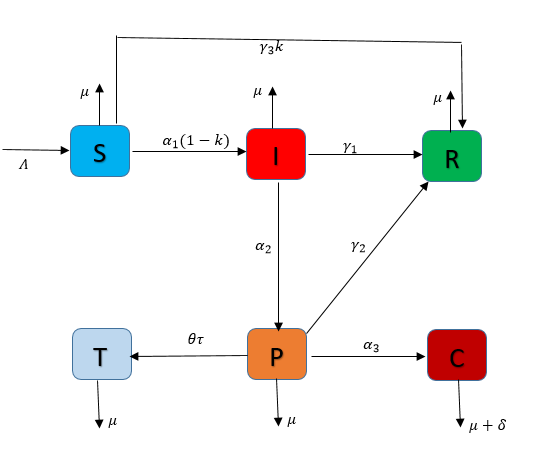
Human papillomavirus (HPV) is a global health problem that causes the vast majority of cervical cancers. { A novel mathematical model for HPV, as it progresses to cervical cancer, was formulated using a system of six ordinary differential equations that incorporates behavioural dynamics in the description of some control measures. In particular, this study introduces a novel chained dependency framework where the awareness parameter depends on Cancer burden, and the screening rate is a function of awareness}. The essential epidemiological features of the model, such as the positivity and boundedness of the model, the basic reproduction number $\mathcal{R}_0$, the disease-free equilibrium, and the endemic equilibrium, are derived. The disease-free equilibrium is shown to be locally and globally asymptotically stable when $\mathcal{R}_0 < 1$. The endemic level of infection is expressed in terms of $\mathcal{R}_0$, and deductions are made from their relationship. Sensitivity analysis is conducted to determine which parameters are of utmost importance using a global sensitivity analysis method called the Partial Rank Correlation Coefficient (PRCC) method. Parameters are set from the literature, and simulation is carried out using the Runge--Kutta 4th order (RK4) method to explore the impact of various parameters on model dynamics. { The results of the analyses not only reveal the impact of awareness campaigns, routine screening programmes, and vaccination in reducing HPV and cervical cancer, but also demonstrate how improved disease outcomes are directly linked to the chained awareness screening structure rather than the usual epidemic dynamics.
Published
How to Cite
Issue
Section
Copyright (c) 2026 Ogechi Regina Amanso, Jeconia Okelo Abonyo, Phineas Roy Kiogora, Obiora Cornelius Collins (Author)

This work is licensed under a Creative Commons Attribution 4.0 International License.
How to Cite
Similar Articles
- A. O. Sangotola, S. B. Adeyemo, O. A. Nuga, A. E. Adeniji, A. J. Adigun, A tuberculosis model with three infected classes , Journal of the Nigerian Society of Physical Sciences: Volume 6, Issue 1, February 2024
- R. El chaal, M. O. Aboutafail, Statistical Modelling by Topological Maps of Kohonen for Classification of the Physicochemical Quality of Surface Waters of the Inaouen Watershed Under Matlab , Journal of the Nigerian Society of Physical Sciences: Volume 4, Issue 2, May 2022
- Ghada A. Ahmed, Fractional-order modeling of visceral leishmaniasis disease transmission dynamics : strategies in eastern Sudan , Journal of the Nigerian Society of Physical Sciences: Volume 5, Issue 4, November 2023
- Olumide S. Adesina, Adedayo F. Adedotuun, Kayode S. Adekeye, Ogbu F. Imaga, Adeleke J. Adeyiga, Toluwalase J. Akingbade, On logistic regression versus support vectors machine using vaccination dataset , Journal of the Nigerian Society of Physical Sciences: Volume 6, Issue 1, February 2024
- Helen Olaronke Edogbanya, Emmanuel Sabastine, Rosalio G. Artes Jr., Regimar A. Rasid, Dynamical and optimal control analysis of lymphatic filariasis and buruli ulcer co-infection , Journal of the Nigerian Society of Physical Sciences: Volume 6, Issue 4, November 2024
- Olumide O. Olaiya, Mark I. Modebei, Saheed A. Bello, A One-Step Block Hybrid Integrator for Solving Fifth Order Korteweg-de Vries Equations , Journal of the Nigerian Society of Physical Sciences: Volume 4, Issue 3, August 2022
- Anas Sani Maihulla, Ibrahim Yusuf, Performance Analysis of Photovoltaic Systems Using (RAMD) Analysis , Journal of the Nigerian Society of Physical Sciences: Volume 3, Issue 3, August 2021
- O. G. Obadina, Adedayo Funmi Adedotuun, O. A. Odusanya, Ridge Estimation's Effectiveness for Multiple Linear Regression with Multicollinearity: An Investigation Using Monte-Carlo Simulations , Journal of the Nigerian Society of Physical Sciences: Volume 3, Issue 4, November 2021
- Segun L. Jegede, Adewale F. Lukman, Kayode Ayinde, Kehinde A. Odeniyi, Jackknife Kibria-Lukman M-Estimator: Simulation and Application , Journal of the Nigerian Society of Physical Sciences: Volume 4, Issue 2, May 2022
- Lek Ming Lim, Yang Lu, Ahmad Sufril Azlan Mohamed, Majid Khan Majahar Ali, Data safety prediction using YOLOv7+G3HN for traffic roads , Journal of the Nigerian Society of Physical Sciences: Volume 6, Issue 3, August 2024
You may also start an advanced similarity search for this article.