Adsorption of dithiazolidine compounds on Fe(110) surface and potential for corrosion inhibition: DFT calculations and adsorption locator/Monte Carlo adsorption simulations
Keywords:
Adsorption, Corrosion inhibition, Dithiazolidine, Fe(110) substrate, HOMO–LUMOAbstract
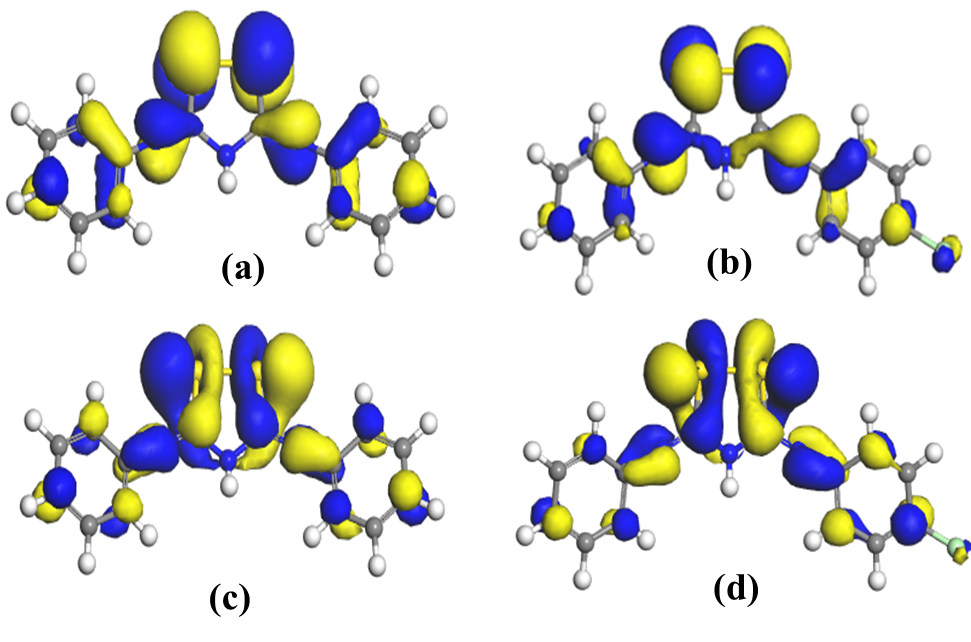
Many corrosion inhibitors act through an adsorption mechanism by forming a stable film that protects the surface from an aggressive environment. The adsorption behaviour of two dithiazolidine derivatives, namely, 3,5-diphenyl-imino-1,2,4-dithiazolidine (DPID) and 3-phenyl-imino-5-chlorophenylimino-1,2,4-dithiazolidine (PCID), on the Fe(110) surface was investigated via density functional theory (DFT) calculations and adsorption locator/Monte Carlo adsorption simulations. Quantum study results reveal that PCID exhibits higher HOMO energy, higher tendency to accept electrons, and greater molecular softness than DPID, though with a smaller HOMO--LUMO energy gap (Delta)E = 0.10355 Ha. Fukui function and Mulliken charge analyses led to the identification of sulphur atoms as the most active adsorption centres in both inhibitors. Adsorption locator/Monte Carlo adsorption simulations confirm that both compounds are strongly adsorbed on the Fe(110) surface in a parallel orientation. DPID and PCID afforded adsorption energies of -137.419 kcal mol-1 and -147.611 kcal mol-1, respectively, whereas the rigid adsorption energy of PCID reached -149.555 kcal mol-1, a demonstration of stronger surface binding. These highly negative adsorption energies suggest predominantly very strong inhibitor-surface interactions, and that both compounds have theoretical potential as corrosion inhibitors for Fe-based surfaces. However, the adsorption strength and predicted inhibition potential of PCID would be greater compared with DPID, which provides theoretical guidance for rational design and prioritization of dithiazolidine-based corrosion inhibitors for future experimental evaluation.
References
[1] K. Berdimuradov, A. Rasulov, H. Yaxshinorov, J. Abdisattorov, E. Berdimurodov, O. Dagdag & M. Rbaa, Corrosion in the chemical processing industry, in Industrial Corrosion: Fundamentals, Failure, Analysis and Prevention, S. Zehra, R. Aslam, M. Mobin, & C. Verma. Wiley, (Ed.) Hoboken, USA, 2025, pp. 131--152. https://doi.org/10.1002/9781394301560.ch6.
[2] N. J. Mohammed, M. R. Yusop & N. K. Othman, ``Green and nano-based strategies for controlling mild steel corrosion in acidic media: a systematic review'', npj Materials Degradation 10 (2026) 16. https://doi.org/10.1038/s41529-025-00726-z.
[3] E. Ituen, L. Yuanhua, C. Verma, A. Alfantazi, O. Akaranta & E. E. Ebenso, ``Synthesis and characterization of walnut husk extract-silver nanocomposites for removal of heavy metals from petroleum wastewater and its consequences on pipework steel corrosion'', Journal of Molecular Liquids 335 (2021) 116132. https://doi.org/10.1016/j.molliq.2021.116132.
[4] A. Chaouiki, M. Chafiq, Y. G. Ko, A. H. Al-Moubaraki, F. Z. Thari, R. Salghi, K. Karrouchi, K. Bougrin, I. H. Ali & H. Lgaz, ``Adsorption mechanism of eco-friendly corrosion inhibitors for exceptional corrosion protection of carbon steel: electrochemical and first-principles DFT evaluations'', Metals 12 (2022) 1598. https://doi.org/10.3390/met12101598.
[5] A. Kokalj, ``Corrosion inhibitors: physisorbed or chemisorbed?'', Corrosion Science 196 (2022) 109939. https://doi.org/10.1016/j.corsci.2021.109939.
[6] A. K. Reddy, Modern Electrochemistry, Plenum Press, New York, USA, 2000. https://www.scribd.com/document/117525559/Modern-Electrochemistry-1-Ionics.
[7] A. Martínez-Mesa & G. Seifert, ``Adsorption of molecular hydrogen on nanostructured surfaces'', Revista Cubana de Física 31 (2014) 32. https://www.researchgate.net/publication/264550354_Adsorption_of_molecular_hydrogen_on_nanostructured_surfaces.
[8] E. Ituen, O. Akaranta & A. James, ``Evaluation of performance of corrosion inhibitors using adsorption isotherm models: an overview'', Chemical Science International Journal 18 (2017) 1. https://doi.org/10.9734/CSJI/2017/28976.
[9] S. De Gisi, G. Lofrano, M. Grassi & M. Notarnicola, ``Characteristics and adsorption capacities of low-cost sorbents for wastewater treatment: a review'', Sustainable Materials and Technologies 9 (2016) 10. https://doi.org/10.1016/j.susmat.2016.06.002.
[10] Y. Artioli, ``Adsorption'', in Elsevier eBooks, Elsevier, Amsterdam, Netherlands, 2008, pp. 60--65. https://doi.org/10.1016/b978-008045405-4.00252-4.
[11] H. Kumar, V. Yadav, S. K. Saha & N. Kang, ``Adsorption and inhibition mechanism of efficient and environment friendly corrosion inhibitor for mild steel: experimental and theoretical study'', Journal of Molecular Liquids 338 (2021) 116634. https://doi.org/10.1016/j.molliq.2021.116634.
[12] O. A. Akinbulumo, O. J. Odejobi & E. L. Odekanle, ``Thermodynamics and adsorption study of the corrosion inhibition of mild steel by Euphorbia heterophylla L. extract in 1.5 M HCl'', Results in Materials 5 (2020) 100074. https://doi.org/10.1016/j.rinma.2020.100074.
[13] N. Setti, A. Barrahi, M. Maatallah, Y. Kaddouri, T. B. Hadda, H. Outada, A. Thakur, R. Touzani, K. Karrouchi, H. A. Abuelizz, B. Dikici, A. Zarrouk & A. Dafali, ``Experimental and computational approach on the corrosion inhibition properties of two newly pyrazole derivatives on carbon steel in acid medium'', Scientific Reports 15 (2025) 3631. https://doi.org/10.1038/s41598-025-87564-w.
[14] E. Ituen, V. Mkpenie, L. Yuanhua & A. Singh, ``Inhibition of erosion corrosion of pipework steel in descaling solution using 5-hydroxytryptamine-based additives: empirical and computational studies'', Journal of Molecular Structure 1204 (2020) 127562. https://doi.org/10.1016/j.molstruc.2019.127562.
[15] C. Verma, E. E. Ebenso, L. O. Olasunkanmi, M. A. Quraishi & I. B. Obot, ``Adsorption behavior of glucosamine-based pyrimidine-fused heterocycles as green corrosion inhibitors for mild steel: experimental and theoretical studies'', The Journal of Physical Chemistry C 120 (2016) 11598. https://doi.org/10.1021/acs.jpcc.6b04429.
[16] H. H. Hammud, W. A. Aljamhi, I. Shawish, N. Hazimah, B. Z. Arfan, M. Haniti, S. A. Hamid, N. S. Sheikh, H. M. Abd El-Lateef, A. Barakat & A. El-Faham, ``Experimental and computational anticorrosion behaviors of pyrazole s-triazine/anilino-morpholino derivatives for steel in acidic solutions'', ACS Omega 9 (2024) 31714. https://doi.org/10.1021/acsomega.4c02569.
[17] E. Ituen, I. Umana, A. Etuk, S. Shaibu, A. Johnson, V. Mkpenie & U. Inyang, ``Computational assessment of structure-activity relationship, adsorption behaviour and significance on corrosion inhibition of some benzothiazole-based compounds'', Engineering and Applied Science Letters 8 (2025) 35. https://doi.org/10.30538/psrp-easl2025.0118.
[18] H. Mi, G. Xiao & X. Chen, ``Theoretical evaluation of corrosion inhibition performance of three antipyrine compounds'', Computational and Theoretical Chemistry 1072 (2015) 7. https://doi.org/10.1016/j.comptc.2015.08.023.
[19] U. Habeeba & N. Raghavendra, ``A theoretical approach to the corrosion inhibition of iron (110) in HCl activation by environmental benign four amino acids: MC simulation and DFT studies'', Extreme Materials 1 (2025) 1. https://doi.org/10.1016/j.exm.2025.02.001.
[20] Z. El Adnani, M. McHarfi, M. Sfaira, M. Benzakour, A. T. Benjelloun & M. Ebn Touhami, ``DFT theoretical study of 7-R-3methylquinoxalin-2(1H)-thiones (R = H; CH3; Cl) as corrosion inhibitors in hydrochloric acid'', Corrosion Science 68 (2013) 223. https://doi.org/10.1016/j.corsci.2012.11.020.
[21] S. Elmi, M. M. Foroughi, M. Shahraki, N. Dehdab & M. Shahid, ``Computational evaluation of N-thiazolyl-2-cyanoacetamide derivatives on corrosion inhibition of aluminum'', Journal of Failure Analysis and Prevention 18 (2018) 887. https://doi.org/10.1007/s11668-018-0476-7.
[22] C. Verma, A. Thakur, R. Ganjoo, S. Sharma, H. Assad, A. Kumar, M. A. Quraishi & A. Alfantazi, ``Coordination bonding and corrosion inhibition potential of nitrogen-rich heterocycles: azoles and triazines as specific examples'', Coordination Chemistry Reviews 488 (2023) 215177. https://doi.org/10.1016/j.ccr.2023.215177.
[23] N. Lahrache, S. Jebbari, A. Barhoumi, M. Omari, N. Labjar, H. Nasrellah, S. Lakhloufi & S. El Hajjaji, ``Synthesis, experimental and theoretical studies on the inhibition of corrosion of C38 steel in a molar hydrochloric acid solution by bis-5,6-methylbenzimidazole-2-thione'', Hybrid Advances 11 (2025) 100543. https://doi.org/10.1016/j.hybadv.2025.100543.
[24] N. Betti, A. A. Al-Amiery, W. K. Al-Azzawi & W. N. R. W. Isahak, ``Corrosion inhibition properties of Schiff base derivative against mild steel in HCl environment complemented with DFT investigations'', Scientific Reports 13 (2023) 8979. https://doi.org/10.1038/s41598-023-36064-w.
[25] M. A. Quraishi, D. S. Chauhan & V. S. Saji, Heterocyclic Organic Corrosion Inhibitors: Principles and Applications, Elsevier, Amsterdam, Netherlands, 2020. https://dokumen.pub/heterocyclic-organic-corrosion-inhibitors-principles-and-applications-0128185589-9780128185582.html.
[26] H. H. Rasul, D. M. Mamad, Y. H. Azeez, R. A. Omer & K. A. Omer, ``Theoretical investigation on corrosion inhibition efficiency of some amino acid compounds'', Computational and Theoretical Chemistry 1225 (2023) 114177. https://doi.org/10.1016/j.comptc.2023.114177.
[27] Z. Chen, Z. Guo & A. A. Fadhil, ``Understanding how rebar steel surface anisotropy affects corrosion inhibitor adsorption and performance: from experimental to theoretical studies'', Journal of Building Engineering 112 (2025) 113815. https://doi.org/10.1016/j.jobe.2025.113815.
[28] N. I. N. Haris, S. Sobri, Y. A. Yusof & N. K. Kassim, ``An overview of molecular dynamic simulation for corrosion inhibition of ferrous metals'', Metals 11 (2021) 46. https://doi.org/10.3390/met11010046.
[29] N. Yilmaz, A. Fitoz & K. C. Emregül, ``A combined electrochemical and theoretical study into the effect of 2-((thiazole-2-ylimino)methyl)phenol as a corrosion inhibitor for mild steel in a highly acidic environment'', Corrosion Science 111 (2016) 110. https://doi.org/10.1016/j.corsci.2016.05.002.
[30] K. Cherrak, O. M. A. Khamaysa, H. Bidi, M. El Massaoudi, I. A. Ali, S. Radi, Y. El Ouadi, F. El-Hajjaji, A. Zarrouk & A. Dafali, ``Performance evaluation of newly synthetized bi-pyrazole derivatives as corrosion inhibitors for mild steel in acid environment'', Journal of Molecular Structure 1261 (2022) 132925. https://doi.org/10.1016/j.molstruc.2022.132925.
[31] M. Scheffler & C. Stampfl, Theory of adsorption on metal substrates, in Handbook of Surface Science, Vol. 2, Elsevier, Amsterdam, Netherlands, 2000, pp. 285--356. https://doi.org/10.1016/S1573-4331(00)80009-8.
[32] A. Kokalj, ``On the alleged importance of the molecular electron-donating ability and the HOMO--LUMO gap in corrosion inhibition studies'', Corrosion Science 180 (2021) 109016. https://doi.org/10.1016/j.corsci.2020.109016.
[33] F. Kayadibi, S. G. Sagdinc & Y. S. Kara, ``Density functional theory studies on the corrosion inhibition of benzoin, benzil, benzoin-(4-phenylthiosemicarbazone) and benzil-(4-phenylthiosemicarbazone) of mild steel in hydrochloric acid'', Protection of Metals and Physical Chemistry of Surfaces 51 (2015) 143. https://doi.org/10.1134/S2070205115010050.
[34] P. Udhayakala, A. M. Samuel, T. V. Rajendiran & S. Gunasekaran, ``DFT study on the adsorption mechanism of some phenyltetrazole substituted compounds as effective corrosion inhibitors for mild steel'', Der Pharma Chemica 5 (2013) 111. https://www.researchgate.net/publication/268444624.
[35] P. P. Zamora, K. Bieger, A. Cuchillo, A. Tello & J. P. Muena, ``Theoretical determination of a reaction intermediate: Fukui function analysis, dual reactivity descriptor and activation energy'', Journal of Molecular Structure 1227 (2021) 129369. https://doi.org/10.1016/j.molstruc.2020.129369.
[36] I. B. Obot, N. O. Obi-Egbedi & S. A. Umoren, ``Antifungal drugs as corrosion inhibitors for aluminium in 0.1 M HCl'', Corrosion Science 51 (2009) 1868. https://doi.org/10.1016/j.corsci.2009.05.017.
[37] A. Kokalj, ``Molecular modeling of organic corrosion inhibitors: calculations, pitfalls, and conceptualization of molecule--surface bonding'', Corrosion Science 193 (2021) 109650. https://doi.org/10.1016/j.corsci.2021.109650.
Published
How to Cite
Issue
Section
Copyright (c) 2026 Ekemini Ituen, Peace Madu, Adewale Olamoyesan, Gospel Asuquo, Chibueze J. Olelewe, Emmanuel E. Etim (Author)

This work is licensed under a Creative Commons Attribution 4.0 International License.