
An empirical evaluation of mathematical, machine learning, and hybrid modeling approaches for COVID-19 forecasting
Keywords:
SEIR model, Hybrid modeling, Infectious disease prediction, Epidemic forecasting, COVID-19Abstract
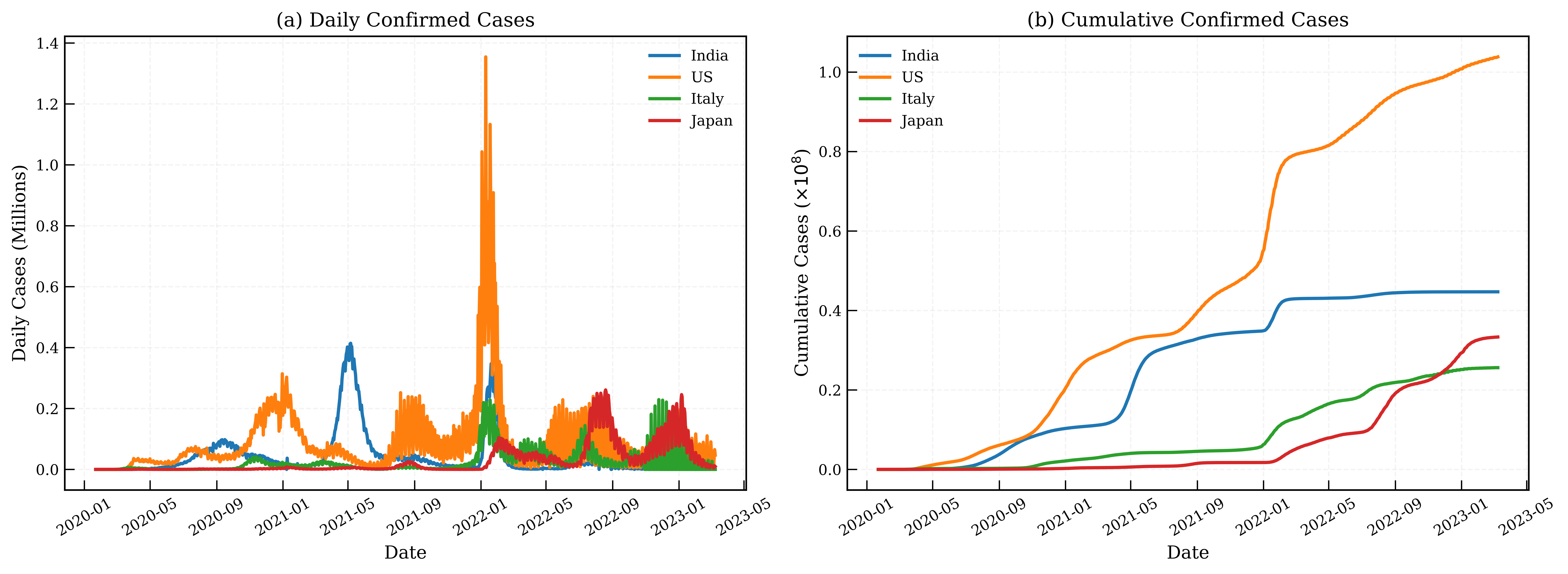
Accurate forecasting of infectious disease spread is essential for public health decision-making. This study compares mechanistic susceptible-exposed-infectious-removed (SEIR) models, machine-learning methods, and hybrid artificial intelligence (AI)-driven epidemiological frameworks using coronavirus disease 2019 (COVID-19) case data from India, the United States, Italy, and Japan. After preprocessing and exploratory analysis, we estimate time-varying transmission rates and develop two hybrid extensions: one predicts beta(t) using machine learning, and the other learns residual errors from the SEIR model. A baseline machine-learning model using lag-based and effective reproduction number (Rt)-driven features is also evaluated. Performance is assessed using mean absolute error (MAE), root mean squared error (RMSE), mean absolute percentage error (MAPE), high-incidence MAPE (on days with observed incidence ge 100 cases), and peak-timing error. With the SEIR transmission-rate spline fitted strictly to training data and all models evaluated on an identical 223-day held-out test window, a simple persistence baseline outperforms the mechanistic SEIR model, both hybrid AI extensions (Tracks A and B), and the pure machine-learning Random Forest model across all four countries (Diebold--Mariano test, p<0.001 in every comparison). The hybrid AI components do not consistently improve forecasting accuracy relative to the SEIR baseline. None of the mechanistic or machine-learning approaches anticipates new epidemic waves beyond the training period, underscoring the difficulty of medium-range epidemic forecasting under genuinely held-out conditions. The comparative evaluation highlights the complementary strengths and limitations of these approaches and provides guidance for future epidemic forecasting models.
Published
How to Cite
Issue
Section
Copyright (c) 2026 Pooja Satwani, Sudhir Kumar Mishra (Author)

This work is licensed under a Creative Commons Attribution 4.0 International License.
How to Cite
Similar Articles
- Olumide O. Olaiya, Rasaq A. Azeez, Mark I. Modebei, Efficient Hybrid Block Method For The Numerical Solution Of Second-order Partial Differential Problems via the Method of Lines , Journal of the Nigerian Society of Physical Sciences: Volume 3, Issue 1, February 2021
- Rachid El chaal, Hamid Dalhi, Otmane Darbal, Omar Boughaleb, Analytical resolution of nonlinear fractional equations using the GERDFM method: Application to nonlinear Schrödinger and truncated Boussinesq-Burgers equations , Journal of the Nigerian Society of Physical Sciences: Volume 7, Issue 4, November 2025
- Monika Saini, Ashish Kumar, Vijay Singh Maan, Deepak Sinwar, Efficient and Intelligent Decision Support System for Smart Irrigation , Journal of the Nigerian Society of Physical Sciences: Volume 4, Issue 4, November 2022
- E. Udensi, R. B. Salau, S. O. Salihu, M. M. Ndamitso, M. T. Bisiriyu, Chemometric authentication of branded and crude spices using integrated GC–MS fingerprints and elemental profiling , Journal of the Nigerian Society of Physical Sciences: Volume 8, Issue 3, August 2026
- Bright O. Osu, K. N. C. Njoku, B. I. Oruh, On the Investment Strategy, Effect of Inflation and Impact of Hedging on Pension Wealth during Accumulation and Distribution Phases , Journal of the Nigerian Society of Physical Sciences: Volume 2, Issue 3, August 2020
- R. R. Hanvey, K. W. Bunonyo, Effect of Treatment Parameter on Oscillatory Flow of Blood Through an Atherosclerotic Artery with Heat Transfer , Journal of the Nigerian Society of Physical Sciences: Volume 4, Issue 3, August 2022
- E. P. Inyang, E. O. Obisung, P. C. Iwuji, J. E. Ntibi, J. Amajama, E. S. William, Masses and thermal properties of a Charmonium and Bottomonium Mesons , Journal of the Nigerian Society of Physical Sciences: Volume 4, Issue 3, August 2022
- Muhammad Dahiru Liman, Salamatu Ibrahim Osanga, Esther Samuel Alu, Sa'adu Zakariya, Regularization Effects in Deep Learning Architecture , Journal of the Nigerian Society of Physical Sciences: Volume 6, Issue 2, May 2024
- Nassima Bou-ydia, Ben-issa El miraoui, Latifa Laallam, Ahmed Jouaiti, Interaction of hydroxyapatite and chitosan with gentamicin and their antimicrobial activities: DFT and molecular docking approach , Journal of the Nigerian Society of Physical Sciences: Volume 7, Issue 3, August 2025
- Priya Dahiya, Jasdev Bhatti, Pankaj Thakur, Weibull-based reliability and profitability analysis of an industrial multi-state repairable system , Journal of the Nigerian Society of Physical Sciences: Volume 8, Issue 3, August 2026
You may also start an advanced similarity search for this article.







