An empirical evaluation of mathematical, machine learning, and hybrid modeling approaches for COVID-19 forecasting
Keywords:
SEIR model, Hybrid modeling, Infectious disease prediction, Epidemic forecasting, COVID-19Abstract
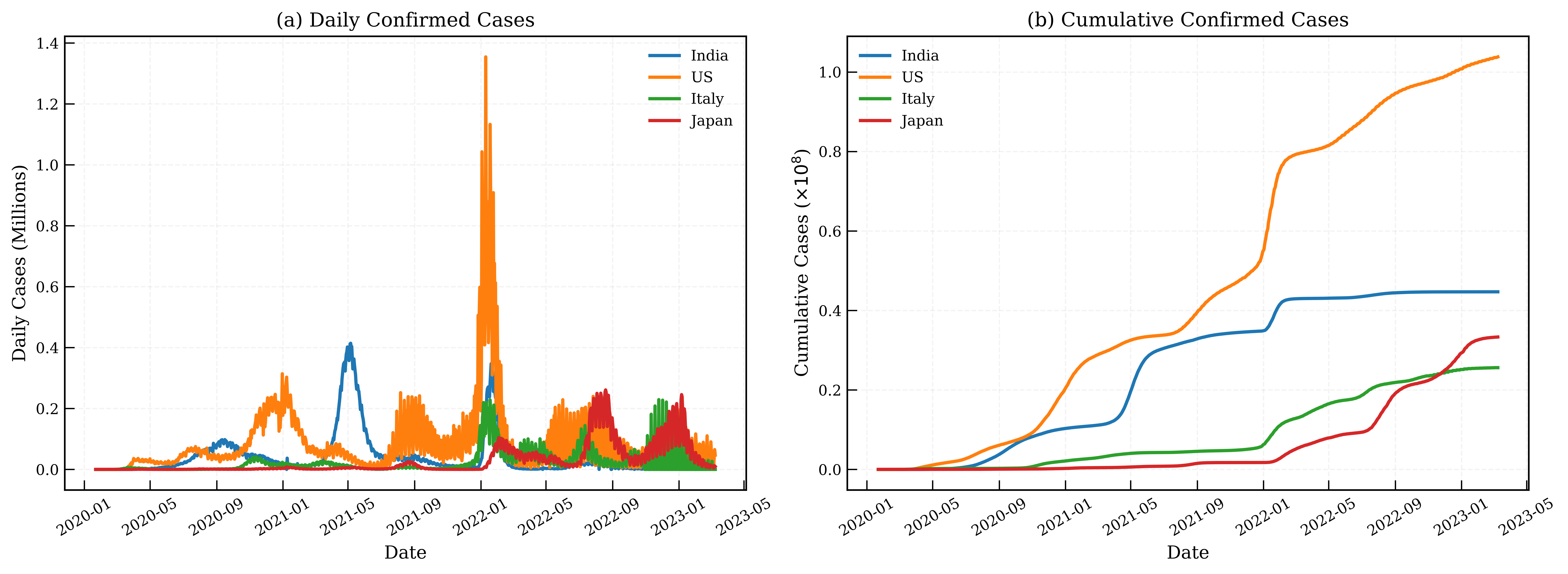
Accurate forecasting of infectious disease spread is essential for public health decision-making. This study compares mechanistic susceptible-exposed-infectious-removed (SEIR) models, machine-learning methods, and hybrid artificial intelligence (AI)-driven epidemiological frameworks using coronavirus disease 2019 (COVID-19) case data from India, the United States, Italy, and Japan. After preprocessing and exploratory analysis, we estimate time-varying transmission rates and develop two hybrid extensions: one predicts beta(t) using machine learning, and the other learns residual errors from the SEIR model. A baseline machine-learning model using lag-based and effective reproduction number (Rt)-driven features is also evaluated. Performance is assessed using mean absolute error (MAE), root mean squared error (RMSE), mean absolute percentage error (MAPE), high-incidence MAPE (on days with observed incidence ge 100 cases), and peak-timing error. With the SEIR transmission-rate spline fitted strictly to training data and all models evaluated on an identical 223-day held-out test window, a simple persistence baseline outperforms the mechanistic SEIR model, both hybrid AI extensions (Tracks A and B), and the pure machine-learning Random Forest model across all four countries (Diebold--Mariano test, p<0.001 in every comparison). The hybrid AI components do not consistently improve forecasting accuracy relative to the SEIR baseline. None of the mechanistic or machine-learning approaches anticipates new epidemic waves beyond the training period, underscoring the difficulty of medium-range epidemic forecasting under genuinely held-out conditions. The comparative evaluation highlights the complementary strengths and limitations of these approaches and provides guidance for future epidemic forecasting models.
Published
How to Cite
Issue
Section
Copyright (c) 2026 Pooja Satwani, Sudhir Kumar Mishra (Author)

This work is licensed under a Creative Commons Attribution 4.0 International License.
How to Cite
Similar Articles
- Christopher Ifeanyi Eke, Kholoud Maswadi, Musa Phiri, Mulenga Mwege, Mohammad Imran, Dekera Kenneth Kwaghtyo, Akeremale Olusola Collins, Effective tweets classification for disaster crisis based on ensemble of classifiers , Journal of the Nigerian Society of Physical Sciences: Volume 7, Issue 3, August 2025
- P. O. Odion, M. N. Musa, S. U. Shuaibu, Age Prediction from Sclera Images using Deep Learning , Journal of the Nigerian Society of Physical Sciences: Volume 4, Issue 3, August 2022
- B. O. Adebesin, J. O. Adeniyi, I. A. Adimula, S. J. Adebiyi, S. O. Ikubanni, B. J. Adekoya, Current Understanding of the Equatorial E x B Drift velocities in the African Sector: A Short Review , Journal of the Nigerian Society of Physical Sciences: Volume 4, Issue 1, February 2022
- Idongesit E. Eteng, Udeze L. Chinedu, Ayei E. Ibor, A stacked ensemble approach with resampling techniques for highly effective fraud detection in imbalanced datasets , Journal of the Nigerian Society of Physical Sciences: Volume 7, Issue 1, February 2025
- Abdelhak Erraji, Abderrahim Maizate, Mohamed Ouzzif, An integral approach for complete migration from a relational database to MongoDB , Journal of the Nigerian Society of Physical Sciences: Volume 5, Issue 2, May 2023
- Pushap Lata Sharma, Deepak Bains, Pankaj Thakur, Thermal instability of rotating Jeffrey nanofluids in porous media with variable gravity , Journal of the Nigerian Society of Physical Sciences: Volume 5, Issue 2, May 2023
- Friday Obarhua, Oluwasemire John Adegboro, An Order Four Continuous Numerical Method for Solving General Second Order Ordinary Differential Equations , Journal of the Nigerian Society of Physical Sciences: Volume 3, Issue 1, February 2021
- K. O. Sodeinde, S. O. Olusanya, D. U. Momodu, V. F. Enogheghase, O. S. Lawal, Waste glass: An excellent adsorbent for crystal violet dye, Pb2+ and Cd2+ heavy metals ions decontamination from wastewater , Journal of the Nigerian Society of Physical Sciences: Volume 3, Issue 4, November 2021
- R. Latha, K. Lakshminarayanachari, C. Bhaskar, An analytical model for point source pollutants in an urban area with mesoscale wind and wet deposition , Journal of the Nigerian Society of Physical Sciences: Volume 6, Issue 4, November 2024
- Diva Marchandra Mulansari, Maulana Malik, Sindy Devila, Ibrahim Mohammed Sulaiman, Dian Lestari, Fevi Novkaniza, Fida Fathiyah Addini, A hybrid IFR-IDY conjugate gradient algorithm for unconstrained optimization and its application in portfolio selection , Journal of the Nigerian Society of Physical Sciences: Volume 8, Issue 1, February 2026
You may also start an advanced similarity search for this article.