A hybrid IFR-IDY conjugate gradient algorithm for unconstrained optimization and its application in portfolio selection
Keywords:
Inexact line search, Global convergence, Investment, Numerical optimization, Strong WolfeAbstract
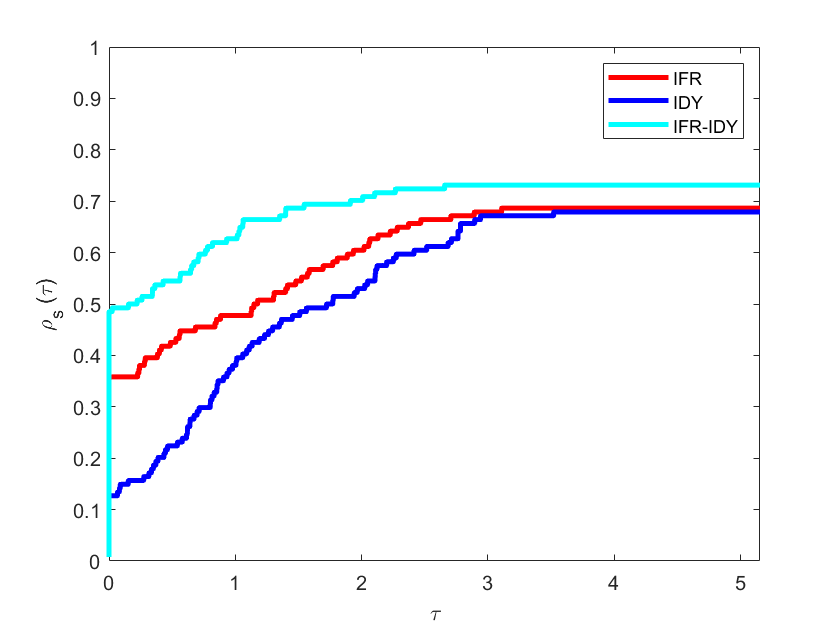
This study introduces the Improved Fletcher-Reeves (IFR)-Improved Dai-Yuan (IDY) hybrid conjugate gradient method, which combines the strengths of the IFR and IDY parameters through a minimum-operator strategy to enhance robustness in unconstrained optimization. The method is shown to satisfy descent and global convergence properties under the strong Wolfe line search. Numerical experiments on 134 benchmark functions demonstrate that IFR-IDY achieves superior performance, solving 98 problems more than IFR and IDY and exhibiting faster CPU times and fewer iterations in most cases. The method is also used to solve an IDX30 portfolio optimization problem, which results in an optimal allocation with an expected return of 0.00042 and a risk of 0.000050545. These results highlight the efficiency of IFR-IDY and its practical applicability in real-world decision-making.
References
[1] N. Andrei, Nonlinear Conjugate Gradient Methods for Unconstrained Optimization, Springer International Publishing, Cham, Switzerland, 2020. https://doi.org/10.1007/978-3-030-42950-8.
[2] S. Wright & J. Nocedal, Numerical Optimization, Springer, New York, USA, 1999. https://doi.org/10.1007/978-0-387-40065-5.
[3] S. K. Mishra & B. Ram, Introduction to Unconstrained Optimization with R, Springer Nature, Singapore, 2019. https://doi.org/10.1007/978-981-13-7438-8.
[4] M. R. Hestenes & E. Stiefel, “Methods of conjugate gradients for solving linear systems”, Journal of Research of the National Bureau of Standards 49 (1952) 409–436. https://doi.org/10.6028/JRES.049.044.
[5] R. Fletcher & C. M. Reeves, “Function minimization by conjugate gradients”, The Computer Journal 7 (1964) 149. https://doi.org/10.1093/comjnl/7.2.149.
[6] E. Polak & G. Ribiére, “Note sur la convergence de méthodes de directions conjuguées”, Revue Française d’Informatique et de Recherche Opérationnelle, Série Rouge 3 (1969) 16. https://doi.org/10.1051/m2an/196903R100351.
[7] R. Fletcher, Practical Methods of Optimization, John Wiley & Sons, Chichester, United Kingdom, 2000. https://doi.org/10.1002/9781118723203.
[8] Y.-H. Dai & Y. Yuan, “A nonlinear conjugate gradient method with a strong global convergence property”, SIAM Journal on Optimization 10 (1999) 177. https://doi.org/10.1137/S1052623497318992.
[9] Y. Liu & C. Storey, “Efficient generalized conjugate gradient algorithms, part 1: theory”, Journal of Optimization Theory and Applications 69 (1991) 129. https://doi.org/10.1007/BF00940064.
[10] X. Jiang & J. Jian, “Improved Fletcher–Reeves and Dai–Yuan conjugate gradient methods with the strong Wolfe line search”, Journal of Computational and Applied Mathematics 348 (2019) 525. https://doi.org/10.1016/j.cam.2018.09.034.
[11] M. Malik, M. Mamat, S. S. Abas, I. M. Sulaiman & F. Sukono, “A new coefficient of the conjugate gradient method with the sufficient descent condition and global convergence properties”, Engineering Letters 28 (2020) 704. https://doi.org/10.3176/proc.2020.3.04.
[12] Maulana Malik, Mustafa Mamat, Siti Sabariah Abas, Ibrahim Mohammed Sulaiman & S. Sukono, “Performance analysis of new spectral and hybrid conjugate gradient methods for solving unconstrained optimization problems”, IAENG International Journal of Computer Science 48 (2021) 66–79. https://doi.org/10.1142/S0218196721500031.
[13] M. Malik, A. B. Abubakar, I. M. Sulaiman, M. Mamat & S. S. Abas, “A new three-term conjugate gradient method for unconstrained optimization with applications in portfolio selection and robotic motion control”, IAENG International Journal of Applied Mathematics 51 (2021). https://doi.org/10.1142/S0218196721500031.
[14] S. M. Ibrahim, A. M. Awwal, M. Malik, R. Khalid, A. M. Benjamin, M. K. M. Nawawi & E. N. Madi, “An efficient gradient-based algorithm with descent direction for unconstrained optimization with applications to image restoration and robotic motion control”, PeerJ Computer Science 11 (2025) e2783. https://doi.org/10.7717/peerj-cs.2783.
[15] F. Novkaniza, M. Malik, I. M. Sulaiman & D. Aldila, “Modified spectral conjugate gradient iterative scheme for unconstrained optimization problems with application on COVID-19 model”, Frontiers in Applied Mathematics and Statistics 8 (2022) 1014956. https://doi.org/10.3389/fams.2022.1014956.
[16] P. Kumam, A. B. Abubakar, M. Malik, A. H. Ibrahim, N. Pakkaranang & B. Panyanak, “A hybrid HS–LS conjugate gradient algorithm for unconstrained optimization problems with application in motion control and image recovery”, Journal of Computational and Applied Mathematics 433 (2023) 115304. https://doi.org/10.1016/j.cam.2023.115304.
[17] A. M. Awwal & N. Pakkaranang, “New structured spectral gradient methods for nonlinear least squares optimization problems with application in robotic motion control”, Journal of Computational and Applied Mathematics 469 (2025) 116671. https://doi.org/10.1016/j.cam.2024.116671.
[18] M. Al-Baali, “Descent property and global convergence of the Fletcher–Reeves method with inexact line search”, IMA Journal of Numerical Analysis 5 (1985) 121. https://doi.org/10.1093/imanum/5.1.121.
[19] Y.-H. Dai & Y. Yuan, “An efficient hybrid conjugate gradient method for unconstrained optimization”, Annals of Operations Research 103 (2001) 33. https://doi.org/10.1023/A:1012912516239.
[20] X. Yang, Z. Luo & X. Dai, “A global convergence of LS–CD hybrid conjugate gradient method”, Advances in Numerical Analysis 2013 (2013) 517452. https://doi.org/10.1155/2013/517452.
[21] E. D. Dolan & J. J. Moré, “Benchmarking optimization software with performance profiles”, Mathematical Programming 91 (2002) 201. https://doi.org/10.1007/s101070100263.
[22] J. Sabi’u, I. M. Sulaiman, P. Kaelo, M. Malik & S. A. Kamaruddin, “An optimal choice Dai–Liao conjugate gradient algorithm for unconstrained optimization and portfolio selection”, AIMS Mathematics 9 (2024) 642. https://doi.org/10.3934/math.2024032.
[23] Maulana Malik, Ibrahim Mohammed Sulaiman, Auwal Bala Abubakar, Gianinna Ardaneswari & Sukono, “A new family of hybrid three-term conjugate gradient method for unconstrained optimization with application to image restoration and portfolio selection”, AIMS Mathematics 8 (2023) 1–28. https://doi.org/10.3934/math.2023001.
[24] J. Deepho, A. B. Abubakar, M. Malik & I. K. Argyros, “Solving unconstrained optimization problems via hybrid CD–DY conjugate gradient methods with applications”, Journal of Computational and Applied Mathematics 405 (2022) 113823. https://doi.org/10.1016/j.cam.2021.113823.
[25] M. Malik, I. M. Sulaiman, M. Mamat & S. S. Abas, “A new class of nonlinear conjugate gradient method for unconstrained optimization models and its application in portfolio selection”, Nonlinear Functional Analysis and Applications (2021) 811. https://doi.org/10.1007/978-3-030-73839-6_28.
[26] M. Bartholomew-Biggs, Nonlinear Optimization with Financial Applications, Springer, New York, USA, 2005. https://doi.org/10.1007/0-387-28240-6.
Published
How to Cite
Issue
Section
Copyright (c) 2025 Diva Marchandra Mulansari, Maulana Malik, Sindy Devila, Ibrahim Mohammed Sulaiman, Dian Lestari, Fevi Novkaniza, Fida Fathiyah Addini (Author)

This work is licensed under a Creative Commons Attribution 4.0 International License.