An empirical evaluation of mathematical, machine learning, and hybrid modeling approaches for COVID-19 forecasting
Keywords:
SEIR model, Hybrid modeling, Infectious disease prediction, Epidemic forecasting, COVID-19Abstract
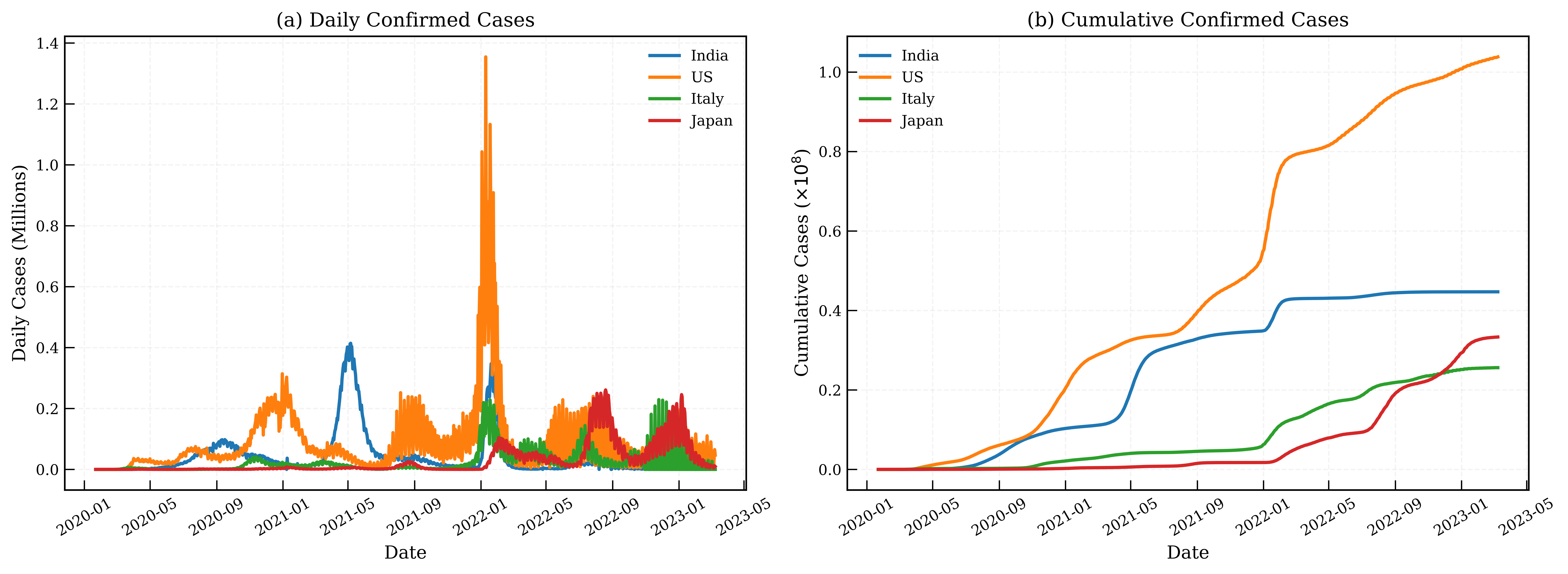
Accurate forecasting of infectious disease spread is essential for public health decision-making. This study compares mechanistic susceptible-exposed-infectious-removed (SEIR) models, machine-learning methods, and hybrid artificial intelligence (AI)-driven epidemiological frameworks using coronavirus disease 2019 (COVID-19) case data from India, the United States, Italy, and Japan. After preprocessing and exploratory analysis, we estimate time-varying transmission rates and develop two hybrid extensions: one predicts beta(t) using machine learning, and the other learns residual errors from the SEIR model. A baseline machine-learning model using lag-based and effective reproduction number (Rt)-driven features is also evaluated. Performance is assessed using mean absolute error (MAE), root mean squared error (RMSE), mean absolute percentage error (MAPE), high-incidence MAPE (on days with observed incidence ge 100 cases), and peak-timing error. With the SEIR transmission-rate spline fitted strictly to training data and all models evaluated on an identical 223-day held-out test window, a simple persistence baseline outperforms the mechanistic SEIR model, both hybrid AI extensions (Tracks A and B), and the pure machine-learning Random Forest model across all four countries (Diebold--Mariano test, p<0.001 in every comparison). The hybrid AI components do not consistently improve forecasting accuracy relative to the SEIR baseline. None of the mechanistic or machine-learning approaches anticipates new epidemic waves beyond the training period, underscoring the difficulty of medium-range epidemic forecasting under genuinely held-out conditions. The comparative evaluation highlights the complementary strengths and limitations of these approaches and provides guidance for future epidemic forecasting models.
Published
How to Cite
Issue
Section
Copyright (c) 2026 Pooja Satwani, Sudhir Kumar Mishra (Author)

This work is licensed under a Creative Commons Attribution 4.0 International License.
How to Cite
Similar Articles
- C. A. Onate, S. O. Mobolaji, J. A. Akinpelu, Eigensolutions and thermodynamic properties constrained by magnetic field of cyclotron frequency , Journal of the Nigerian Society of Physical Sciences: Volume 7, Issue 4, November 2025
- Aliyu Itari Abdullahi, Nuhu Degree Umar, Application of Remote Sensing and Geoinformatics Techniques in Erosion Mapping and Groundwater Management in the River Amba Watershed, Central Nigeria , Journal of the Nigerian Society of Physical Sciences: Volume 3, Issue 2, May 2021
- Farukh Ahmed Mulani, Waseem Ahmad Khan, Shahid Ahmad Wani, On the construction and structural analysis of Bell-enriched Appell-lambda polynomials via quasi-monomiality , Journal of the Nigerian Society of Physical Sciences: Volume 8, Issue 4, November 2026 (in progress)
- Sherifdeen O. Bolarinwa, Eli Danladi, Andrew Ichoja, Muhammad Y. Onimisia, Christopher U. Achem, Synergistic Study of Reduced Graphene Oxide as Interfacial Buffer Layer in HTL-free Perovskite Solar Cells with Carbon Electrode , Journal of the Nigerian Society of Physical Sciences: Volume 4, Issue 3, August 2022
- Suha Ibrahim Salih Al-Ali, Zaidun Naji Abudi, Mohammed Nsaif Abbas, Modelling and Simulation for the use of Natural Waste to Purified Contaminated Heavy Metals , Journal of the Nigerian Society of Physical Sciences: Volume 5, Issue 1, February 2023
- Arezu Jahanshir, Jalil Naji, Relativistic correction on bottomia within the gaussian basis function method , Journal of the Nigerian Society of Physical Sciences: Volume 7, Issue 4, November 2025
- Osita Miracle Nwakeze, Naveed Uddin Mohammed, Obaze Caleb Akachukwu, Umerah Anthony Tochukwu, Oji Nkechi Blessing, Ibeh Sylvarine Chinasa, Odeh Christopher, Dynamic-kernel CNN-LSTM for real-time intrusion detection in low-power healthcare IoT systems , Journal of the Nigerian Society of Physical Sciences: Volume 8, Issue 3, August 2026
- Mahesh Kumar Singh, Arun Kumar Singh, Pushpa Choudhary, Akhilesh Kumar Singh, Lalit Kumar Tyagi, A practical deep learning framework for multi-class skin cancer detection using U-Net segmentation and ResNet50 transfer learning , Journal of the Nigerian Society of Physical Sciences: Volume 8, Issue 3, August 2026
- K. K. Adama, I. B. Onyeachu, The corrosion characteristics of SS316L stainless steel in a typical acid cleaning solution and its inhibition by 1-benzylimidazole: Weight loss, electrochemical and SEM characterizations , Journal of the Nigerian Society of Physical Sciences: Volume 4, Issue 2, May 2022
- Boikanyo Makubate, Marang Pearl Matsuokwane, Lesego Gabaitiri, Broderick O. Oluyede, Simbarashe Chamunorwa, The Type II Topp-Leone-G Power Series Distribution with Applications on Bladder Cancer , Journal of the Nigerian Society of Physical Sciences: Volume 4, Issue 3, August 2022
You may also start an advanced similarity search for this article.