Trust inversion and its exploitation: A threat model of the Model Context Protocol for agentic AI
Keywords:
Model context protocol, MCP security, Agentic AI, Trust inversion, Tool poisoningAbstract
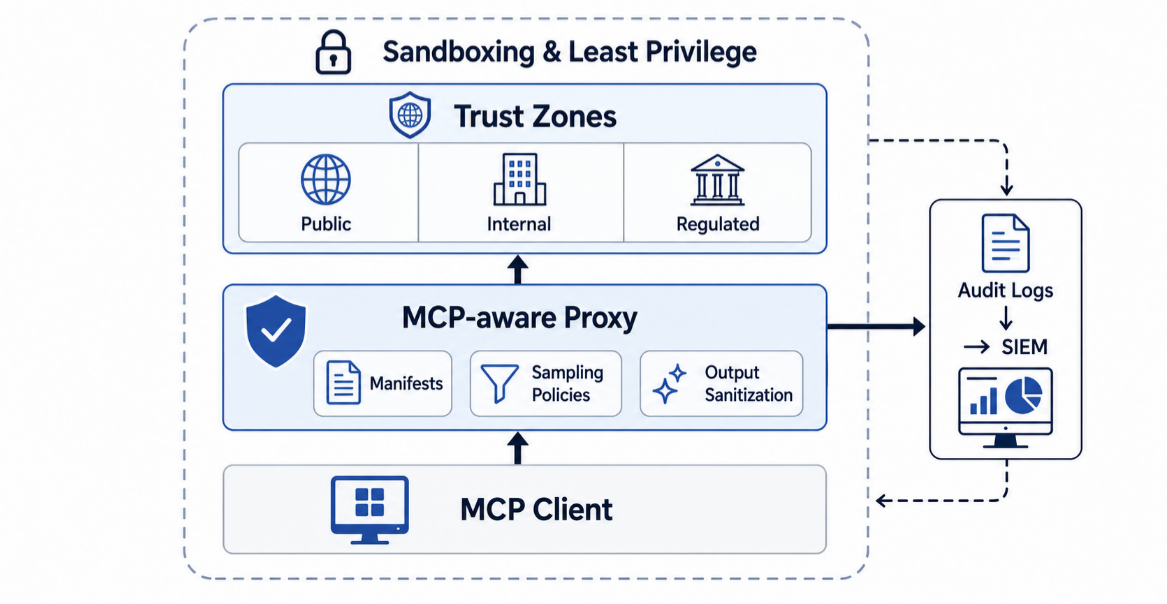
The Model Context Protocol (MCP) standardizes connections between large language model applications and external tools and data. Its capability negotiation, dynamic discovery, insertion of tool results into model context, and server-initiated sampling create composition risks when server-originated artefacts influence actions executed under client authority. We define trust inversion as a condition in which an artefact crossing from a less-trusted MCP component into the client decision context is interpreted as operational authority without provenance-bound policy re-evaluation. The term is used as an MCP-specific analytical lens, not as a replacement for confused-deputy, indirect prompt-injection, control/data-plane-confusion, or transitive-authorization concepts. We construct an architecture-level threat model using three deployment profiles---local stdio, remote Streamable HTTP, and multi-server---together with STRIDE classification, explicit assets and security objectives, and a five-by-five likelihood--impact matrix. Publicly documented demonstrations, guidance-based attack classes, and an implementation CVE are coded by actor, preconditions, attack path, affected layer, violated property, and candidate controls. The analysis groups risks into descriptor and capability drift, cross-tool trust propagation, and sampling-mediated server influence, while separating protocol, ecosystem, implementation, and deployment weaknesses. We propose immediately deployable controls, including transport authentication, least privilege, trust-zone separation, schema validation, sandboxing, and audit logging, and distinguish them from extensions requiring standardization, including signed capability manifests and re-attestation. The resulting checklist is a threat-modelling aid; its mitigation effectiveness remains to be established through prototype implementation, red-team testing, and deployment-specific evaluation.
References
[1] Anthropic, ``Introducing the Model Context Protocol'', 25 November 2024. Available online: https://www.anthropic.com/news/model-context-protocol.
[2] Model Context Protocol, ``Tools'', Model Context Protocol specification, version 2025-11-25, 2025. Available online: https://modelcontextprotocol.io/specification/2025-11-25/server/tools.
[3] National Security Agency, Model Context Protocol (MCP): Security design considerations for AI-driven automation, U/OO/6030316-26, PP-26-1834, Version 1.0, National Security Agency, Fort Meade, Maryland, USA, May 2026. Available online: https://media.defense.gov/2026/Jun/02/2003943289/-1/-1/0/CSI_MCP_SECURITY.PDF.
[4] K. Evans, T. Bonner & C. McCauley, ``Exploiting MCP tool parameters'', HiddenLayer, 15 May 2025. Available online: https://www.hiddenlayer.com/research/exploiting-mcp-tool-parameters.
[5] M. Milanta & L. Beurer-Kellner, ``GitHub MCP exploited: Accessing private repositories via MCP'', Invariant Labs, 26 May 2025. Available online: https://invariantlabs.ai/blog/mcp-github-vulnerability.
[6] L. Beurer-Kellner & M. Fischer, ``WhatsApp MCP exploited: Exfiltrating your message history via MCP'', Invariant Labs, 7 April 2025. Available online: https://invariantlabs.ai/blog/whatsapp-mcp-exploited.
[7] A. Lumelsky, ``Critical RCE vulnerability in Anthropic MCP Inspector---CVE-2025-49596'', Oligo Security, 27 June 2025. Available online: https://www.oligo.security/blog/critical-rce-vulnerability-in-anthropic-mcp-inspector-cve-2025-49596.
[8] National Institute of Standards and Technology, ``CVE-2025-49596 detail'', National Vulnerability Database, 2025. Available online: https://nvd.nist.gov/vuln/detail/CVE-2025-49596.
[9] Model Context Protocol, ``Sampling'', Model Context Protocol specification, version 2025-11-25, 2025. Available online: https://modelcontextprotocol.io/specification/2025-11-25/client/sampling.
[10] Model Context Protocol, ``Authorization'', Model Context Protocol specification, version 2025-11-25, 2025. Available online: https://modelcontextprotocol.io/specification/2025-11-25/basic/authorization.
[11] Model Context Protocol, ``Security best practices'', Model Context Protocol documentation, version 2025-11-25, 2025. Available online: https://modelcontextprotocol.io/docs/2025-11-25/tutorials/security/security_best_practices.
[12] N. G. Maloyan & D. E. Namiot, ``Breaking the protocol: Security analysis of the Model Context Protocol specification and prompt injection vulnerabilities in tool-integrated LLM agents'', Modern Information Technologies and IT-Education 21 (2025) 420. https://doi.org/10.25559/SITITO.021.202503.420-428.
[13] M. M. Hasan, H. Li, E. Fallahzadeh, G. K. Rajbahadur, B. Adams & A. E. Hassan, ``Model Context Protocol (MCP) at first glance: Studying the security and maintainability of MCP servers'', ACM Transactions on Software Engineering and Methodology (2026), advance online publication. https://doi.org/10.1145/3814959.
[14] X. Hou, Y. Zhao, S. Wang & H. Wang, ``Model Context Protocol (MCP): Landscape, security threats, and future research directions'', ACM Transactions on Software Engineering and Methodology (2026), advance online publication. https://doi.org/10.1145/3796519.
[15] C. Huang, X. Huang, N. P. Tran & A. Milani Fard, ``Model Context Protocol threat modeling and analysis of vulnerabilities to prompt injection with tool poisoning'', Journal of Cybersecurity and Privacy 6 (2026) 84. https://doi.org/10.3390/jcp6030084.
[16] X. Li & X. Gao, A first look at the security issues in the Model Context Protocol ecosystem, 2026 56th Annual IEEE/IFIP International Conference on Dependable Systems and Networks, Charlotte, North Carolina, USA, 22--25 June 2026, pp. 379--392. https://doi.org/10.1109/DSN69566.2026.00046.
[17] H. Song, Y. Shen, W. Luo, L. Guo, T. Chen, J. Wang, B. Li, X. Zhang & J. Chen, ``Beyond the protocol: Unveiling attack vectors in the Model Context Protocol (MCP) ecosystem'', IEEE Transactions on Software Engineering 52 (2026) 2410. https://doi.org/10.1109/TSE.2026.3694876.
[18] J. T. Halloran, B. Radosevich & G. Black, MCP safety audit: LLMs with the Model Context Protocol allow major security exploits, Proceedings of SPIE 14046, Assurance and Security for AI-Enabled Systems 2026, National Harbor, Maryland, USA, 26 April--1 May 2026, Article 140460A. https://doi.org/10.1117/12.3097390.
[19] S. Zhao, Q. Hou, Z. Zhan, Y. Wang, Y. Xie, Y. Guo, L. Chen, S. Li & Z. Xue, ``Mind your server: A systematic study of parasitic toolchain attacks on the MCP ecosystem'', arXiv:2509.06572 (2025). https://arxiv.org/pdf/2509.06572v1.
[20] K. Greshake, S. Abdelnabi, S. Mishra, C. Endres, T. Holz & M. Fritz, Not what you've signed up for: Compromising real-world LLM-integrated applications with indirect prompt injection, Proceedings of the 16th ACM Workshop on Artificial Intelligence and Security, Copenhagen, Denmark, 30 November 2023, pp. 79--90. https://doi.org/10.1145/3605764.3623985.
[21] Q. Zhan, Z. Liang, Z. Ying & D. Kang, InjecAgent: Benchmarking indirect prompt injections in tool-integrated large language model agents, Findings of the Association for Computational Linguistics: ACL 2024, Bangkok, Thailand, 2024, pp. 10471--10506. https://doi.org/10.18653/v1/2024.findings-acl.624.
[22] J. Yi, Y. Xie, B. Zhu, E. Kiciman, G. Sun, X. Xie & F. Wu, Benchmarking and defending against indirect prompt injection attacks on large language models, Proceedings of the 31st ACM SIGKDD Conference on Knowledge Discovery and Data Mining, Vol. 1, Toronto, Canada, 2025, pp. 1809--1820. https://doi.org/10.1145/3690624.3709179.
[23] Q. Zhan, R. Fang, H. S. Panchal & D. Kang, Adaptive attacks break defenses against indirect prompt injection attacks on LLM agents, Findings of the Association for Computational Linguistics: NAACL 2025, Albuquerque, New Mexico, USA, 2025, pp. 7116--7132. https://doi.org/10.18653/v1/2025.findings-naacl.395.
[24] OWASP Foundation, ``OWASP Top 10 for LLM applications 2025'', 17 November 2024. Available online: https://genai.owasp.org/resource/owasp-top-10-for-llm-applications-2025/.
[25] S. Jamshidi, A. Moradi Dakhel, K. W. Nafi & F. Khomh, ``Semantic attacks on tool-augmented LLMs: Securing the Model Context Protocol against descriptor-level manipulation'', arXiv:2512.06556 (2025). https://doi.org/10.48550/arXiv.2512.06556.
Published
How to Cite
Issue
Section
Copyright (c) 2026 Muhammad Qaim Aliyu Sambo, Augustine Yusuf, Ifeanyi Nwokoro, Abdulrahman Umar Sadiq, Victor Legbo Yisa (Author)

This work is licensed under a Creative Commons Attribution 4.0 International License.