Forecasting of the epidemiological situation: Case of COVID-19 in Morocco
Keywords:
ARIMA, COVID-19, Pandemic, FBProphet, Time series forecastingAbstract
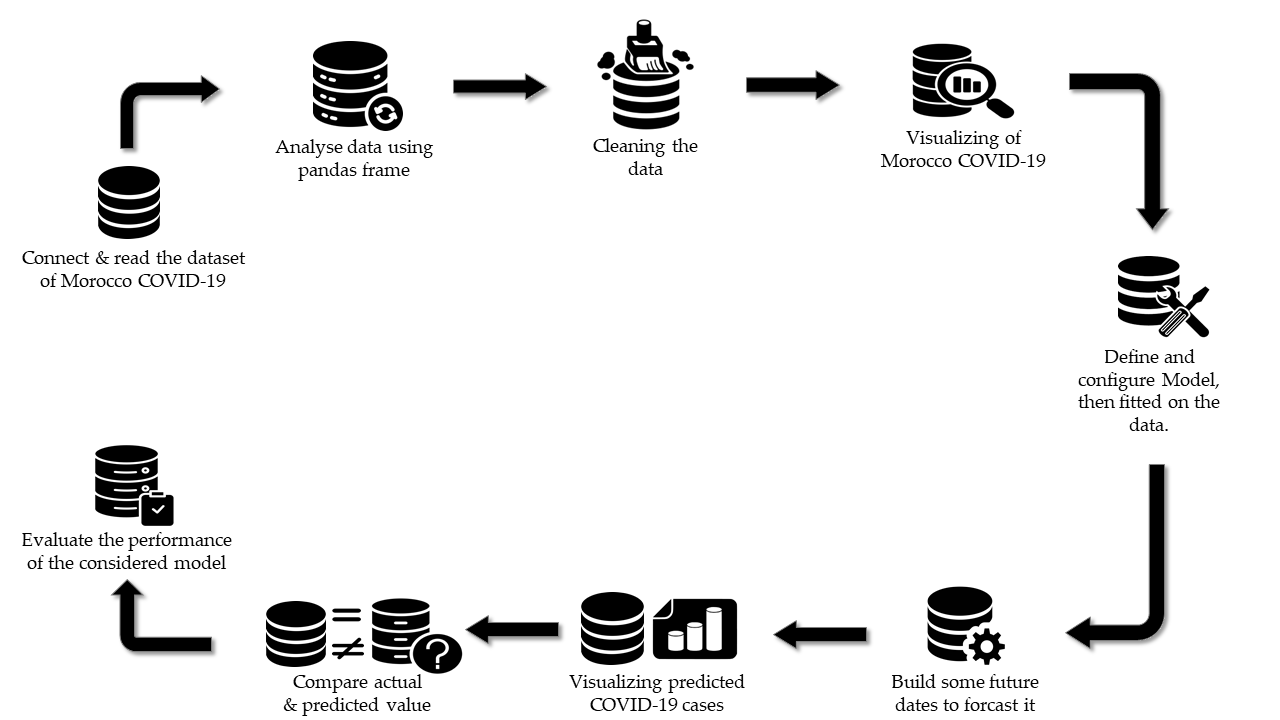
Since the coronavirus pandemic started, many people have died due to the disease. The epidemic has been challenging to predict, as it progresses and spreads throughout the world. We used Auto-Regressive Integrated Moving Average (ARIMA) models to predict the outbreak of COVID-19 in the upcoming months in Morocco. In this work, we measured the effective reproduction number using the real data and the forecasted data produced by the two commonly used approaches, to reveal how effective the measures taken by the Moroccan government have been in controlling the COVID-19 outbreak. The prediction results for the next few months show a strong evolution in the number of confirmed and death cases in Morocco. We study the spread of COVID-19 in Morocco to see how many cases are discovered, recovered, and dead, and the forecasting of further cases is used as a basic novel method. It is based on time series models. We used coronavirus outbreak data from March 02, 2020, to August 04, 2021. ARIMA (Autoregressive integrated moving average) and Prophet time-series models are used to forecast the development of COVID-19, which is not a novel method. The mean absolute error, root mean square error, and coefficient of determination R2 were computed to assess the model's performance. Our study aims to provide a better understanding of the infectious disease outbreak that affected Morocco. It also provides information on the disease outbreak's epidemiology. Our study shows that the FBProphet model is more accurate in predicting the prevalence of COVID-19. It can help guide the government's efforts to prevent the virus' spread.
Published
How to Cite
Issue
Section
Copyright (c) 2022 El Mehdi Chouit, Mohamed RACHDI, Mostapha BELLAFKIH, Brahim RAOUYANE

This work is licensed under a Creative Commons Attribution 4.0 International License.
How to Cite
Similar Articles
- J. Damisa, J. O. Emegha, I. L. Ikhioya, Deposition Time induced Structural and Optical Properties of Lead Tin Sulphide Thin Films , Journal of the Nigerian Society of Physical Sciences: Volume 3, Issue 4, November 2021
- Monika Saini, Ashish Kumar, Fuzzy semi-Markovian stochastic model for single-unit system with repairman arrival delay under Lindley lifetime distribution using bell-shaped membership function , Journal of the Nigerian Society of Physical Sciences: Volume 8, Issue 3, August 2026
- Gurpreet Singh Tuteja, Tapshi Lal, A study of growth of COVID-19 with super-spreaders using the modified SIR model including iceberg phenomenon , Journal of the Nigerian Society of Physical Sciences: Volume 6, Issue 2, May 2024
- Nikita Bhardwaj, Monika Saini, Ashish Kumar, Estimation of reliability characteristics of single-unit repairable system with preventive maintenance and server arrival time , Journal of the Nigerian Society of Physical Sciences: Volume 8, Issue 2, May 2026
- Osita Miracle Nwakeze, Naveed Uddin Mohammed, Obaze Caleb Akachukwu, Umerah Anthony Tochukwu, Oji Nkechi Blessing, Ibeh Sylvarine Chinasa, Odeh Christopher, Dynamic-kernel CNN-LSTM for real-time intrusion detection in low-power healthcare IoT systems , Journal of the Nigerian Society of Physical Sciences: Volume 8, Issue 3, August 2026
- Muhammad Alhassan, Azhar Abdul Rahman, Iskandar Shahrim Mustafa, Kabiru Alhaji Bala, Factors influencing the thermal stability of HEMA polymer gel dosimeters for clinical radiotherapy , Journal of the Nigerian Society of Physical Sciences: Volume 8, Issue 2, May 2026
- Mohammad F. Marashdeh, The group-theoretic origin of spin: the reality locus andcohomology of the spin spectrum , Journal of the Nigerian Society of Physical Sciences: Volume 8, Issue 3, August 2026
- Josephine E. Ochigbo, Joel N. Ndam, Wipuni U. Sirisena, Optimal control with the effects of ivermectin and live stock availability on malaria transmission , Journal of the Nigerian Society of Physical Sciences: Volume 6, Issue 3, August 2024
- Sylvester J. Gemanam, Nursakinah Suardi, Barnabas A. Ikyo, Samson Damilola Oluwafemi, Terver Daniel, Samuel T. Kungur, Biostimulation Effects and Temperature Variation in Stimulated Dielectric Substance (Diabetic Blood Comparable to Non-Diabetic Blood) Based on the Specific Absorption Rate (SAR) in Laser Therapy , Journal of the Nigerian Society of Physical Sciences: Volume 3, Issue 2, May 2021
- Mahesh Kumar Singh, Pushpa Choudhary, Arun Kumar Singh, Pushpendra Singh, LWRNPIP: Design of a light weight restrictive non-fungible token based on practically unclonable functions via image signature patterns , Journal of the Nigerian Society of Physical Sciences: Volume 7, Issue 4, November 2025
You may also start an advanced similarity search for this article.