Analysis of a fractional order climate model due to excessive emission and accumulation of carbon dioxide in the atmosphere
Keywords:
Climate change, Fractional order, Carbon dioxide, Excessive emissionAbstract
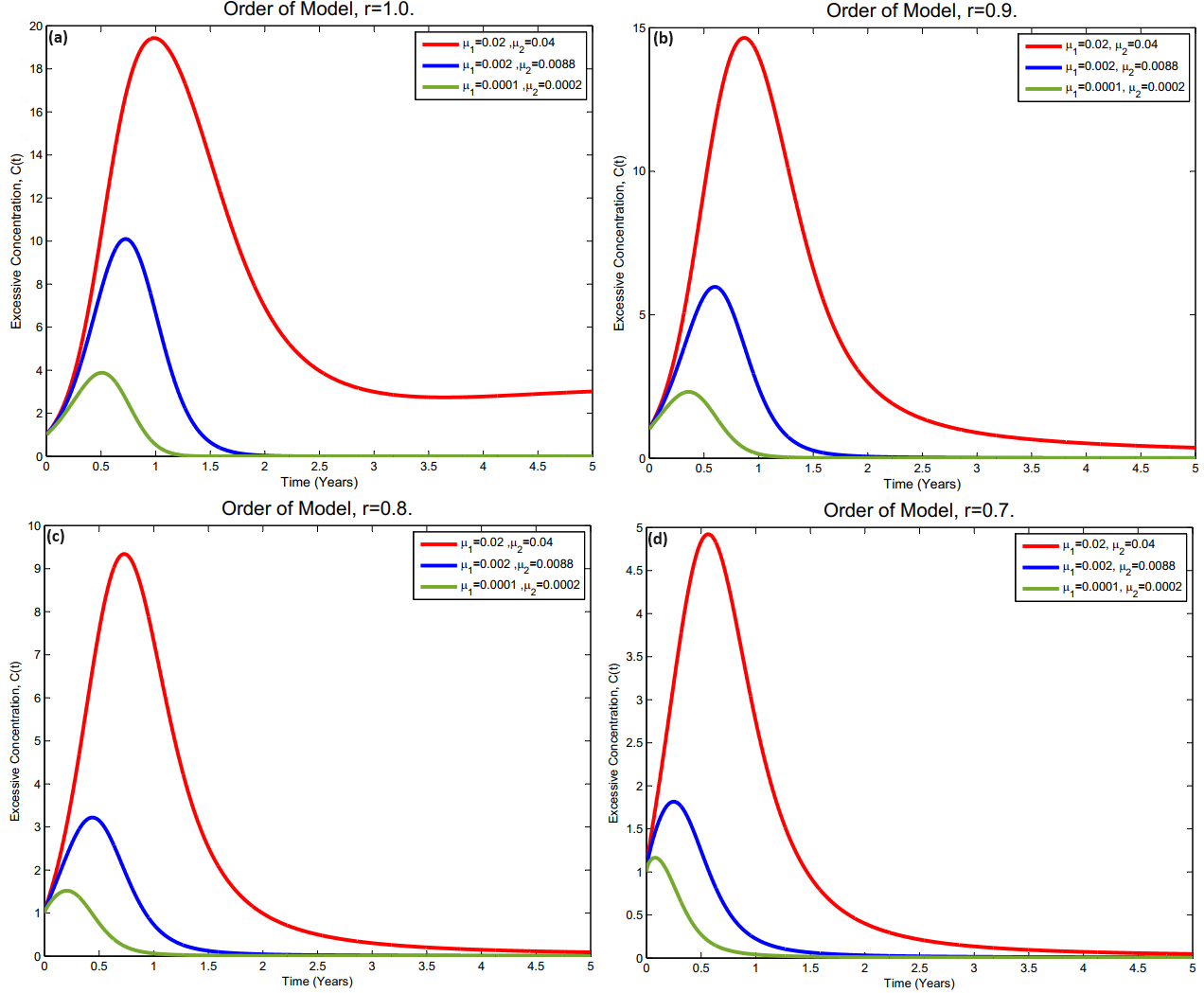
The devastating consequences of climate change on our planet cannot be taken lightly. Greenhouse gas emissions due to the various activities of the increasing human population are solely responsible for this change. The chief and most significant of these gases is carbon dioxide. A fractional-order model of five compartments is considered. The uniqueness and existence, the positivity, and the boundedness of the model solution are established. The equilibrium points of the model are given. By formulating different Lyapunov functions, the global stability of the four equilibrium points was determined. The numerical simulation of the model was done using the Predict-Evaluate-Correct-Evaluate method of Adam-Bashforth-Moulton by considering four different orders of 0.7, 0.8, 0.9, and 1.0. According to the results, excessive concentrations of carbon dioxide in the atmosphere can be reduced by the joint employment of mitigation measures.
Published
How to Cite
Issue
Section
Copyright (c) 2023 Peter Urane Achimugwu, Mathew Ngugi Kinyanjui, David Mumo Malonza

This work is licensed under a Creative Commons Attribution 4.0 International License.
How to Cite
Similar Articles
- O. E. Osafile, O. N. Nenuwe, Lattice Dynamics and thermodynamic Responses of XNbSn Half-Heusler Semiconductors: A First-Principles Approach , Journal of the Nigerian Society of Physical Sciences: Volume 3, Issue 2, May 2021
- Odilon Joseph TOWANOU, Hagninou Elagnon Venance Donnou, Gabin Koto N’Gobi, Augustin Enonsi Leode, Basile Kounouh´ewa, Solar Energy Storage by Fuel Cell Technology at Abomey-Calavi (Benin) , Journal of the Nigerian Society of Physical Sciences: Volume 5, Issue 2, May 2023
- Amos Orenyi Bajeh, Mary Olayinka Olaoye, Fatima Enehezei Usman-Hamza, Ikeola Suhurat Olatinwo, Peter ogirima Sadiku, Abdulkadir Bolakale Sakariyah, An adaptive neuro-fuzzy inference system for multinomial malware classification , Journal of the Nigerian Society of Physical Sciences: Volume 7, Issue 1, February 2025
- O. G. Obadina, Adedayo Funmi Adedotuun, O. A. Odusanya, Ridge Estimation's Effectiveness for Multiple Linear Regression with Multicollinearity: An Investigation Using Monte-Carlo Simulations , Journal of the Nigerian Society of Physical Sciences: Volume 3, Issue 4, November 2021
- A. Y. Fasasi, E. Ajenifuja, E. Osagie, L. O. Animasaun, A. E. Adeoye, E. I. Obiajunwa, Optical, Dielectric and Optoelectronic Properties of Spray Deposited Cu-doped Fe2O3 Thin Films , Journal of the Nigerian Society of Physical Sciences: Volume 5, Issue 3, August 2023
- Paavithashnee Ravi Kumar, Majid Khan Majahar Ali, Olayemi Joshua Ibidoja, Identifying heterogeneity for increasing the prediction accuracy of machine learning models , Journal of the Nigerian Society of Physical Sciences: Volume 6, Issue 3, August 2024
- xiaojie zhou, Majid Khan Majahar Ali, Farah Aini Abdullah, Lili Wu, Ying Tian, Tao Li, Kaihui Li, Implementing a dung beetle optimization algorithm enhanced with multi-strategy fusion techniques , Journal of the Nigerian Society of Physical Sciences: Volume 7, Issue 2, May 2025
- M. O. Ogunniran, O. A. Tayo, Y. Haruna, A. F. Adebisi, Linear Stability Analysis of Runge-Kutta Methods for Singular Lane-Emden Equations , Journal of the Nigerian Society of Physical Sciences: Volume 2, Issue 3, August 2020
- Bright O. Osu, K. N. C. Njoku, B. I. Oruh, On the Investment Strategy, Effect of Inflation and Impact of Hedging on Pension Wealth during Accumulation and Distribution Phases , Journal of the Nigerian Society of Physical Sciences: Volume 2, Issue 3, August 2020
- Sylvester J. Gemanam, Nursakinah Suardi, Barnabas A. Ikyo, Samson Damilola Oluwafemi, Terver Daniel, Samuel T. Kungur, Biostimulation Effects and Temperature Variation in Stimulated Dielectric Substance (Diabetic Blood Comparable to Non-Diabetic Blood) Based on the Specific Absorption Rate (SAR) in Laser Therapy , Journal of the Nigerian Society of Physical Sciences: Volume 3, Issue 2, May 2021
You may also start an advanced similarity search for this article.