Analysis of a fractional order climate model due to excessive emission and accumulation of carbon dioxide in the atmosphere
Keywords:
Climate change, Fractional order, Carbon dioxide, Excessive emissionAbstract
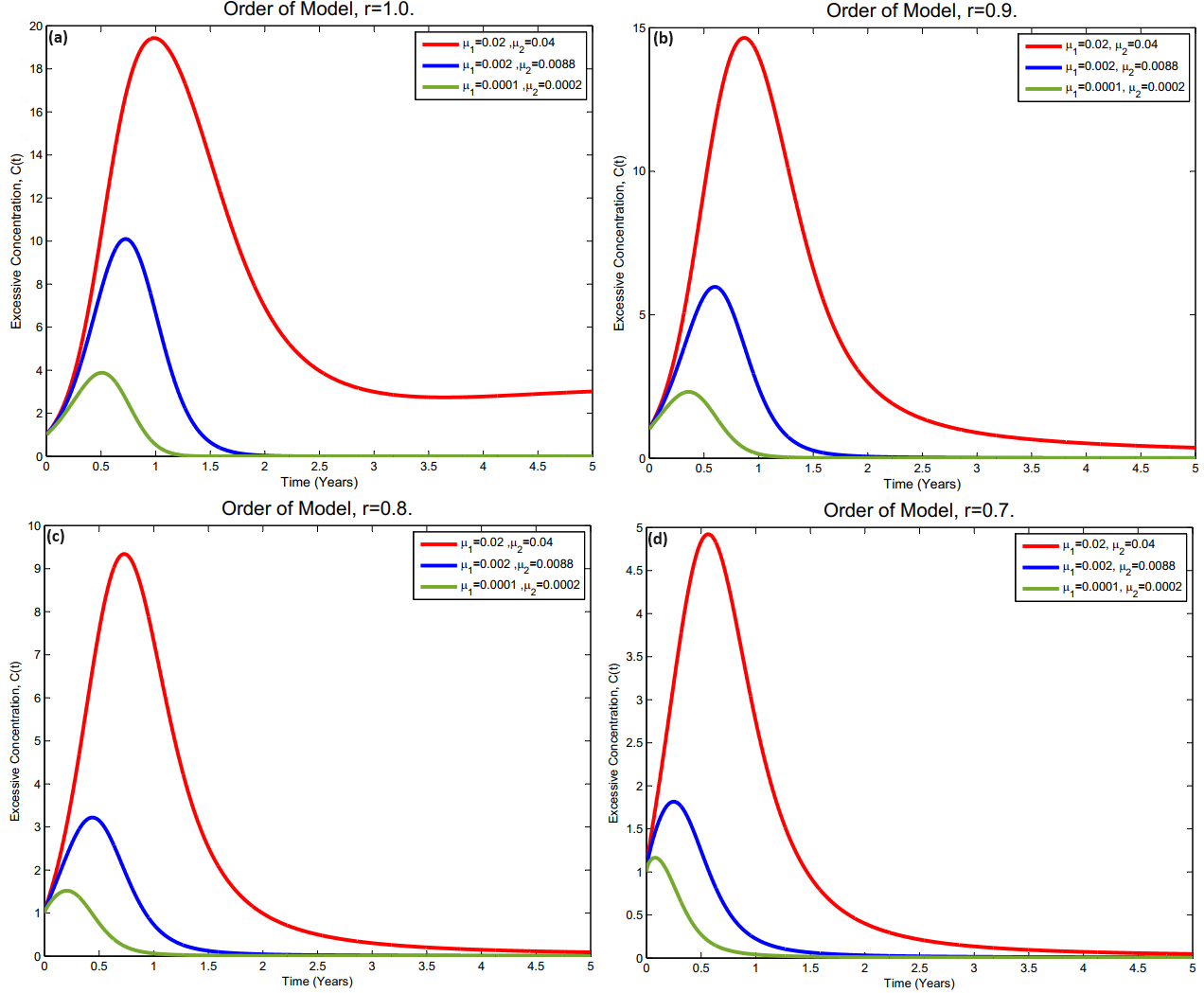
The devastating consequences of climate change on our planet cannot be taken lightly. Greenhouse gas emissions due to the various activities of the increasing human population are solely responsible for this change. The chief and most significant of these gases is carbon dioxide. A fractional-order model of five compartments is considered. The uniqueness and existence, the positivity, and the boundedness of the model solution are established. The equilibrium points of the model are given. By formulating different Lyapunov functions, the global stability of the four equilibrium points was determined. The numerical simulation of the model was done using the Predict-Evaluate-Correct-Evaluate method of Adam-Bashforth-Moulton by considering four different orders of 0.7, 0.8, 0.9, and 1.0. According to the results, excessive concentrations of carbon dioxide in the atmosphere can be reduced by the joint employment of mitigation measures.
Published
How to Cite
Issue
Section
Copyright (c) 2023 Peter Urane Achimugwu, Mathew Ngugi Kinyanjui, David Mumo Malonza

This work is licensed under a Creative Commons Attribution 4.0 International License.
How to Cite
Similar Articles
- M. A. Okono, E. P. Agbo, B. J. Ekah, U. J. Ekah, E. B. Ettah, C. O. Edet, Statistical Analysis and Distribution of Global Solar Radiation and Temperature Over Southern Nigeria , Journal of the Nigerian Society of Physical Sciences: Volume 4, Issue 3, August 2022
- Jamilu Adamu, Aminu Sulaiman Halliru, Bala Ma’aji Abdulhamid, On Some Pursuit Differential Game Problem in a Hilbert Space , Journal of the Nigerian Society of Physical Sciences: Volume 4, Issue 1, February 2022
- Olusegun Olotu, Charles Aladesaye, Kazeem Adebowale Dawodu, Modified Gradient Flow Method for Solving One-Dimensional Optimal Control Problem Governed by Linear Equality Constraint , Journal of the Nigerian Society of Physical Sciences: Volume 4, Issue 1, February 2022
- Catherine N. Ogbizi-Ugbe, Osowomuabe Njama-Abang, Samuel Oladimeji, Idongetsit E. Eteng, Edim A. Emanuel, Synergistic intelligence: a novel hybrid model for precision agriculture using k-means, naive Bayes, and knowledge graphs , Journal of the Nigerian Society of Physical Sciences: Volume 8, Issue 1, February 2026
- Hamza Abubakar, Abdu Sagir Masanawa, Surajo Yusuf, G. I. Boaku, Optimal representation to High Order Random Boolean kSatisability via Election Algorithm as Heuristic Search Approach in Hopeld Neural Networks , Journal of the Nigerian Society of Physical Sciences: Volume 3, Issue 3, August 2021
- Tunde Tajudeen Yusuf, Afeez Abidemi, Ayodeji Sunday Afolabi, Emmanuel Jesuyon Dansu, Optimal Control of the Coronavirus Pandemic with Impacts of Implemented Control Measures , Journal of the Nigerian Society of Physical Sciences: Volume 4, Issue 1, February 2022
- B. T. Iorhuna, T. T. Awuhe, I. C. Azuaga, E Isaac, F. Shuaibu, B. Yohanna, Synthesis, Characterization and Antimicrobial Activities of Copper-Tea Leaves (Camellia Sinensis) Extract Nanoparticles.: None , Journal of the Nigerian Society of Physical Sciences: Volume 4, Issue 4, November 2022
- Emmanuel Adeyefa, O. S. Esan, Exponentially Fitted Chebyshev Based Algorithm as Second Order Initial Value Solver , Journal of the Nigerian Society of Physical Sciences: Volume 2, Issue 1, February 2020
- Victor Oboni Atabo, Solomon Ortwer Adee, A New Special 15-Step Block Method for Solving General Fourth Order Ordinary Differential Equations , Journal of the Nigerian Society of Physical Sciences: Volume 3, Issue 4, November 2021
- Terver Daniel, F. Eriba-Idoko, J. O. Tsor, S. T. Kungur, E. O. Enokela, F. Gbaorun, E. C. Hemba, A. A. McAsule, N. S. Akiiga, P. O. Ushie, Effects of Repeated Frying on Physical Properties of Cooking Oil obtained from Local Markets in Makurdi Metropolis, Benue State, Nigeria. , Journal of the Nigerian Society of Physical Sciences: Volume 3, Issue 4, November 2021
You may also start an advanced similarity search for this article.