The analysis of a novel COVID-19 model with the fractional-order incorporating the impact of the vaccination campaign in Nigeria via the Laplace-Adomian Decomposition Method
Keywords:
Caputo fractional derivative, COVID-19 disease, Laplace-Adomian decomposition method, Vaccination rateAbstract
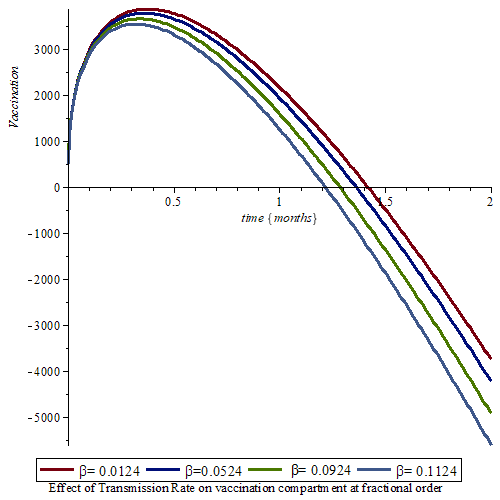
This study underscores the crucial role of COVID-19 vaccinations in managing the pandemic, with a specific focus on Nigeria. Employing a fractional-order mathematical modeling approach, the research assesses vaccination efficacy, minimum effectiveness, and duration. The model’s numerical solution is derived through the Laplace Adomian Decomposition Method (LADM), utilizing rapidly converging infinite series. Simulation results illustrate the impact of COVID-19 transmission and vaccination rates. The study concludes that implementing a vaccination strategy in an integer order proves to be the most effective approach to controlling the spread of COVID-19. These findings have significant implications for researchers, policymakers, and healthcare workers. They emphasize the central role of fractional calculus in facilitating vaccine implementation in the ongoing battle against COVID-19. The study calls for global efforts to maximize vaccination implementation for the overall benefit of public health.
Published
How to Cite
Issue
Section
Copyright (c) 2024 Akeem Olarewaju Yunus, Morufu Oyedunsi Olayiwola

This work is licensed under a Creative Commons Attribution 4.0 International License.
How to Cite
Similar Articles
- Silifat Adaramaja Abdulraheem, Salisu Aliyu, Fatima Binta Abdullahi, Hyper-parameter tuning for support vector machine using an improved cat swarm optimization algorithm , Journal of the Nigerian Society of Physical Sciences: Volume 5, Issue 4, November 2023
- Edikan E. Akpanibah, Udeme O. Ini, An Investor’s Investment Plan with Stochastic Interest Rate under the CEV Model and the Ornstein-Uhlenbeck Process , Journal of the Nigerian Society of Physical Sciences: Volume 3, Issue 3, August 2021
- Ahmad Alhawarat, Sultanah Masmali, Shahrina Ismail, Hamid El Hor, A descent-safeguarded PRP-type conjugate gradient with global convergence and CUTEst benchmarks , Journal of the Nigerian Society of Physical Sciences: Volume 8, Issue 2, May 2026
- E. I. Akinola, R. A. Oderinu, S. Alao, O. E. Opaleye, An Integral Transform-Weighted Residual Method for Solving Second Order Linear Boundary Value Differential Equations with Semi-Infinite Domain , Journal of the Nigerian Society of Physical Sciences: Volume 4, Issue 4, November 2022
- E. Omugbe, M. Abu-Shady, E. P. Inyang, Approximate bound state solutions of the fractional Schr\"{o}dinger equation under the spin-spin-dependent Cornell potential , Journal of the Nigerian Society of Physical Sciences: Volume 6, Issue 1, February 2024
- Omowumi F. Lawal, Tunde T. Yusuf, Afeez Abidemi, On mathematical modelling of optimal control of typhoid fever with efficiency analysis , Journal of the Nigerian Society of Physical Sciences: Volume 6, Issue 4, November 2024
- S. Adamu, O. O. Aduroja, A. S. Onanaye, M. R. Odekunle, Iterative method for the numerical solution of optimal control model for mosquito and insecticide , Journal of the Nigerian Society of Physical Sciences: Volume 6, Issue 2, May 2024
- O. M. Ogunlaran, M. A. Kehinde, M. A. Akanbi, E. I. AKINOLA, A Chebyshev polynomial based block integrator for the direct numerical solution of fourth order ordinary differential equations , Journal of the Nigerian Society of Physical Sciences: Volume 6, Issue 2, May 2024
- Raphael Ozighor Enihe, Rajesh Prasad, Francisca Nonyelum Ogwueleka, Fatimah Binta Abdullahi, The effect of imbalance data mitigation techniques on cardiovascular disease prediction , Journal of the Nigerian Society of Physical Sciences: Volume 7, Issue 2, May 2025
- Haitham Qawaqneh, Waqar Afzal, Mujahid Abbas, Muhammad Tariq, Mehreen Shehzadi Khan, Siegfried Macías, Jorge E. Macías-Díaz, Hijaz Ahmad, Waleed Mohammed Abdelfattah, New fractional Hermite–Hadamard and Fejér inequalities involving special functions with applications to numerical quadrature rules , Journal of the Nigerian Society of Physical Sciences: Volume 8, Issue 4, November 2026 (in progress)
You may also start an advanced similarity search for this article.