Integrated data-driven credit default prediction in Uganda using machine learning models
Keywords:
SVM, XGBoost, Credit defaulter, Prediction model, Financial dataAbstract
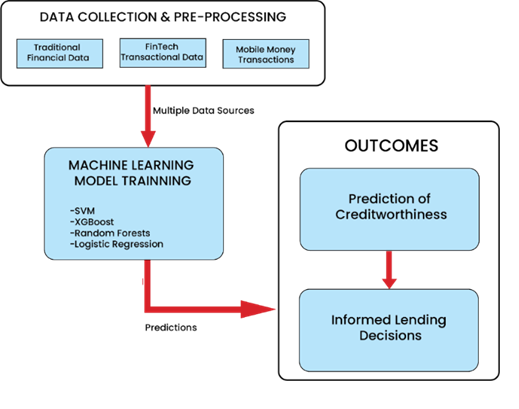
The prediction of credit facility defaulters is quite a challenge in Uganda, particularly for those without a formal banking history. Existing prediction models cater for prediction using conventional banking records which is not sufficient. The use of integrated data to cater for the unbanked population is required to further enhance financial inclusivity and stability in Uganda’s financial landscape. This study therefore aims at filling this gap by using machine learning techniques on a rich blend of financial data, including mobile money and Fintech (Financial Technology) services, as well as traditional banking records. Several machine learning algorithms used for loan default prediction were compared, such as Random Forest, Logistic Regression, Support Vector Machines (SVM), and Extreme Gradient Boosting (XGBoost). Random Forest Model showed 96.66% accuracy, 79.65% recall, 96.52% precision and 0.85 AUC. XGBoost model was found to have an accuracy of 95.23%; recall, 73.32%; precision, 94.11%; and Area Under the Curve (AUC) of 0.81. However, Random Forest performed best by all metrics with XGBoost following slightly. Logistic Regression showed 89.53% accuracy but had a very low recall at 43.24% and precision at 66.59%. SVM performed averagely with 93.21% accuracy and 62.80% recall all falling below that of XGBoost and Random Forest. Thus, the study revealed the significance of machine learning models like Random Forest and XGBoost for credit scoring prediction. Overall, it will improve the ability of institutions and policymakers to identify potential default borrowers so as to mitigate loan default rates and ensure economic growth in underserved communities through more accurate and inclusive credit evaluation tools.
Published
How to Cite
Issue
Section
Copyright (c) 2025 George Muddu, Shefiu Olusegun Ganiyu, Adekunle Olugbenga Ejidokun, Yusuf Abass Aleshinloye (Author)

This work is licensed under a Creative Commons Attribution 4.0 International License.
How to Cite
Similar Articles
- Sunday Samuel Bako, Norhaslinda Ali, Jayanthi Arasan, Assessing model selection techniques for distributions use in hydrological extremes in the presence of trimming and subsampling , Journal of the Nigerian Society of Physical Sciences: Volume 6, Issue 4, November 2024
- Fatmawati, Faishal F. Herdicho, Nurina Fitriani, Norma Alias, Mazlan Hashim, Olumuyiwa J. Peter, Optimal control strategies for dynamical model of climate change under real data , Journal of the Nigerian Society of Physical Sciences: Volume 7, Issue 3, August 2025
- Saheed Ajao, Isaac Olopade, Titilayo Akinwumi, Sunday Adewale, Adelani Adesanya, Understanding the Transmission Dynamics and Control of HIV Infection: A Mathematical Model Approach , Journal of the Nigerian Society of Physical Sciences: Volume 5, Issue 2, May 2023
- Obiora Cornelius Collins, Mathematical model analysis for maize yield under co-infection of maize streak virus and maize stripe virus diseases with control measures , Journal of the Nigerian Society of Physical Sciences: Volume 8, Issue 2, May 2026
- Atiek Iriany, Wigbertus Ngabu, Henny Pramoedyo, Amarifai, Geographically weighted regression random forest for modeling soil particles , Journal of the Nigerian Society of Physical Sciences: Volume 8, Issue 2, May 2026
- Nour Hamad Abu Afouna, Majid Khan Majahar Ali, Optimizing precision farming: enhancing machine learning efficiency with robust regression techniques in high-dimensional data , Journal of the Nigerian Society of Physical Sciences: Volume 7, Issue 1, February 2025
- Sulaiman Awwal Akinwunmi, David Opeoluwa Oyewola, Spectral convolution of star-like transformation semigroups for modeling telecommunication signal strength and user experience in Gombe state, Nigeria , Journal of the Nigerian Society of Physical Sciences: Volume 8, Issue 2, May 2026
- Waheed B. Yahya, Yusuf Bello, Abdulrazaq AbdulRaheem, Model Fitness and Predictive Accuracy in Linear Mixed-Effects Models with Latent Clusters , Journal of the Nigerian Society of Physical Sciences: Volume 5, Issue 3, August 2023
- E. A. Nwaibeh, M. K. M. Ali, M. O. Adewole, The dynamics of hybrid-immune and immunodeficient susceptible individuals and the three stages of COVID-19 vaccination , Journal of the Nigerian Society of Physical Sciences: Volume 6, Issue 3, August 2024
- Bolarinwa Bolaji, B. I. Omede, U. B. Odionyenma, P. B. Ojih, Abdullahi A. Ibrahim, Modelling the transmission dynamics of Omicron variant of COVID-19 in densely populated city of Lagos in Nigeria , Journal of the Nigerian Society of Physical Sciences: Volume 5, Issue 2, May 2023
You may also start an advanced similarity search for this article.